
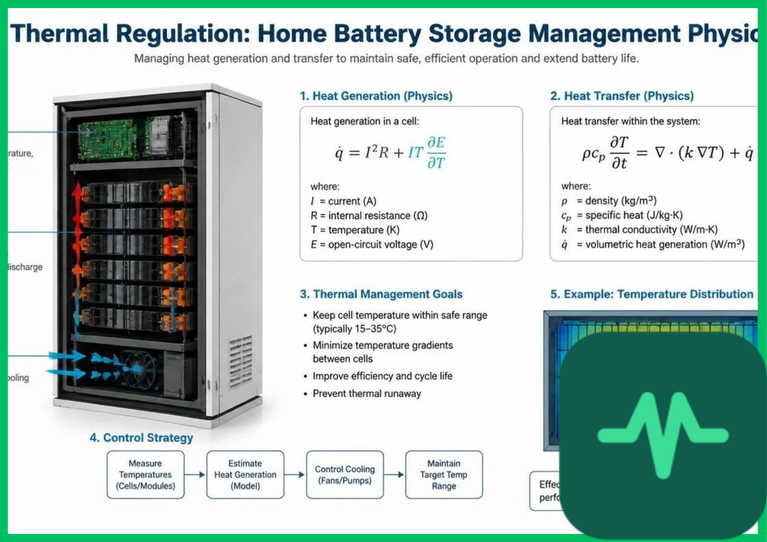
 ) battery packs outside strict thermal boundaries accelerates capacity degradation, elevates internal direct current resistance (
 ), and increases safety risks. Thermal management systems maintain cell core temperatures within an optimal window of
 to
 (
 to
 ). Analyzing convective heat transfer coefficients, coolant fluid dynamics, and passive phase-change materials is essential for evaluating residential battery storage performance and longevity.
Electrochemical Heat Generation and Arrhenius Degradation Kinetics
The foundational thermodynamic challenge governing residential battery thermal management is internal heat generation during charge and discharge cycling. Total thermal energy generation ( ) within a lithium-ion battery cell is governed by two primary physical phenomena: reaction heat (entropy changes during intercalation) and irreversible ohmic joule heating (
 ), formulated mathematically as:
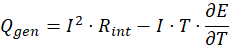
where  represents operating current,
 is internal cell resistance,
 is absolute temperature, and
 denotes the temperature coefficient of open-circuit voltage.
Under high-rate residential power demands—such as supplying electrical energy to heat pumps or EV chargers simultaneously—high current flows generate substantial joule heating. If unmanaged, internal cell temperatures rise rapidly. Battery capacity degradation follows Arrhenius kinetics, where elevated temperatures accelerate parasitic chemical reactions, electrolyte decomposition, and solid electrolyte interphase (SEI) layer thickening. Conversely, operating below  (
 ) increases electrolyte viscosity and lithium-ion diffusion resistance, inducing lithium plating on graphite or LFP anodes and causing irreversible capacity loss.
Liquid Cooling Plates and Convective Heat Transfer Physics
To maintain uniform cell temperature distributions across multi-kilowatt-hour residential battery modules, advanced storage systems deploy active liquid cooling plates integrated directly between prismatic or pouch cell configurations. Common heat transfer fluids include engineered ethylene glycol-water mixtures or dielectric silicone oils possessing high thermal conductivities and low freezing points.
The convective heat transfer rate ( ) from the battery cell casing surface to the circulating liquid coolant is quantified by Newton's law of cooling:

where  represents the convective heat transfer coefficient (
 ),
 is the wetted surface area,
 is cell wall temperature, and
 is bulk coolant temperature.
Extruded aluminum liquid cold plates featuring internal micro-channel geometries maximize surface area contact and fluid turbulence (Reynolds number  ), elevating convective heat transfer coefficients. Variable-speed circulation pumps adjust fluid flow rates dynamically based on real-time thermistor telemetry, restricting temperature differentials (
 ) across the entire battery pack to less than
 (
 ). Minimizing temperature gradients prevents localized thermal hot spots that accelerate differential degradation among individual cell strings.
Technical Data Specifications of Home Battery Thermal Management Parameters
| Thermal Management Parameter | Engineering Specification Standard |
|---|---|
| Optimal Cell Core Temperature Range |  to  (  to  ) |
Maximum Allowable Cell Delta Temp ( ) |  (  ) across module array |
| Coolant Fluid Composition | 30% to 50% ethylene glycol-water mixture |
| Active Cooling Pump Flow Rate |  to  closed-loop circulation |
| Phase-Change Material (PCM) Melting Point |  to  (  to  ) |
| Thermal Runaway Trigger Threshold |  to  (  to  ) |
| Ambient Operating Envelope |  to  (  to  ) |
Phase-Change Materials (PCM) and Passive Thermal Regulation
In addition to active liquid cooling loops, residential battery storage systems increasingly integrate passive thermal management systems utilizing organic or inorganic phase-change materials (PCMs). Paraffin waxes, fatty acids, or salt hydrates encapsulated within thin aluminum modular sheets absorb or release latent heat during isothermal phase transitions.
When residential battery temperature rises due to high-rate power discharges, the PCM absorbs thermal energy by melting at a precise thermal threshold (typically  [
 ]), buffering peak core temperatures without requiring auxiliary parasitic electrical power. Conversely, during low ambient temperature intervals, solidifying PCM releases latent heat back into the battery pack, providing passive thermal stabilization. Integrating PCMs with active liquid cooling reduces total parasitic auxiliary power consumption by 30% to 50%, elevating net residential energy storage round-trip efficiency.
Thermal Runaway Containment and Gas Venting Mechanics
A critical engineering mandate in residential battery thermal management is preventing catastrophic thermal runaway propagation. If internal short circuits, mechanical puncture, or severe overvoltage conditions cause a single cell to fail exothermically, temperatures surge past  (
 ), generating flammable gases and triggering cascading cell failure.
Residential battery management systems (BMS) enforce multi-layered thermal containment protocols:
- Aerogel Insulation Barriers: High-performance silica aerogel or mica thermal insulation sheets placed between adjacent prismatic cells impede conductive heat transfer, preventing thermal propagation to neighboring cells.
- Pressure-Relief Plenums: Sealed battery enclosures feature calibrated rupture discs or exhaust channels that direct toxic off-gases safely out of the residential dwelling and through exterior flame-arresting vents.
- Automatic Disconnect Switchgear: Solid-state pyro-fuses and contactors sever electrical circuit continuity within milliseconds of detecting abnormal temperature spikes or voltage anomalies.
The Final Take
Mastering home battery thermal management system efficiency requires precise control over convective liquid cooling, phase-change material latent heat absorption, and strict thermal runaway containment. Citing IEA energy storage assessments, maintaining cell core temperatures between  and
 (
 and
 ) minimizes capacity degradation and internal resistance. By combining active fluid dynamics with robust safety architecture, residential battery storage systems deliver high-efficiency, long-lasting energy storage performance.

Comments (0)
Login to leave a comment.
No comments yet. Be the first to share your thoughts!