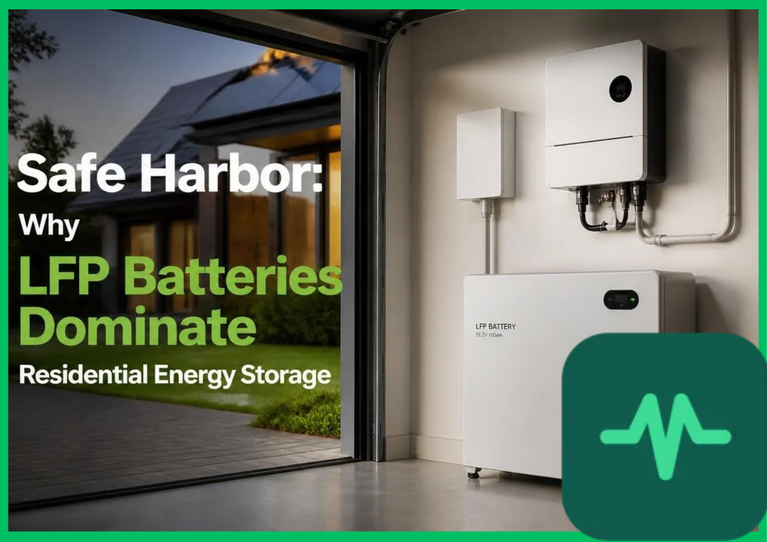
It stores clean solar energy captured during the sunlit hours. It stands ready to keep your lights, refrigerator, and heating systems running smoothly if a sudden storm knocks out the local power grid.
You want that system to be completely dependable. More than anything, you want it to be safe.
When families invite energy storage systems into their homes, peace of mind matters above all else.
For years, people worried about the fire risks associated with lithium-ion batteries. Headlines about rare electronic failures made homeowners hesitant to install large energy packs indoors.
A quiet chemical shift changed that reality completely.
According to global energy tracking reports from the International Energy Agency (IEA), efficiency frameworks from ENERGY STAR, and academic battery materials research, lithium iron phosphate (LFP) batteries now dominate the residential storage market.
Here is how LFP chemistry works, why its molecular stability prevents thermal runaway, and why it provides a safe harbor for modern homes.
The Chemistry of Stability
To understand why LFP batteries became the undisputed gold standard for residential energy storage, you have to look at their molecular structure.
Standard lithium-ion batteries—like those commonly used in high-performance electric cars or consumer electronics—frequently rely on nickel, manganese, and cobalt (NMC).
Those chemistries offer high energy density, packing immense power into lightweight spaces.
They also carry a vulnerability. Under extreme stress, overcharging, or physical damage, NMC cells can suffer from internal heating that triggers thermal runaway—a dangerous chain reaction where rising temperatures lead to fire.
Lithium iron phosphate (LFP) chemistry takes a completely different path.
The cathode in an LFP battery uses powerful covalent bonds between phosphorus and oxygen atoms.
Academic materials research shows that this olivine crystal structure is exceptionally strong and stable.
Even when subjected to intense heat, physical punctures, or severe overcharging, the phosphate bonds hold firm.
The material is far less likely to release oxygen under duress, meaning it completely resists the cascading chain reactions that cause fires in older battery types.
It is chemically engineered to remain cool, calm, and stable inside your home.
Built for the Long Haul
Safety is only part of the story. Residential energy storage systems face a grueling daily routine.
They charge up when solar panels produce surplus energy, and they discharge every evening to power household appliances.
That cycle happens 365 days a year, year after year.
Traditional battery chemistries wear down under that constant rhythm, losing capacity after a few thousand cycles.
LFP batteries thrive under heavy cycling.
According to academic energy storage studies and IEA market deployment reviews, LFP cells routinely endure 3,000 to 6,000—and sometimes up to 10,000—full charge and discharge cycles while retaining over 80% of their original capacity.
If you cycle your home battery once a day, an LFP system can easily deliver over a decade or two of reliable daily service.
This incredible durability translates into genuine long-term value, sparing homeowners the expense and hassle of premature replacements.
Abundant Materials and Ethical Security
Beyond safety and longevity, LFP batteries offer another massive global advantage: material availability.
Early lithium-ion chemistries relied heavily on cobalt and nickel. Mining cobalt raises serious ethical and environmental concerns, often involving harsh labor conditions and fragile ecosystems in specific regions. Furthermore, cobalt and nickel prices suffer from violent global market swings.
LFP batteries completely eliminate cobalt and nickel from their cathode composition.
Instead, they rely on iron and phosphate—abundant, inexpensive, and widely available elements sourced easily across the globe.
According to UNEP resource assessments and IEA technology outlooks, shifting toward LFP chemistry insulates clean energy supply chains from mineral scarcity and volatile commodity prices.
It ensures that residential energy storage remains affordable, accessible, and ethically sound for communities everywhere.
Safe Energy Independence at Home
Installing a residential energy storage system represents a profound step toward energy independence.
It protects your family from utility outages, shields your household budget from fluctuating electricity rates, and lets you maximize the clean solar energy captured on your roof.
Knowing that your battery system rests on stable, non-flammable LFP chemistry lets you rest easy at night.
You do not have to compromise safety for sustainability.
Through advanced materials science and robust engineering, LFP technology provides a secure foundation for modern households.
We are building a clean energy future that protects our planet while keeping our homes safe, warm, and fully powered.
Comments (0)
Login to leave a comment.
No comments yet. Be the first to share your thoughts!