
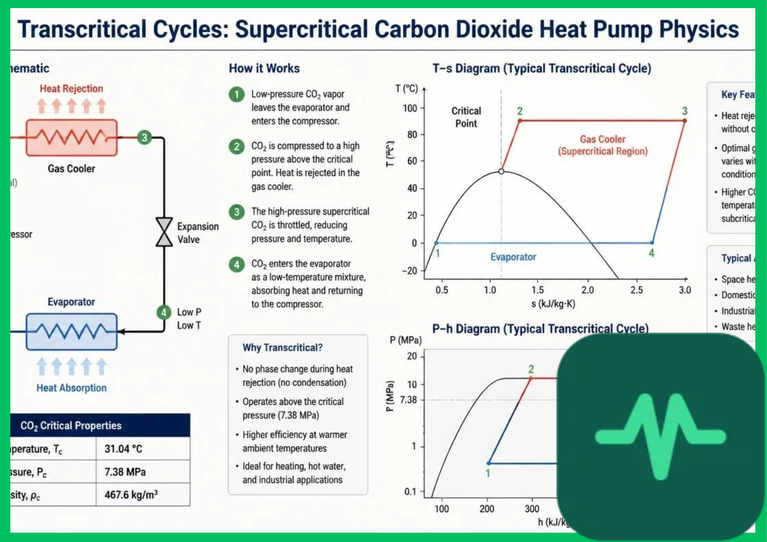
 (
 ). Supercritical carbon dioxide (
 ) heat pumps operating on transcritical thermodynamic cycles utilize natural carbon dioxide (
 ,
 ) as a working fluid, providing exceptional volumetric heating capacities and high-temperature thermal delivery without synthetic greenhouse gas liabilities. Analyzing transcritical fluid dynamics, gas cooler heat rejection glide matching, and internal heat exchanger optimization is essential for evaluating supercritical carbon dioxide heat pump efficiency.
Transcritical Thermodynamic Cycle and Fluid Mechanics
The foundational thermodynamic principle governing supercritical carbon dioxide heat pumps is the transcritical cycle. Unlike traditional subcritical vapor-compression cycles where condensation occurs at constant temperature and pressure inside a condenser, a transcritical cycle operates below the critical pressure on the low-pressure evaporation side ( [
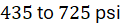 ]) and above the critical pressure on the high-pressure heat rejection side (
 [
 ]).
Carbon dioxide possesses a critical temperature of  (
 ) and a critical pressure of
 (
 ). When compressed above this critical threshold,
 exists as a supercritical fluid exhibiting liquid-like densities coupled with gas-like transport properties, high thermal conductivity, and low dynamic viscosity. Because supercritical fluids do not undergo a discrete phase change (condensation) during heat rejection, heat transfer occurs through a continuous, single-phase isobaric cooling process inside a specialized gas cooler rather than a traditional condenser.
This single-phase cooling behavior alters the pressure-enthalpy ( -
 ) and temperature-entropy (
 -
 ) diagrams of the vapor-compression cycle. The high-pressure discharge gas enters the gas cooler at temperatures well above the critical point, transitioning from a dense gas-like state to a liquid-like supercritical state as thermal energy is extracted by the secondary fluid loop.
Gas Cooler Heat Rejection and Temperature Glide Matching
In standard subcritical heat pumps, heat rejection occurs at an isothermal condensation temperature, creating a large temperature mismatch and associated entropy generation when heating a single-phase secondary fluid—such as water—whose temperature rises progressively from inlet to outlet. This thermal pinch point degrades overall thermodynamic efficiency.
Supercritical carbon dioxide heat rejection eliminates this constraint through large temperature glide matching. As supercritical  flows through the gas cooler counter-flow heat exchanger, its temperature decreases continuously from high compressor discharge temperatures (
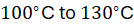 [
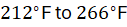 ]) down to subcritical liquid-gas transition points. This continuous temperature drop aligns precisely with the sensible heating curve of municipal water or industrial process loops rising from
 (
 ) to
 (
 ). Minimizing the temperature difference between the working fluid and the heating load reduces internal thermodynamic irreversibility, elevating the heating coefficient of performance (
 ).
Technical Data Specifications of Supercritical  Heat Pumps
Supercritical  Parameter | Engineering & Thermodynamic Specification Standard |
|---|---|
| Critical Temperature and Pressure |  (  ) and  (  ) |
| High-Pressure Gas Cooler Operating Range |  (  ) transcritical pressure |
| Low-Pressure Evaporator Operating Range |  ( 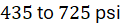 ) suction pressure |
| Compressor Discharge Temperature |  to  (  to  ) thermal output |
| Working Fluid Global Warming Potential |  natural working fluid (  ) |
Heating Coefficient of Performance ( ) |  at  (  ) water delivery |
| Internal Heat Exchanger (IHX) Effectiveness | 65% to 85% thermal energy recovery efficiency |
High-Temperature Industrial Heating and Compressor Engineering
Delivering high-temperature domestic hot water or industrial process steam requires specialized compressor engineering capable of withstanding extreme mechanical pressure differentials. Because  operating pressures are 5 to 10 times higher than conventional synthetic refrigerants such as R134a or R410A, compressor shells, scroll wraps, and piston-cylinder assemblies must be forged from high-tensile alloy steels and nodular cast irons.
Semi-hermetic reciprocating compressors and dual-stage rotary compressors maintain volumetric efficiencies exceeding 85% under high pressure ratios ( to
 ). Lubrication management requires specialized polyalkylene glycol (PAG) or polyolester (POE) synthetic lubricants exhibiting high kinematic viscosity under high pressures, preventing oil dilution and bearing failure in supercritical environments. Furthermore, high discharge temperatures require intermediate desuperheating or liquid injection to protect compressor reed valves and discharge ports from thermal fatigue.
Internal Heat Exchanger (IHX) and Coefficient of Performance Optimization
Optimizing coefficient of performance ( ) in supercritical carbon dioxide heat pumps requires managing the high enthalpy state of the high-pressure fluid exiting the gas cooler before it enters the expansion valve. Without intervention, uncooled high-pressure fluid retains high enthalpy, reducing the net refrigerating effect across the evaporator coil.
To maximize efficiency, systems incorporate an internal heat exchanger (IHX), also known as a suction line heat exchanger. The high-pressure fluid exiting the gas cooler is routed through a counter-flow plate heat exchanger where it exchanges thermal energy with cold, low-pressure suction vapor returning from the evaporator. This internal heat transfer subcools the high-pressure liquid stream by  to
 (
 to
 ) while superheating the suction vapor entering the compressor.
Subcooling increases specific enthalpy drop across the expansion valve, boosting volumetric heating capacity and raising system  by 10% to 20%. According to IEA industrial heating assessments, optimized transcritical
 heat pumps deliver high-temperature water up to
 (
 ) with
 values ranging from
 to
 , displacing fossil-fuel boilers entirely across commercial and industrial district heating networks.


Comments (0)
Login to leave a comment.
No comments yet. Be the first to share your thoughts!