
 ) sits at a dilute concentration near
 —corresponding to a partial pressure of roughly
 (
 ), compared to
 (
 ) or higher in point-source industrial flue gas. Under IEA net-zero pathways, direct air capture (DAC) deployment is projected to scale from early commercial facilities toward tens of millions of tonnes per year by 2030 and hundreds of millions of tonnes per year by mid-century. Extracting dilute
 and releasing it as a concentrated stream (
 purity) for geological storage or carbon mineralization requires overcoming steep thermodynamic separation work and sorbent regeneration barriers. Evaluating amine-functionalized solid sorbents, temperature-vacuum swing adsorption, specific thermal energy demand, and carbon mineralization kinetics is essential for analyzing direct air capture sorbent regeneration thermal energy.
Thermodynamics of Dilute CO2 Capture and Desorption
Capturing  from ambient air requires doing thermodynamic work against a large concentration gradient. Because atmospheric partial pressure is low (
 ), the minimum theoretical separation work per mole of
 is higher than for concentrated point sources, while contactor air fans must move massive volumetric air flows through low-pressure-drop sorbent beds.
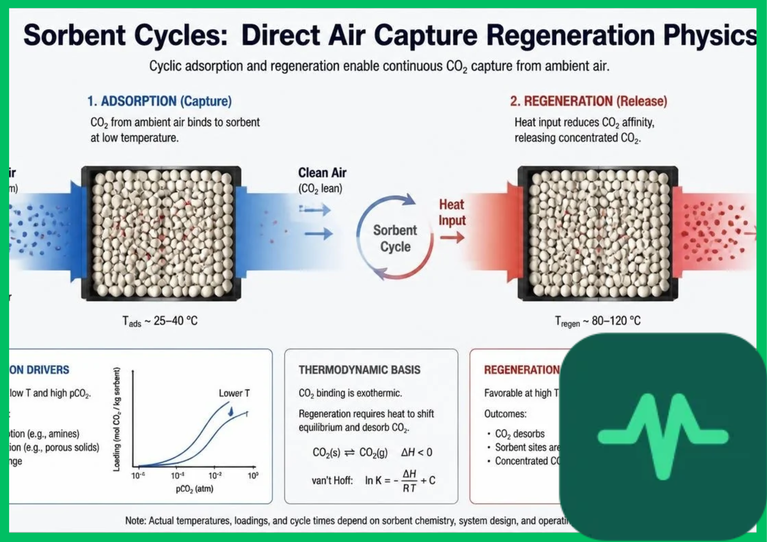
In solid-sorbent direct air capture (S-DAC),  binds reversibly to chemical or physical adsorption sites on a solid porous substrate during the adsorption phase, then releases upon heating and pressure reduction during desorption. The total thermal energy required to regenerate a sorbent bed (
 ) combines sensible heating of the sorbent matrix and structural containment, latent heat of co-adsorbed water, and the endothermic heat of desorption (
 ):

where  and
 denote sorbent and co-adsorbed water masses,
 and
 represent specific heat capacities,
 is the regeneration temperature swing,
 is water vaporization enthalpy,
 is moles of captured
 , and
 is desorption enthalpy (
 ). Minimizing parasitic sensible heat of inert support mass and excess co-adsorbed moisture is central to lowering specific thermal energy demand (
 or
 ).
Amine-Functionalized Solid Sorbents and Chemisorption Kinetics
Because physisorbents such as activated carbons or zeolites lose selectivity under ambient humidity and low partial pressure, solid-sorbent DAC systems widely deploy amine-functionalized solid sorbents grafted or impregnated onto porous supports—such as hierarchical silica, alumina, metal-organic frameworks (MOFs), or polymeric resins. Primary ( ), secondary (
 ), and tertiary (
 ) amine groups react chemically with
 to form carbamates, carbamic acid, or bicarbonates depending on local water availability:

Under dry conditions, two amine sites typically bind one  molecule to form an ammonium carbamate pair, whereas ambient moisture enables bicarbonate formation that can approach one
 molecule per amine group at lower desorption enthalpy. However, strong chemisorption bonds require substantial thermal energy to break during regeneration, and oxidative degradation occurs when oxygen and elevated temperatures attack amine functional groups over repeated adsorption-desorption cycles.
Temperature-Vacuum Swing Adsorption and Specific Thermal Energy Demand
To release bound  without overheating organic amine groups above their thermal stability limits (
 to
 [
 to
 ]), solid-sorbent systems operate temperature-vacuum swing adsorption (TVSA) cycles. After the sorbent bed reaches saturation, the air contactor closes, vacuum pumps evacuate residual air to lower total pressure, and indirect heat transfer—via steam, hot water, or thermal oil loops—raises bed temperature to roughly
 to
 (
 to
 ).
Combining moderate heating with sub-atmospheric vacuum lowers the equilibrium  partial pressure needed to drive desorption, allowing complete release at gentler temperatures than thermal swing alone. Typical solid-sorbent DAC regeneration demands roughly
 (
 ) of thermal energy alongside electrical fan and vacuum work, whereas high-temperature liquid-solvent calcination cycles (
 to
 [
 to
 ]) require higher thermal inputs (
 [
 ]).
Technical Data Specifications of Solid-Sorbent DAC Regeneration
| Sorbent DAC Parameter | Engineering & Thermodynamic Specification Standard |
|---|---|
Ambient  Partial Pressure |  (  ) at  air concentration |
| TVSA Regeneration Temperature |  to  (  to  ) thermal swing |
| Specific Thermal Energy Demand |  (  ) |
Desorbed  Stream Purity |  prior to compression or mineralization |
| Sorbent Cyclic Durability Target |  cycles before replacement |
| Low-Carbon Heat Source Pairing | Geothermal, industrial waste heat, solar thermal, nuclear |
| Water Footprint (S-DAC) | Low ( ); net-positive in humid air |
Heat Integration, Low-Carbon Energy, and Carbon Mineralization Kinetics
Whether direct air capture achieves net-negative carbon removal depends directly on the carbon intensity of the thermal and electrical energy driving regeneration. Using fossil-derived heat or high-emission grid electricity re-introduces  that erodes net removal efficiency. Pairing TVSA beds with geothermal brines, low-grade industrial waste heat, concentrated solar thermal collectors, or nuclear steam lowers lifecycle emissions and reduces operating cost per tonne of
 removed.
Once desorbed and compressed, concentrated  either enters deep saline formations or undergoes carbon mineralization kinetics in reactive rock formations—such as flood basalts or ultramafic peridotites—or alkaline industrial residues. In geological mineralization, dissolved
 reacts with divalent cations (
 ,
 ,
 ) leached from silicate minerals to precipitate stable solid carbonate minerals (such as calcite,
 , or magnesite,
 ), locking carbon permanently in rock rather than relying on structural caprock containment alone.
Cycle Timing, Moisture Effects, and Operational Trade-Offs
Optimizing cycle duration and moisture management governs real-world plant throughput. Shorter adsorption-desorption cycles increase annual  capture per contactor module, yet frequent heating and cooling raise sensible thermal losses and accelerate amine oxidation if oxygen remains during warm-up. Ambient humidity simultaneously helps amine hydration and competes for adsorption sites or adds latent vaporization load if excess water condenses in the bed.
Engineering teams balance these trade-offs through internal heat recovery between cooling and heating beds, nitrogen or steam purge steps, and durable amine-grafted architectures. Sustained advances in low-enthalpy sorbents and low-carbon heat integration determine how economically direct air capture scales toward gigatonne-scale climate targets.


Comments (0)
Login to leave a comment.
No comments yet. Be the first to share your thoughts!