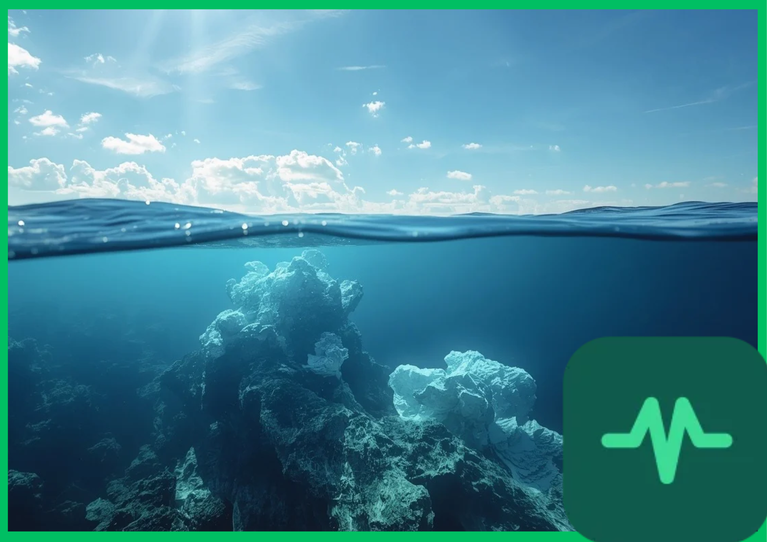
 down to
 , causing widespread ocean acidification and destabilizing marine calcifying organisms. Ocean alkalinity enhancement (OAE) accelerates natural silicate and carbonate weathering cycles by introducing alkaline minerals—such as olivine (
 ), calcium hydroxide (
 ), or crushed limestone (
 )—into marine surface waters. This alkaline augmentation shifts seawater carbonate equilibrium, increasing dissolved inorganic carbon storage capacity and sequestering atmospheric carbon dioxide as stable bicarbonate and carbonate ions without exacerbating acidification.
Seawater Carbonate Chemistry and Dissolved Inorganic Carbon
The foundational chemical mechanism driving ocean alkalinity enhancement relies on seawater carbonate chemistry and the speciation of dissolved inorganic carbon (DIC). When carbon dioxide dissolves in seawater, it forms aqueous carbon dioxide ( ), which hydrates to form carbonic acid (
 ). This weak acid dissociates into bicarbonate ions (
 ) and carbonate ions (
 ), releasing hydrogen ions (
 ) and lowering seawater pH:


Total alkalinity ( ) quantifies the excess of proton acceptors over proton donors in seawater, defined mathematically as:


Adding alkaline minerals or dissolution products directly to seawater increases total alkalinity ( ) without altering total dissolved inorganic carbon (
 ) initially. This chemical shift alters the seawater carbonate equilibrium, driving a stoichiometric conversion of aqueous
 and
 into stable
 ions. The reduction in aqueous
 partial pressure (
 ) widens the air-sea gas transfer gradient, inducing an influx of atmospheric carbon dioxide into the surface ocean until chemical equilibrium is re-established.
Mineral Dissolution Kinetics and Olivine Weathering
Executing ocean alkalinity enhancement requires selecting appropriate alkaline mineral feedstocks and optimizing their dissolution kinetics in marine environments. Natural alkaline minerals fall into two primary categories: fast-reacting hydroxides and slow-weathering silicates.
- Silicate Minerals (Olivine and Basalt): Utilizing magnesium-rich olivine (
 ) mimics natural long-term weathering cycles. When fine-grained olivine powder is dispersed across high-energy coastal zones or surface ocean regions, it dissolves in slightly acidic seawater according to the chemical dissolution reaction:
- Hydroxide and Carbonate Minerals: Utilizing quicklime (
 ), slaked lime (
 ), or electrochemically processed sodium hydroxide (
 ) accelerates dissolution rates instantaneously, raising seawater pH rapidly upon discharge. However, localized precipitation risks (such as calcium carbonate scaling) require careful dispersion management.


This reaction consumes dissolved carbon dioxide and aqueous protons, generating dissolved magnesium cations and bicarbonate ions while increasing total alkalinity. However, olivine dissolution kinetics are slow, requiring fine particle grinding (median grain sizes under  to
 [
 ]) and high turbulence to achieve complete dissolution within targeted residence times.
Technical Data Specifications of OAE Parameters
| Ocean Alkalinity Enhancement Parameter | Engineering & Geochemical Specification Standard |
|---|---|
| Pre-Industrial Surface Ocean pH Baseline |  nominal seawater pH |
| Current Anthropogenic Surface Ocean pH |  (0.1 unit drop / ocean acidification trend) |
| Olivine Particle Sizing Threshold |  to  (  ) for rapid dissolution |
| Seawater Alkalinity Stoichiometry |  |
| Air-Sea Equilibrium Response Time | Months to years depending on ocean mixing depth |
| Marine Carbon Uptake Efficiency |  |
| Trace Metal Leachate Concentration Limits | Strict regulatory thresholds for nickel, chromium, and cobalt |
Ecological Impacts, Trace Metal Seawater Chemistry, and Monitoring
While ocean alkalinity enhancement offers massive carbon removal potential, large-scale mineral dispersion introduces complex ecological and geochemical considerations. Unrefined silicate minerals—particularly geological olivine deposits—frequently contain trace heavy metal impurities, including nickel ( ), chromium (
 ), and cobalt (
 ). When fine mineral powders dissolve in seawater, these trace metals leach into the marine water column. Environmental impact assessments mandated by UNEP guidelines require strict purification protocols to ensure leachate concentrations remain well below toxic thresholds for marine phytoplankton, zooplankton, and benthic organisms.
Furthermore, rapid localized increases in seawater pH or calcium carbonate saturation states ( ) can induce calcium carbonate precipitation (secondary mineral scaling), reducing carbonate ion availability for shell-forming organisms like foraminifera, pteropods, and coral reef ecosystems. Comprehensive monitoring programs utilize autonomous biogeochemical Argo floats, moored pH sensors, and satellite ocean color telemetry to track carbonate system metrics and verify carbon sequestration additionality in real time.
Global Sequestration Capacity and Logistics
Scaling ocean alkalinity enhancement to gigaton removal levels requires evaluating global supply chain logistics, mineral mining capacity, and maritime dispersion infrastructure. Mining, crushing, and milling millions of metric tons of olivine or limestone demands significant energy inputs, which must be powered by renewable energy sources to maintain net-negative carbon accounting.
Dispersion strategies leverage existing maritime transport networks, discharging fine mineral slurries through dedicated diffuser systems installed on commercial bulk carriers or offshore platforms traversing high-energy, well-mixed ocean regions. Academic assessments indicate that deploying OAE across 5% to 10% of global shelf seas could sequester between  and
 of
 annually, establishing a potent geochemical carbon dioxide removal pathway.
The Final Take
Mastering oceanic buffering marine alkalinity enhancement mechanics expands the technical scope of permanent carbon dioxide removal by harnessing natural geochemical cycles. Citing UNEP marine assessments and academic oceanographic literature, accelerating silicate mineral weathering and shifting seawater carbonate equilibria increases dissolved inorganic carbon storage while mitigating ocean acidification. By resolving trace metal leaching constraints and optimizing dissolution kinetics, ocean alkalinity enhancement establishes an essential foundation for marine climate restoration.
Comments (0)
Login to leave a comment.
No comments yet. Be the first to share your thoughts!