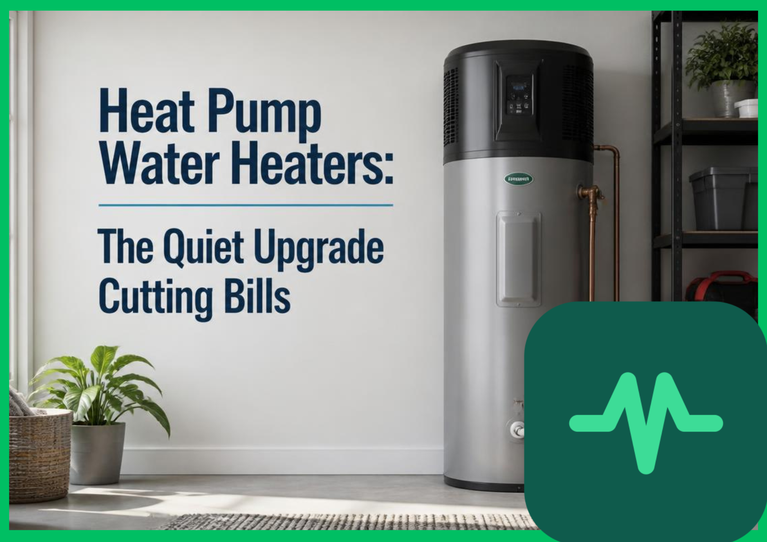
Heat pump water heaters offer a genuinely different approach. Let's look at how they actually work, and whether the upgrade makes sense.
How they're different from a traditional water heater
A standard water heater creates heat directly, using electric resistance or gas. It's simple, but simple isn't always efficient.
A heat pump water heater works differently. Instead of creating heat from scratch, it pulls existing heat from the surrounding air and transfers it into the water. This process uses significantly less energy, since it's moving heat rather than generating it entirely on its own.
Think of it like the difference between building a fire versus simply relocating warmth that already exists nearby.
Why this matters for your bill
Water heating is often one of the largest energy costs in a home, quietly running day and night regardless of whether anyone's home.
Because heat pump water heaters use notably less energy to do the same job, many households see a meaningful, steady reduction in their water heating costs. This isn't a one-time saving. It compounds month after month, year after year.
The honest tradeoffs worth knowing
These units typically cost more upfront than a standard water heater. That's a real, honest tradeoff worth acknowledging clearly.
The savings over time usually offset that higher initial cost, often within a handful of years, though the exact timeline depends on your household's water usage and local energy prices.
There's also a space and location consideration. Heat pump water heaters work best in a space with enough surrounding air volume, like a basement or a utility room, rather than a small, cramped closet.
The temperature and space quirk nobody mentions
Because these units pull heat from surrounding air, they naturally cool that space down slightly. In a warm basement, this is barely noticeable. In a small, already-cool space, it can be a real, if minor, side effect worth planning for.
Some homeowners actually appreciate this in warmer climates, since it adds a small, secondary cooling effect to the room. In colder climates, it's worth considering the placement a little more carefully.
What installation actually looks like
In many cases, a heat pump water heater can replace a standard unit in roughly the same physical spot, provided there's enough surrounding airspace. A qualified installer can quickly assess whether your specific setup is a good fit.
The unit typically needs a standard electrical connection, similar to an electric water heater, along with some basic drainage for the condensation the process naturally creates.
Real-world savings expectations
Most households see their water heating energy use drop substantially compared to a standard electric water heater. The exact number depends on household size, hot water habits, and local climate.
Larger families using more hot water daily tend to see the most noticeable difference, simply because there's more usage for the efficiency gains to apply to.
Maintenance, honestly
These units require slightly more attention than a basic water heater, mainly around keeping the air filter clean so the heat-pulling process keeps working efficiently.
Beyond that occasional filter check, maintenance needs are generally comparable to a standard water heater.
Who benefits most from this upgrade
Homeowners planning to stay in their home for several more years benefit most, since that gives the energy savings enough time to fully offset the higher upfront cost.
Households with genuinely high hot water usage, larger families especially, tend to see savings add up faster than smaller households.
And anyone with a suitable installation space, like a basement or larger utility room, will get the most efficient performance from the unit.
The honest bottom line
A heat pump water heater costs more initially, but it quietly earns that cost back through genuinely lower energy use, month after month. For the right home and household, it's one of the more overlooked, practical upgrades available today.
It won't make headlines. It just quietly does its job, using less energy every single day to accomplish exactly the same result.
Comments (0)
Login to leave a comment.
No comments yet. Be the first to share your thoughts!