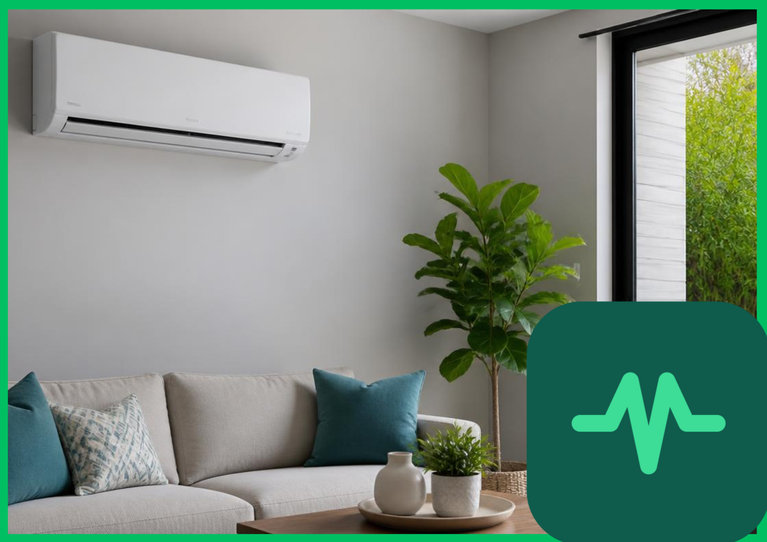
For years, that meant limited, often inefficient options. Ductless mini split heat pumps changed that conversation entirely.
What makes them different
A traditional central system pushes heated or cooled air through ductwork into every room. A ductless mini split skips that entirely.
Instead, a small outdoor unit connects directly to one or more indoor units mounted on a wall or ceiling in specific rooms. No ducts. No major construction. Just a compact, direct connection delivering heating or cooling exactly where it's needed.
Why this appeals to so many homeowners
The installation flexibility is genuinely remarkable. Rooms without existing ductwork, garage conversions, additions, or older homes built before central air became standard, all become realistic candidates for efficient heating and cooling.
There's also a comfort advantage. Because each indoor unit operates independently, you can heat or cool individual rooms exactly to your preference, rather than fighting over one thermostat for the entire house.
The efficiency advantage, explained simply
Ductwork loses energy. Air traveling through long duct runs, especially through unconditioned spaces like attics, loses some of its heating or cooling power before it even reaches the room.
A ductless system skips that loss entirely, since it delivers conditioned air directly at the point of use. This directness often translates into genuinely lower energy use compared to older ducted systems, room for room.
Where ductless mini splits shine the most
Room additions are a classic use case, since extending existing ductwork to a new space is often expensive and complicated.
Older homes without any existing ductwork benefit enormously, avoiding the disruptive, costly process of installing ducts throughout an entire house.
Garages converted into living spaces, home offices, or guest suites are another strong fit, since these spaces often exist outside a home's original heating and cooling footprint entirely.
The honest limitations worth knowing
The upfront cost per room can add up if you're outfitting an entire home with multiple indoor units, rather than just one or two specific spaces.
The indoor units themselves are visible on the wall or ceiling, which some homeowners love for their sleek, modern look, and others would rather hide behind traditional vents.
And while a single unit efficiently handles one room, cooling or heating an entire large, open home may require multiple units working together, rather than one central system managing everything at once.
What installation actually involves
Installation is notably simpler than adding traditional ductwork, though it still requires a small hole through an exterior wall to connect the indoor and outdoor components.
Most installations take a single day for a basic one-room setup, with more complex multi-room installations taking a bit longer depending on the number of indoor units involved.
A realistic cost comparison
While the per-room cost of a mini split can be higher than simply extending existing ductwork, the comparison changes significantly for homes without any ductwork at all. In those cases, mini splits often end up considerably more affordable than installing an entirely new duct system from scratch.
Maintenance expectations
Mini splits require simple, regular filter cleaning, similar to any heating and cooling system. Beyond that routine task, they generally need only occasional professional check-ups to keep running efficiently for many years.
Who should genuinely consider one
Anyone with a room addition, converted space, or older home lacking ductwork is a strong candidate. So is anyone wanting more precise, room-by-room control over their comfort, rather than one setting for an entire house.
Homeowners focused on energy efficiency also benefit, given the reduced energy loss compared to long duct runs.
The honest bottom line
Ductless mini split heat pumps solve a genuinely common problem, providing efficient heating and cooling in spaces that traditional systems struggle to reach. They're not the right fit for every single home, but for the right space, they offer a flexible, efficient solution that keeps earning its growing popularity.



Comments (0)
Login to leave a comment.
No comments yet. Be the first to share your thoughts!