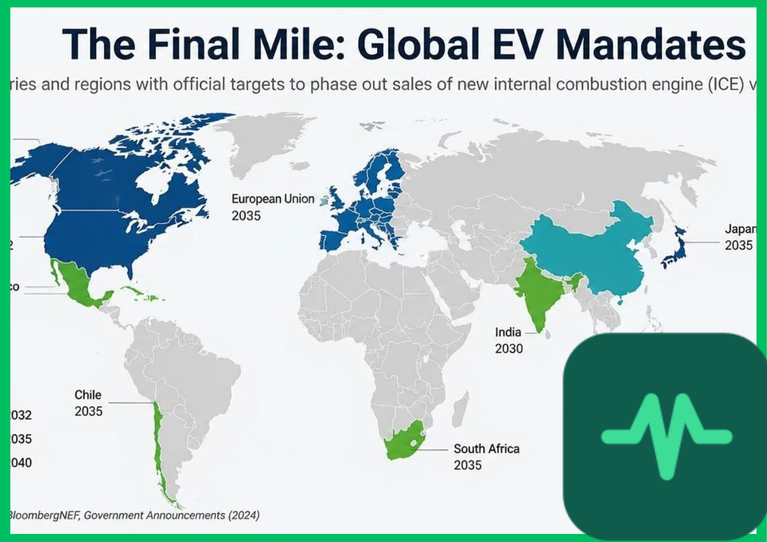
The Final Mile: Regulatory Mechanics and Industrial Impacts of Global EV Mandates
For over a century, the internal combustion engine (ICE) dominated global transportation infrastructure. The industrial, urban, and logistical frameworks of modern society were built around the consumption of liquid petroleum products. This reliance established a lock-in effect, causing severe urban localized air pollution and high greenhouse gas emissions.
As international climate frameworks tighten and lithium-ion battery pack prices fall below the critical threshold of $100 per kilowatt-hour, voluntary market adoption is no longer the sole driver of the electric mobility transition. Governments worldwide are implementing binding Zero-Emission Vehicle (ZEV) mandates and hard ICE phaseout timelines. These regulatory interventions establish long-term legal certainty, forcing global automotive supply chains to completely retool assembly lines and finalize the transport sector's transition to electrification.
The Structural Limits of Voluntary Vehicle Adoption
The necessity of binding vehicle mandates can be analyzed through transport economics and asset depreciation cycles. Relying entirely on organic consumer preference to displace legacy automotive technology introduces deep transition delays. Legacy original equipment manufacturers (OEMs) possess extensive capital tied up in specialized tooling, engine foundries, and powertrain manufacturing facilities. Without external regulatory force, manufacturers are incentivized to prolong the production of high-margin ICE vehicles to maximize returns on their existing tooling investments.
This delay carries long-term environmental consequences due to fleet turnover dynamics. Passenger vehicles remain active within global fleets for an average lifespan of 12 to 15 years. Consequently, every combustion vehicle sold today locks in a fixed, non-mitigatable carbon emission profile stretching into the late 2030s. Transport modeling demonstrates that relying on voluntary market shifts is insufficient to meet global net-zero targets within necessary ecological timelines, making legal phaseout mandates a structural necessity.
The Regulatory Mechanisms of ZEV Mandates
Modern electric vehicle mandates operate through sophisticated compliance architectures rather than simple bans. Regulators utilize three core policy levers to enforce the automotive pivot:
Credit-Based Sales Quotas
Mechanics: Environmental agencies assign escalating annual ZEV targets to automakers based on total production volume. Selling an electric vehicle grants the OEM clean vehicle credits.
Compliance Impact: Manufacturers that fall short of their annual clean sales quotas must either purchase surplus credits from pure-EV competitors or face heavy statutory financial fines. This credit-trading framework directly subsidizes electric vehicle development using capital penalized from non-compliant ICE sales.
Stringent Fleet-Wide Fleet Emissions Standards
Mechanics: Frameworks such as the Corporate Average Fuel Economy (CAFE) standards in the United States and evolving Euro 7 targets in the European Union place strict, low caps on the average carbon emissions allowed per kilometer across an automaker's entire product line.
Compliance Impact: The tailpipe limits are progressively lowered to levels that are mechanically impossible for conventional gasoline or diesel engines to meet without extensive hybridization or pure battery integration, effectively phasing out non-electrified drivetrains by default.
Binding ICE Phaseout Target Dates
Mechanics: Jurisdictions enact hard legislative deadlines that completely outlaw the sale of brand-new, non-zero-emission passenger cars and light commercial vehicles past a specific calendar year.
Global Phaseout Timelines and Market Objectives
The execution of these vehicle mandates varies across key economic zones, creating a multi-tiered global manufacturing requirement:
The European Union: Under the Fit for 55 package, the EU has codified a 100% CO2 reduction target for all new passenger cars and vans starting in 2035. This regulation effectively blocks the registration of standard internal combustion vehicles across all 27 member states.
China (The Dual-Credit System): China’s Ministry of Industry and Information Technology enforces a corporate credit scheme that simultaneously scores automakers on fuel consumption and new energy vehicle (NEV) production. The national automotive roadmap targets NEVs to account for over 50% of new car sales by 2035, with conventional ICE options transitioned entirely to fuel-efficient plug-in hybrids.
United States (EPA Multi-Pollutant Standards): The Environmental Protection Agency (EPA) has finalized strict tailpipe emission standards for light-duty vehicles spanning model years 2027 through 2032. Industry projections indicate these federal requirements will drive electric vehicles to make up roughly 56% of all new U.S. passenger car sales by 2032.
Thermodynamic Efficiency and Air Quality Metrics
Forcing the transition to electric powertrains yields clear thermodynamic and public health benefits. Electric drivetrains operate with superior energy conversion physics compared to fossil-fuel options. Modern electric motors convert 85% to 90% of grid electrical energy into kinetic motion at the wheels. In contrast, internal combustion engines waste roughly 75% to 80% of their chemical fuel energy as ambient heat and friction, resulting in a net thermal efficiency under 25%. Mandates eliminate this systemic energy waste across national transport networks.
Concurrently, removing tailpipes directly addresses urban health crises. Combustion fleets discharge high volumes of nitrogen oxides (NOx), sulfur dioxide (SO2), and fine particulate matter (PM2.5) into urban boundaries. Data compiled by the United Nations Environment Programme (UNEP) links these fine particles to high regional rates of cardiovascular strain and chronic respiratory illness. Transitioning to zero-tailpipe transportation options isolates vehicle charging to power grids—where emissions can be abated centrally via renewable source integration—improving public health outcomes within major population centers.
Managing Infrastructure Bottlenecks and Grid Capacities
Transitioning global automotive production from mechanical engines to chemical battery packs presents sharp logistical, material, and electrical grid hurdles.
The primary structural challenges include:
Upstream Mineral Supply Chains: Meeting escalating ZEV quotas demands a rapid, secure scale-up in the mining, refining, and processing of battery-grade lithium, cobalt, nickel, and synthetic graphite.
Electrical Grid Balancing: Integrating high-volume EV fleets requires extensive local distribution grid upgrades. Uncoordinated vehicle charging during peak evening hours can overload regional substations and drop line voltages.
To mitigate these grid bottlenecks, utilities and transport networks are deploying smart charging software and high-voltage DC fast-charging networks. By using time-of-use pricing models, operators can financially incentivize EV owners to charge during off-peak windows when surplus wind or solar energy is abundant. Additionally, the development of domestic battery gigafactories helps stabilize automotive supply chains, easing the transition for legacy labor forces through specialized technical retraining.
The Future of Global Transportation Policy
Global electric vehicle mandates establish a clear regulatory pathway past a century of fossil-fuel dependence. By replacing volatile consumer trends with clear legislative parameters and strict fleet emission penalties, these frameworks ensure that the transport sector achieves complete carbon neutrality. As manufacturing costs reach parity with combustion models, binding vehicle mandates will solidify zero-emission mobility as the universal standard for modern transport infrastructure worldwide.

Comments (0)
Login to leave a comment.
No comments yet. Be the first to share your thoughts!