You watch the traffic stream past. For decades, the air filled with the heavy, choking roar of internal combustion engines, leaving behind a thick cloud of exhaust fumes.
Today, the soundscape is changing.
A sleek car glides past you in total silence, powered entirely by electricity.
That quiet vehicle represents more than just a new way to travel. It marks a profound turning point in human history.
For over a century, our global transportation network relied exclusively on burning fossil fuels.
We pumped oil from the earth, refined it into gasoline, and burned it in millions of individual cars, releasing billions of tons of carbon dioxide into our shared atmosphere.
That linear habit drove our planet toward a climate emergency.
How do you transform an entire global industry built on oil and gas?
You watch consumer choices shift as clean technology crosses the line from a luxury hobby into an everyday reality.
A quiet, unstoppable transportation revolution is reshaping highways across the globe.
According to global energy reports from the International Energy Agency (IEA), resource protection frameworks from the United Nations Environment Programme (UNEP), efficiency benchmarks from ENERGY STAR, and academic mobility research, global electric vehicle adoption trends are accelerating faster than ever before.
By tracking international sales milestones and shifting consumer expectations, we can see how electric mobility is rewriting the future of travel.
Here is how global adoption trends work, why international markets are shifting toward zero-emission transport, and how widespread electrification secures our sustainable future.
The Turning Point of Global Road Transport
To understand why electric vehicle adoption matters so much, you have to look at the sheer scale of the historical challenge.
The global transportation sector accounts for a massive share of total greenhouse gas emissions.
For generations, personal cars and heavy trucks burned through finite oil reserves while warming our planet and polluting urban air quality.
Early efforts to introduce electric cars faced stubborn roadblocks.
Vehicles were expensive. Driving ranges were short. Charging stations were rare, leaving drivers with deep anxiety about getting stranded miles from home.
Skeptics argued that clean transport would remain a niche market for wealthy environmental enthusiasts.
Physics and engineering proved the skeptics wrong.
Battery prices dropped steadily year after year. Energy density climbed. Charging networks expanded outward from city centers into rural highway corridors.
The tipping point arrived when driving an electric vehicle stopped requiring personal compromise and started offering a superior driving experience.
Instant torque, smooth acceleration, and cheap home charging won over everyday drivers across every continent.
What Do the Latest Adoption Numbers Show?
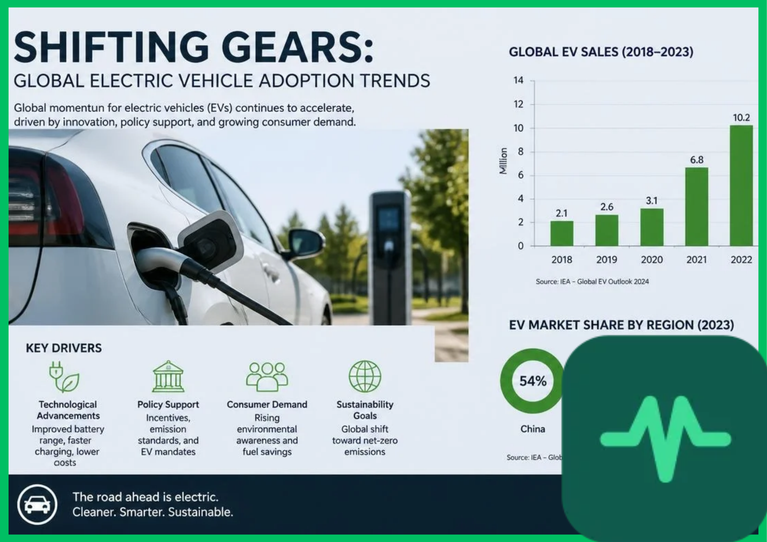
Global statistics reveal an extraordinary acceleration in market growth.
According to International Energy Agency (IEA) assessments, electric car sales worldwide are scaling toward historic heights, accounting for nearly 30% of all new vehicle sales globally.
Millions of new electric cars roll off manufacturing lines and into customer driveways every single year.
This rapid expansion is no longer confined to a single wealthy nation or isolated region.
Adoption rates are surging across diverse international markets, from dense European urban centers to fast-growing Asian metropolitan areas and expanding Latin American corridors.
Drivers everywhere realize a simple economic truth: charging a car battery with electricity costs significantly less money over time than filling a tank with volatile petroleum fuels.
When clean transport becomes cheaper and more pleasant than burning oil, market momentum becomes unstoppable.
The Science of Consumer Shifting and Market Dynamics
What drives millions of independent car buyers around the world to choose electric over combustion engines?
It comes down to a mix of personal economics, environmental awareness, and technological maturity.
Academic research into mobility trends shows that once public charging infrastructure reaches a critical density threshold, consumer anxiety drops sharply.
When drivers see their neighbors, friends, and coworkers driving electric cars without trouble, social norms shift.
People realize that home charging eliminates weekly trips to messy gas stations entirely. You plug your car in overnight while you sleep, and you wake up every morning with a full tank of clean energy.
According to ENERGY STAR and international appliance efficiency evaluations, electric powertrains convert over 85% of electrical energy into motion, compared to less than 30% efficiency for traditional combustion engines.
That massive efficiency gap translates directly into lower energy consumption and lower household carbon footprints.
Environmental Integrity and Global Equity
As electric vehicle adoption expands across the globe, maintaining environmental and social equity remains a vital priority.
Transitioning away from oil must not create new injustices elsewhere.
According to UNEP resource governance frameworks, global supply chains for clean transport must prioritize ethical mineral sourcing, worker safety, and community protection.
When international manufacturers embrace circular manufacturing, closed-loop battery recycling, and earth-abundant chemistries like sodium-ion cells, clean transport becomes truly sustainable from top to bottom.
Furthermore, as emerging economies build out their clean energy grids, electric mobility offers developing nations a chance to leapfrog the heavy smog and oil dependency that plagued industrialized nations for a century.
Driving Toward a Sustainable Future
Global electric vehicle adoption trends prove that humanity can successfully redesign its core industrial systems when brilliant engineering meets practical economics.
We no longer have to accept that personal travel requires burning fossil fuels and polluting our shared air.
By tracking international market growth, expanding charging accessibility, and embracing efficient electric powertrains, we transform our highways into clean corridors of movement.
We step away from oil dependency, embracing a smart, efficient, and enduring standard of transportation.
Through collaborative international progress, rigorous academic research, and a deep respect for our planetary climate, global electric vehicle adoption secures a clean, thriving future for our world.


Comments (0)
Login to leave a comment.
No comments yet. Be the first to share your thoughts!