It sits quietly plugged into the wall charger.
It runs silently, producing zero tailpipe emissions on the road.
You feel a quiet wave of pride, believing your daily commute helps protect the natural environment.
Yet if you trace the history of that car back to its origins, a darker story emerges.
Hidden deep inside the vehicle's heavy floor lies a battery pack packed with lithium, cobalt, nickel, and manganese.
Where did those raw minerals come from?
Were they mined under safe conditions that protected workers, or were they scavenged from dangerous pits that exploited children and polluted fragile rivers?
For years, the global automotive supply chain was a black box.
Automakers bought battery cells from tier-one suppliers who bought processed metals from global traders who bought raw ores from mines scattered across remote continents.
Nobody knew the true origin of the materials inside our vehicles.
We cannot build a genuinely ethical clean energy transition while hiding the human and environmental cost of our battery minerals behind anonymous corporate supply chains.
What if every electric vehicle battery carried a permanent, unalterable digital identity from the moment it was mined?
What if a secure digital record tracked every single component, mineral source, and carbon footprint across the entire life of the battery?
A quiet, profound digital transparency revolution is transforming manufacturing floors across the globe.
According to global clean energy reports from the International Energy Agency (IEA), resource governance frameworks from the United Nations Environment Programme (UNEP), efficiency benchmarks from ENERGY STAR, and academic supply chain research, EV battery passport transparency regulations are changing our industrial accountability.
By utilizing secure blockchain records, unique QR codes, and standardized material tracking, we bring the hidden history of every battery out of the shadows.
Here is how digital battery passports work, why supply chain traceability changes manufacturing economics, and how a digital pedigree secures our sustainable future.
The Dark Secrets of Anonymous Supply Chains
To understand why digital battery passports matter so much, you have to look at the complex chaos of traditional global mineral sourcing.
A single electric vehicle battery contains hundreds of kilograms of refined metals.
Those materials pass through dozens of different hands, countries, and processing facilities before ever reaching an automotive assembly line.
Along that journey, raw minerals from ethical mines get mixed with minerals sourced from illegal operations using forced labor or destroying protected rainforests.
Once mixed inside a refined battery cell, tracing the original source became virtually impossible.
Corporations could easily claim ignorance, hiding behind vague supplier pledges and greenwashed marketing campaigns.
Skeptics once argued that tracking minerals across thousands of opaque international borders was too complex and expensive for global trade.
Supply chain researchers and international regulators proved those skeptics wrong.
Ignorance is no longer an acceptable excuse for human exploitation or environmental destruction.
If an automaker sells a battery, they must prove its ethical pedigree.
What Is an EV Battery Passport?
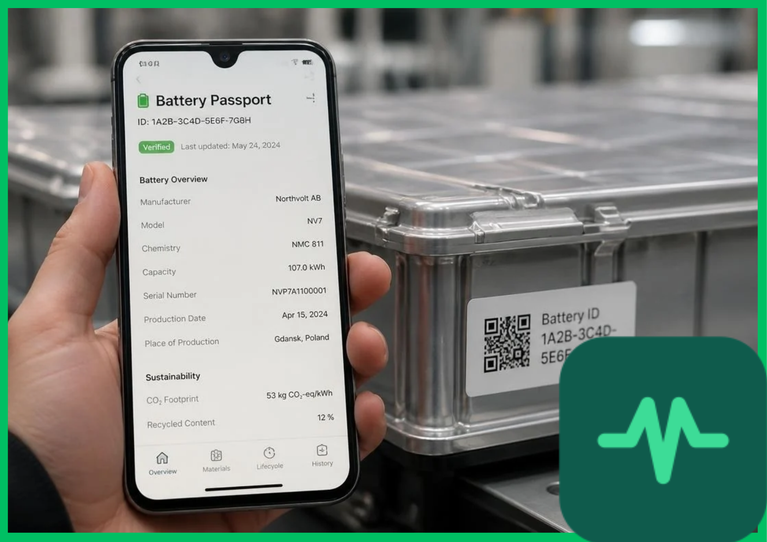
An EV battery passport is a secure, standardized digital record—accessed via a unique QR code laser-etched onto the battery casing—that tracks the exact origin of raw materials, carbon emission metrics during manufacturing, chemical composition, and recycling instructions across the entire operational lifespan of an electric vehicle battery.
Instead of hiding behind anonymous corporate paperwork, the system operates through radical digital accountability:
- Digital Identity Assignment: Every battery receives a unique cryptographic serial number at the factory, linking it permanently to a secure cloud database.
- Source Tracking: Mining operations and chemical refiners upload certified data confirming where and how raw lithium, cobalt, and nickel were extracted.
- Carbon Accounting: Automated software calculates the exact greenhouse gas emissions generated during mineral refining and cell manufacturing, recording the carbon footprint on the passport.
- Lifecycle Monitoring: As the vehicle ages, the passport updates with health metrics, charge cycles, and repair history, guiding future recyclers on how to dismantle and harvest the internal materials safely.
You scan the code with a smartphone, and the entire life story of the battery appears instantly on screen.
The Science of Cryptographic Traceability and Data Security
How can international regulators and everyday consumers trust that data recorded on a battery passport has not been altered or falsified by corrupt suppliers?
It comes down to decentralized ledger technology and cryptographic data verification.
Academic supply chain research shows that modern battery passports use tamper-proof distributed ledgers—similar to blockchain architecture—where every transaction or transfer of ownership must be verified and signed digitally by participating parties.
Once data gets entered into the ledger, it cannot be quietly erased or modified.
Furthermore, ENERGY STAR and international industrial efficiency evaluations prove that transparent digital tracking forces manufacturers to optimize their supply chains, weeding out inefficient, high-emission processing plants.
When emissions and labor practices are exposed in public digital records, bad actors lose business immediately.
Transparency drives instant ethical reform.
Environmental Integrity and Human Rights Protection
The environmental and social benefits of EV battery passport transparency regulations extend far beyond clean corporate spreadsheets or regulatory compliance.
They provide an essential shield for vulnerable communities and fragile ecosystems worldwide.
According to UNEP resource governance frameworks, transparent mineral tracking ensures that mining revenues support local community development rather than funding illicit armed conflicts or environmental devastation in developing regions.
When battery manufacturers are legally required to prove their materials are clean, they stop buying from unregulated mines.
According to IEA clean energy roadmaps, scaling up universal supply chain traceability is an absolute pillar to achieve ethical decarbonization targets without compromising human rights.
When every battery wears a verified digital pedigree, sustainable manufacturing becomes a strict global law.
Overcoming Data Standards and Cybersecurity Realties
Scaling digital battery passports from pioneering pilot projects into mandatory global industrial practice involves navigating real-world technological and regulatory hurdles.
Different nations, automakers, and software developers must agree on universal open data standards so a battery manufactured in Asia, installed in a vehicle in North America, and recycled in Europe can be read seamlessly by any authorized system.
Software engineers, international standard-setting bodies, and industrial trade groups are solving these challenges by establishing open-source interoperability protocols, deploying encrypted cloud storage, and building user-friendly mobile interfaces for customs agents and recyclers.
As regulatory frameworks harmonize worldwide, digital battery passports are transitioning successfully from visionary concept papers into mandatory global trade law.
Securing a Digital Pedigree Toward a Sustainable Future
EV battery passport transparency regulations prove that digital innovation can bring absolute honesty and accountability to global manufacturing.
We no longer have to accept that driving a clean electric car requires turning a blind eye to hidden human and environmental suffering in our supply chains.
By tracking every mineral from mine to vehicle through secure digital ledgers, we ensure that our clean energy transition remains clean from the very start.
We step away from corporate opacity, embracing a truthful, transparent, and enduring standard of global commerce.
Through brilliant cryptographic design, rigorous academic research, and a deep respect for human dignity, a digital pedigree secures an ethical, fair, and sustainable future for every community on Earth.
Comments (0)
Login to leave a comment.
No comments yet. Be the first to share your thoughts!