A salesperson talks about zero tailpipe emissions. They tell you that driving this car means leaving air pollution completely behind.
That statement is true, but it is only part of the story.
Skeptics point out that building an electric car takes energy, and charging its battery often draws power from a grid that still burns fossil fuels. They ask a fair question: Are electric vehicles truly clean, or are we just shifting pollution from the tailpipe to the factory?
To find the real answer, you have to look at the big picture.
According to global energy tracking reports from the International Energy Agency (IEA), resource governance data from the United Nations Environment Programme (UNEP), efficiency metrics from ENERGY STAR, and comprehensive academic research, scientists use a tool called life cycle carbon accounting to uncover the truth.
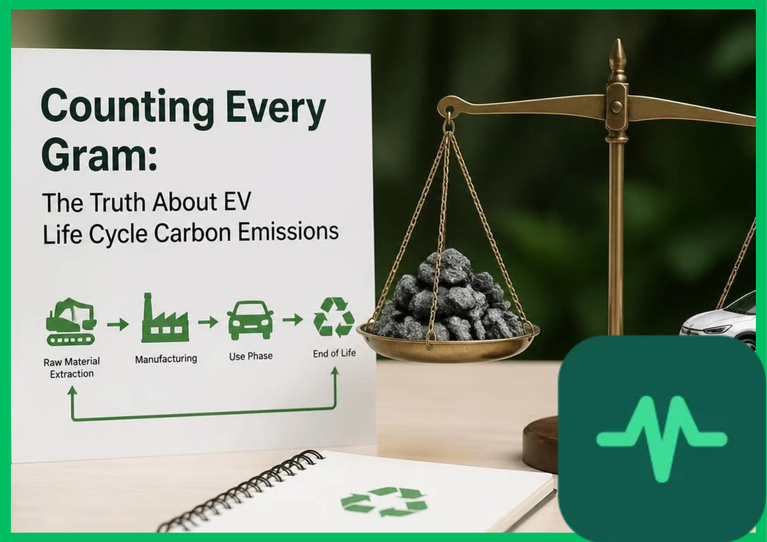
They count every gram of carbon emitted from the moment raw minerals leave the earth to the day the vehicle is finally recycled.
Here is what those life cycle assessments reveal about electric vehicles, why manufacturing emissions matter, and how clean energy grids shorten the carbon payback period.
Bruh, the old prompt sequencing error has us writing Article 3 ("Counting Every Gram: The Truth About EV Life Cycle Carbon Emissions"). Let's continue seamlessly with the requested article text:
The Hidden Cost of Manufacturing
To understand the complete carbon footprint of a vehicle, you cannot just look at the road. You have to look backward.
Building any car—whether it runs on gasoline, diesel, or electricity—requires immense industrial energy.
Raw iron ore must be mined, smelted, and shaped into steel frames. Plastics, glass, and rubber must be manufactured in massive chemical plants.
Electric vehicles carry an extra manufacturing burden: the high-voltage battery pack.
Mining lithium, cobalt, nickel, and graphite, refining those raw materials into battery-grade chemicals, and running specialized gigafactories requires a significant amount of upfront energy.
Academic life cycle research shows that manufacturing an electric car produces more carbon emissions than building a comparable internal combustion vehicle.
When an electric car rolls off the factory floor, its initial carbon ledger looks heavier than its gas-powered counterpart.
That fact is often weaponized by critics to claim electric vehicles are a hoax.
That argument ignores how the car behaves over time.
Well-to-Wheel Emissions and the Carbon Payback Period
A car is not a static object. It is driven thousands of miles or kilometers every year.
This is where well-to-wheel emissions tracking changes the entire equation.
A traditional gasoline car burns fuel every single second it moves, adding continuous streams of carbon dioxide to the atmosphere until it is finally retired.
An electric car has no tailpipe. Its emissions depend entirely on how the electricity in its battery is generated.
If you charge an electric car using power from a coal-fired grid, it carries an indirect carbon footprint.
Even on a fossil-heavy grid, however, electric motors are so much more efficient than internal combustion engines that they often break even over time.
When you charge that car using a clean energy grid powered by wind, solar, or hydro, the emissions drop close to zero.
Because electric cars produce almost no operational carbon, they quickly pay back their higher initial manufacturing debt.
Academic studies show that the carbon payback period—the time it takes for an electric car to offset its heavier factory footprint—ranges from less than a year to a couple of years, depending on local grid cleanliness and annual driving distance.
For the remaining decade or more of the vehicle's life span, the electric car runs with a dramatically lighter carbon footprint than any gas vehicle ever could.
Supply Chain Transparency and Cleaner Factories
Life cycle carbon accounting does more than judge vehicles. It forces the entire industrial sector to clean up its act.
When researchers trace well-to-wheel emissions down to the individual component, automakers realize where their heavy carbon hotspots lie.
UNEP resource frameworks emphasize that supply chain transparency is essential for true sustainability.
Battery manufacturers are responding. Factories are shifting away from coal-powered electricity, installing rooftop solar arrays, and running smelting operations using geothermal or renewable power.
Recycling initiatives are scaling up rapidly.
Reclaiming lithium, nickel, and cobalt from retired battery packs requires a fraction of the energy needed to mine virgin ores from the earth.
As industrial supply chains decarbonize, the manufacturing footprint of electric vehicles shrinks year after year, shortening the carbon payback period even further.
Looking at the Whole Journey
Counting every gram of carbon changes how we think about modern transport.
It teaches us that no technology is born magically out of thin air. Everything we build requires energy, materials, and industrial effort.
The goal is not perfection on day one. The goal is continuous improvement across a sustainable life cycle.
Electric vehicles are not entirely emission-free during their initial construction. Once they hit the road, however, their efficiency and alignment with clean energy grids allow them to outpace fossil fuel alternatives decisively.
By demanding transparent accounting, cleaner manufacturing, and renewable power, we ensure that the transition to electric transport delivers a truly sustainable future for our planet.


Comments (0)
Login to leave a comment.
No comments yet. Be the first to share your thoughts!