Why this timing problem is genuinely real
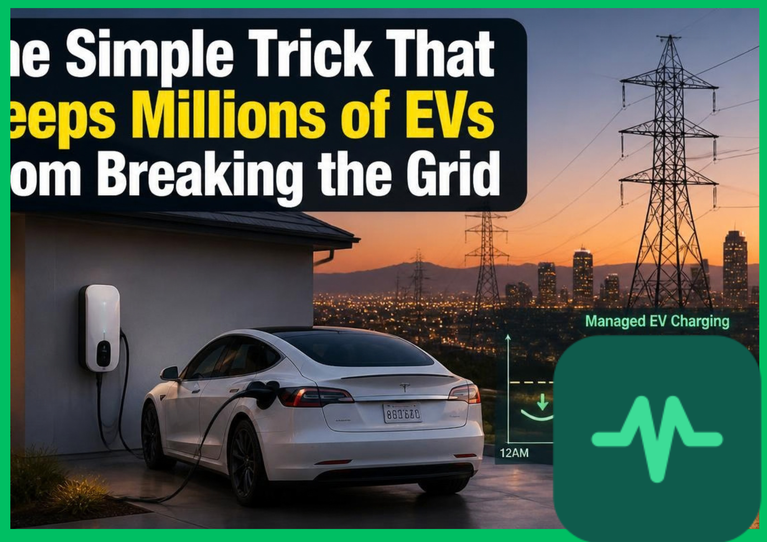
Most people charge their electric car when it's most convenient, right after arriving home in the evening. Multiply this single habit across an entire street, an entire neighborhood, an entire city, and you get a sudden, sharp spike in electricity demand, all concentrated into the same narrow window.
Grids are built to handle predictable, steady demand reasonably well. A sudden, shared spike like this creates real stress, sometimes pushing costs higher or even straining local equipment beyond what it's comfortably designed to handle.
What smart charging actually does about this
Smart charging uses simple technology to spread this demand out more evenly, rather than letting everyone draw power at the exact same moment. Instead of charging immediately the second you plug in, your car can wait, then start charging later, automatically, at a smarter time.
You still wake up to a fully charged car. The system simply times things more thoughtfully in the background, without you needing to think about it at all.
Why this timing shift genuinely helps
Electricity demand naturally rises and falls throughout the day. Early evening hours, right when everyone gets home, tend to be some of the busiest, most demanding hours for the whole grid.
Smart charging can shift your car's charging toward quieter overnight hours instead, when overall demand is naturally lower. This spreads the load more evenly across the full day, rather than piling it all into one narrow, stressful window.
Why this matters for keeping electricity costs reasonable
Uncoordinated charging, with everyone plugging in at once, can raise costs and even slow down how quickly new charging stations get properly connected to the grid in growing neighborhoods.
Smart charging helps avoid this kind of unnecessary strain, which can translate into more stable, reasonable electricity costs for everyone on the grid, not just electric car owners specifically.
How this actually works from your side
Most smart charging setups connect through an app or a built-in feature in your car or charger. You simply tell the system when you actually need the car ready, say, seven in the morning, and it handles the rest.
The system decides the smartest time to actually draw power, working backward from your deadline, rather than starting the moment you plug in regardless of what else is happening on the grid at that exact time.
Why this benefits you directly, not just the grid
In many places, electricity costs less during off-peak hours, like late at night. Smart charging that shifts your charging into these cheaper hours can genuinely lower your own electricity costs, not just help the broader grid run more smoothly.
This creates a rare situation where doing the more considerate thing for the shared grid also happens to save you money directly, a genuinely nice alignment of individual and collective benefit.
Why this becomes more important as more people go electric
A single electric car charging at a random time barely matters to a large grid. Millions of electric cars all charging in an uncoordinated way at the same popular evening hours becomes a genuinely significant, collective problem.
As electric vehicle numbers continue growing rapidly worldwide, smart charging shifts from being a nice, optional feature into something increasingly important for keeping the whole system running smoothly and affordably for everyone.
The honest limitation worth understanding
Smart charging works best when you have some flexibility in when you actually need your car ready. If you genuinely need a full charge immediately, smart charging naturally has less room to shift things around helpfully.
For most everyday situations, though, plugging in overnight and needing the car ready by morning, this flexibility exists naturally, making smart charging a genuinely easy, low-effort choice for the vast majority of typical charging situations.
Why utility companies increasingly encourage this approach
Electricity providers genuinely benefit when demand spreads more evenly throughout the day, since this reduces strain on their infrastructure and can delay or reduce the need for expensive upgrades purely to handle brief, concentrated demand spikes.
This is part of why many electricity providers now actively offer incentives specifically encouraging smart, off-peak charging, recognizing the genuine, shared benefit this simple shift provides.
What to check if you're setting up your own charging routine
If you have an electric car, check whether your specific charger or vehicle offers built-in smart charging features, or scheduling options within its companion app. Many modern setups include this capability already, simply waiting for you to turn it on.
Setting your desired ready time, rather than always charging immediately, is often as simple as adjusting one setting, yet it genuinely contributes to a meaningfully smoother, more efficient shared electricity system.
The bottom line
Smart charging solves a genuinely real, growing problem, the strain created when many electric car owners naturally charge at the exact same convenient time each evening. By shifting charging toward quieter, off-peak hours automatically, it keeps your car ready when you need it while easing pressure on the shared grid.
This simple, largely invisible technology matters more every year, as electric vehicle numbers keep growing worldwide, quietly keeping a genuinely large, shared system running smoothly without requiring any real effort from you at all.
Comments (0)
Login to leave a comment.
No comments yet. Be the first to share your thoughts!