You unplug and drive away.
That convenience feels simple, almost mundane.
Behind that short stop, however, lies an astonishing feat of electrical engineering and physical science.
Moving massive amounts of electrical energy into a compact battery pack in a matter of minutes pushes the laws of physics to their absolute limits.
For years, critics claimed that electric cars took too long to recharge, turning long-distance travel into an exercise in patience.
Technology changed that reality completely.
According to global transport outlooks from the International Energy Agency (IEA), efficiency frameworks from ENERGY STAR, and academic electrical engineering research, high-power direct current (DC) fast charging is redefining modern mobility.
Here is how high-power charging works, why intense electrical currents create immense heat, and how advanced thermal management makes ultra-fast replenishment possible.
The Bottleneck of Conventional Charging
To understand why high-power DC fast charging is an engineering breakthrough, you have to look at how everyday household charging works.
When you plug an electric car into a standard home wall outlet or a slow public charger, electricity flows as alternating current (AC).
Your car features an onboard charger that converts that incoming AC power into direct current (DC) before it can enter the lithium-ion battery pack.
That conversion process takes time. Standard home chargers deliver roughly 7 to 11 kilowatts of power, meaning a full battery recharge takes several hours.
That speed works wonderfully for overnight home charging, but it fails during long highway road trips where drivers expect quick pit stops.
To slash charging times down to minutes, engineers had to bypass the car's small onboard charger entirely.
They built massive off-board DC fast-charging stations that pump high-voltage electricity straight into the vehicle battery.
Pushing High-Voltage Current Into Chemistry
High-power DC fast chargers operate on a completely different scale.
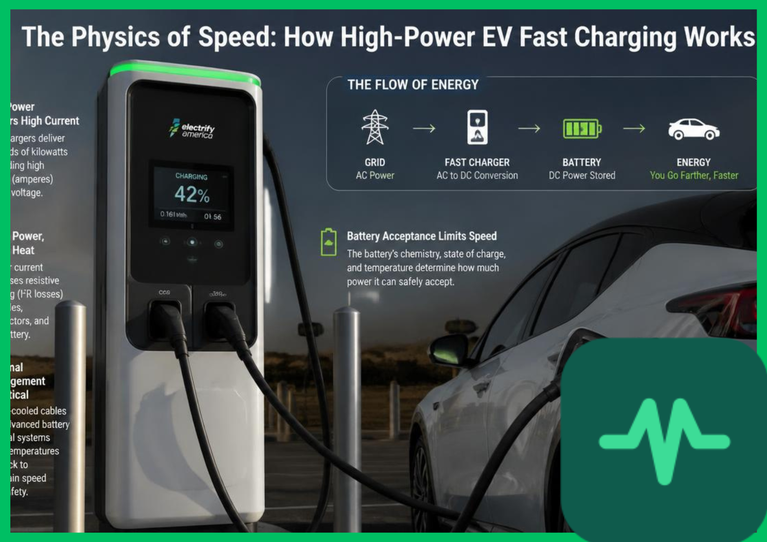
Instead of delivering a trickle of electricity, these heavy-duty charging stations supply voltages ranging from 400 volts to over 1,000 volts DC, pushing hundreds of amperes of current directly into the vehicle.
To grasp the physics, think of electrical current like water flowing through a pipe.
If you want to fill a massive swimming pool instantly, a garden hose will not work; you need a massive industrial fire hose.
Similarly, cramming energy into a high-capacity automotive battery requires massive electrical flow.
When you plug into a DC fast charger, the station's massive power electronics communicate directly with the vehicle's battery management system.
They negotiate the maximum electrical intake the chemistry can safely handle at that exact moment.
The energy surges across thick copper cables, bypassing the onboard converter and forcing lithium ions to shuttle rapidly from the cathode to the anode inside the battery cells.
The Heat Barrier and Liquid Cooling Physics
Pushing thousands of amperes of electrical current through a cable generates a brutal byproduct: heat.
Electrical resistance creates thermal energy. If you push high-power current through ordinary wires, the cables grow scorching hot, risking physical damage, insulation failure, or automatic safety shutdowns.
This is where thermal management becomes mission-critical.
Early fast chargers relied entirely on passive air cooling, which restricted their power output to prevent overheating.
Modern ultra-fast charging stations and next-generation Megawatt Charging Systems (MCS) solve this physical limit through active liquid cooling.
Inside the thick, flexible charging cable, specialized micro-channels circulate a continuous stream of dielectric coolant right alongside the electrical conductors.
This liquid absorbs the intense heat generated during rapid energy transfer, pumping it away to an external radiator.
Without liquid-cooled cables and sophisticated thermal management inside both the charging station and the vehicle battery pack, ultra-fast charging at scales exceeding 300 to 400 kilowatts—or megawatt-level charging for heavy transport—would be physically impossible.
Protecting Battery Health at High Speeds
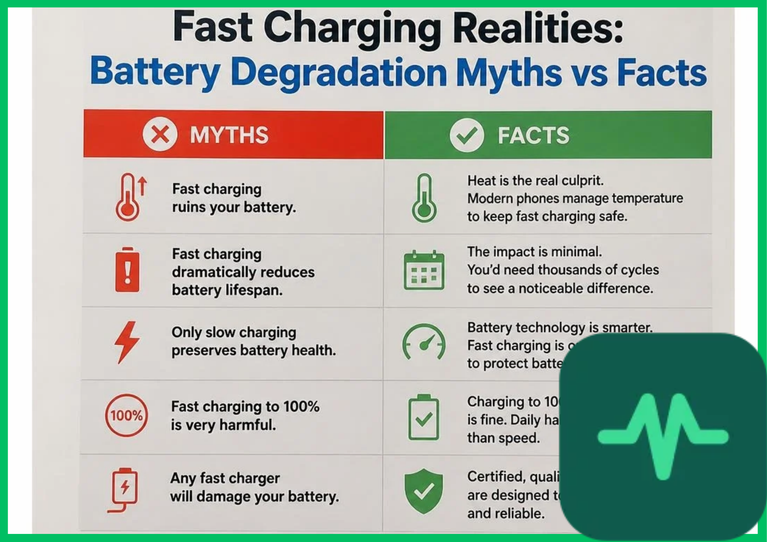
A common concern is whether fast charging ruins a vehicle's battery pack over time.
Academic battery research shows that while pumping high energy into cells creates chemical stress, modern battery management software protects longevity.
A battery does not accept maximum power at a flat rate from zero to 100 percent.
When the battery is nearly empty and cool, it absorbs energy rapidly.
As the state of charge climbs toward 80 percent, the battery management system commands the charging station to taper the electrical current downward.
This smart deceleration prevents internal lithium plating and overheating, preserving long-term battery health while still delivering a rapid 15-to-30-minute top-up for the road.
Powering the Future of Long-Distance Travel
High-power EV fast charging proves that engineering can overcome seemingly rigid physical limitations.
By combining high-voltage DC architecture, intelligent power electronics, and advanced liquid-cooled cables, we turn long-distance electric driving into an effortless experience.
We no longer have to wait hours to refuel our journeys.
Through smart charging science, clean transport becomes faster, more convenient, and fully equipped to power the global transition toward a sustainable future.
Comments (0)
Login to leave a comment.
No comments yet. Be the first to share your thoughts!