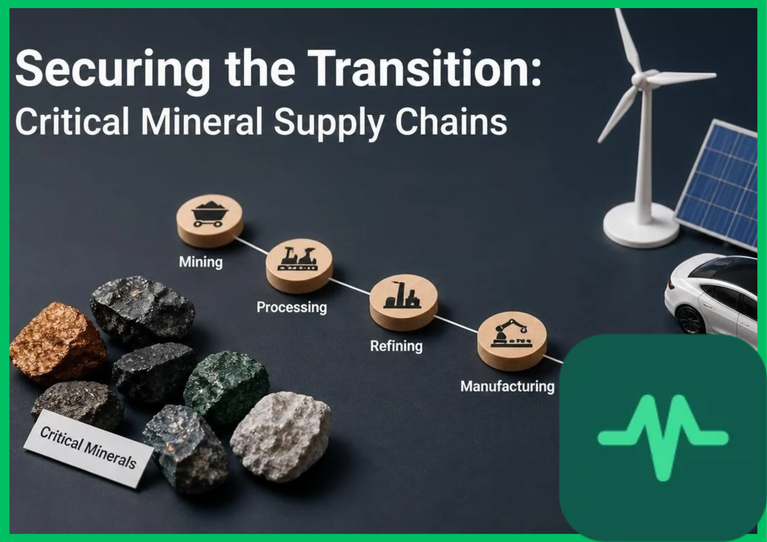
Mineral Intensity and Comparative Resource Demands
Clean energy technologies possess fundamentally higher mineral intensities per unit of capacity than their fossil-fuel counterparts. Constructing a conventional internal combustion engine vehicle requires minimal specialized metal refining outside of baseline structural steel, aluminum, and catalytic platinum group metals. In contrast, manufacturing a single long-range battery electric vehicle (BEV) requires approximately  (
 ) of refined minerals, including lithium, cobalt, nickel, manganese, and graphite.
Utility-scale renewable energy generation exhibits a similar structural shift toward mineral dependency:
- Onshore Wind Turbines: Require substantial quantities of copper for electrical windings, rare earth elements (such as neodymium and dysprosium) for permanent magnet synchronous generators, zinc for corrosion-resistant galvanizing, and structural fiberglass composites.
- Solar Photovoltaic Systems: Consume high-purity solar-grade silicon, silver pastes for front-side metallization contacts, copper wiring harnesses, and minor tellurium or indium inputs for thin-film modules.
- Grid-Scale Energy Storage Systems: Rely heavily on lithium iron phosphate (
 ) or high-nickel cathode chemistries, alongside vanadium for redox flow batteries or zinc-bromine electrolytes.
According to IEA data projections, achieving global net-zero emissions targets increases total lithium demand by over 40 times, cobalt and nickel demand by 20 to 30 times, and copper demand by a factor of 2.5 relative to historical industrial baseline outputs.
Extraction Methodologies and Processing Refining Bottlenecks
Extracting critical minerals from raw ore deposits involves complex hydrometallurgical and pyrometallurgical processing pathways. Each mineral presents distinct chemical engineering challenges and environmental footprints.
Lithium production relies primarily on two extraction methods: hard-rock spodumene ore mining followed by high-temperature calcination and acid roasting, or direct extraction from subsurface brine reservoirs via solar evaporation ponds and direct lithium extraction (DLE) ion-exchange columns. Hard-rock processing yields high-purity lithium hydroxide ( ) or lithium carbonate (
 ) but demands substantial thermal energy inputs and produces large volumes of solid tailings.
Refining nickel and cobalt requires high-pressure acid leaching (HPAL) autoclaves operating at temperatures between  and
 (
 to
 ) and pressures up to
 (
 ). While HPAL extracts high-purity nickel sulfate and cobalt sulfate required for high-energy-density cathode precursors, the process generates acidic slurry waste streams that require rigorous neutralization and dry-stack tailings management to prevent ecological contamination.
Furthermore, global processing and refining capacities exhibit extreme geographic concentration. Over 60% of global lithium and cobalt refining and over 80% of rare earth permanent magnet manufacturing occur within a limited number of industrial processing centers. This high supply chain concentration exposes international clean energy technology manufacturing to severe market volatility, transport disruptions, and supply restrictions.
Geopolitical Supply Risks and Trade Exposure
The heavy geographic concentration of mineral refining creates systemic vulnerabilities for global clean energy deployment. When raw material extraction occurs in one jurisdiction, primary chemical processing in another, and final component manufacturing in a third, supply chains face acute exposure to trade tariffs, export quotas, and logistical choke points.
Industrial analysts utilize Herfindahl-Hirschman Index (HHI) metrics to quantify market concentration across critical mineral sectors. Rare earth element refining currently registers HHI values exceeding 7,000, indicating a highly monopolized industrial structure. Mitigating these systemic supply risks requires executing coordinated industrial policies focused on diversifying import partners, investing in domestic mining exploration, and establishing strategic national mineral stockpiles. Furthermore, expanding trade agreements between resource-rich nations and manufacturing economies ensures predictable material flow while maintaining strict labor and environmental standards.
Circular Economy Strategies and Closed-Loop Recycling
Scaling primary mining operations to satisfy surging global mineral demand introduces severe land-use conflicts, water stress, and greenhouse gas emissions. Transition roadmaps emphasize that circular economy principles and end-of-life recycling must substitute for a growing fraction of primary raw material extraction.
Closed-loop recycling processes recover high-purity battery-grade materials from spent electric vehicle packs and electronic waste using pyrometallurgical smelting, hydrometallurgical leaching, or direct recycling techniques:
- Pyrometallurgical Smelting: Recovers cobalt, nickel, and copper at high thermal efficiencies (
 or
 ), though lithium and aluminum partitions into slag waste streams unless secondary recovery stages are implemented.
- Hydrometallurgical Leaching: Utilizes acid solutions to dissolve cathode materials at lower temperatures, achieving recovery efficiencies exceeding 95% for lithium, cobalt, nickel, and manganese.
- Direct Recycling: Preserves the crystalline structure of active cathode materials by relithiating degraded powders mechanically and thermally, bypassing energy-intensive chemical re-synthesis phases.
Empirical studies published by academic research consortia indicate that aggressive recycling mandates and advanced hydrometallurgical recovery loops can supply 20% to 40% of total global critical mineral demand for batteries by 2040, dramatically reducing primary mining pressures.
Environmental Governance and UNEP Compliance Frameworks
Unchecked mining expansion risks violating international environmental and social governance standards. UNEP resource governance frameworks mandate strict adherence to life-cycle impact assessments, biodiversity protection zones, and community consent protocols. Industrial mining operations must eliminate toxic tailings dam failures through dry-stack filtration technologies, minimize freshwater consumption in arid basins by utilizing closed-loop desalination or brackish water extraction, and enforce zero-harm occupational safety standards.
Independent certification standards—such as the Initiative for Responsible Mining Assurance (IRMA)—audit mining operations against comprehensive environmental and social metrics. Certifying mineral provenance ensures that downstream automotive and energy storage manufacturers procure materials sourced with minimal carbon footprints and zero human rights violations.
Techno-Economic Optimization and Material Substitution
To circumvent supply shortages and price spikes in scarce mineral markets, materials scientists and chemical engineers accelerate research into alternative compositions that reduce or eliminate critical metal dependencies.
In the battery sector, the rapid commercial adoption of lithium iron phosphate ( ) chemistry eliminates expensive, supply-constrained cobalt and nickel entirely, lowering manufacturing costs and diversifying supply risks. Simultaneously, emerging sodium-ion (
 ) battery technologies substitute abundant sodium for scarce lithium, offering viable alternatives for stationary energy storage and entry-level electric mobility. In wind turbine manufacturing, ongoing engineering research focuses on iron-nitride magnets and induction generator designs that eliminate rare earth elements without compromising operational conversion efficiency.
Integrating circular recycling frameworks, diversified extraction sourcing, and material substitution guarantees that critical mineral supply chains maintain the resilience and scale required for a permanent global energy transition.


Comments (0)
Login to leave a comment.
No comments yet. Be the first to share your thoughts!