
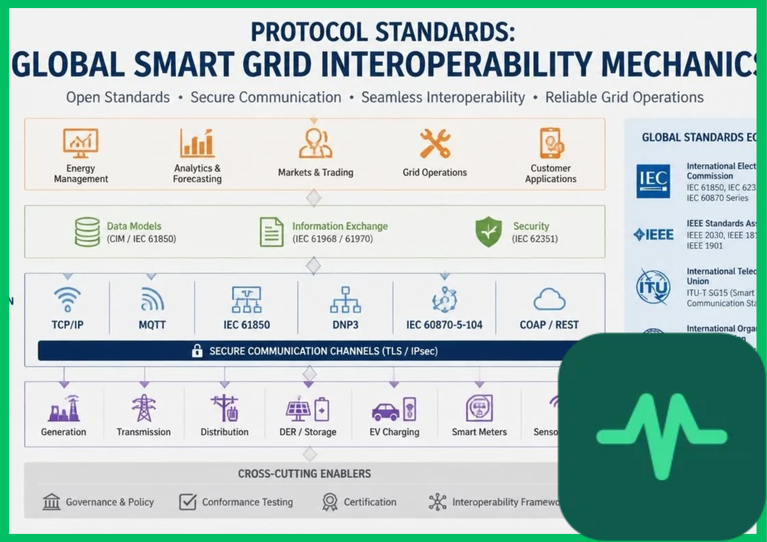
Standardized Communication Protocol Stacks and IEEE 2030.5 Architecture
The foundational technical framework governing global smart grid interoperability relies on standardized application-layer protocols defined by IEEE 2030.5 (also known as the Smart Energy Profile 2.0, or SEP 2.0). Unlike legacy utility protocols such as Modbus or DNP3 that were engineered for simple supervisory control and data acquisition (SCADA) point-to-point links, IEEE 2030.5 utilizes a RESTful (Representational State Transfer) architecture operating over standard Internet Protocol (IP) networks via HTTP/TLS and TCP/IP transport layers.
The IEEE 2030.5 protocol structures electrical grid data into object-oriented XML or JSON resource models. These models map device capabilities, pricing schedules, derate signals, and real-time telemetry into standardized Uniform Resource Identifiers (URIs). By leveraging internet-native protocol stacks, smart inverters, residential battery energy storage systems, heat pumps, and electric vehicle supply equipment (EVSE) communicate natively with utility servers over Wi-Fi, Ethernet, cellular, or Zigbee Smart Energy networks without requiring translation gateways. This uniform data representation reduces integration latency, lowers capital expenditures for utility telecommunication infrastructure, and ensures cross-vendor hardware compatibility across global manufacturing markets.
Automated Demand Response (ADR) and OpenADR 2.0b Mechanics
Managing peak electrical load volatility requires real-time automated demand response (ADR) frameworks capable of shedding or shifting residential and industrial loads within milliseconds of grid frequency fluctuations. OpenADR 2.0b serves as the predominant open-source international standard for transmitting dynamic tariff signals and curtailment commands from utility energy management systems to customer premises equipment (CPE).
The automated demand response operational cycle relies on push-and-pull messaging structures. When distribution system operators detect regional transformer thermal overloads or generation deficits, utility virtual top nodes (VTNs) broadcast XML-formatted event signals to certified virtual end nodes (VENs) integrated within smart home energy gateways or industrial building management systems (BMS).
Upon receiving an automated curtailment signal, the VEN executes pre-programmed shedding algorithms autonomously—adjusting HVAC thermostat setpoints by  to
 (
 to
 ), modulating EV charging current rates down from
 to
 , or initiating battery storage discharge into the home electrical busbar. This automated machine-to-machine execution eliminates human latency, providing responsive peak load shedding that stabilizes municipal distribution feeders.
Technical Data Specifications of Smart Grid Interoperability Standards
| Smart Grid Interoperability Parameter | Engineering & Communication Specification Standard |
|---|---|
| Primary Application-Layer Standard | IEEE 2030.5 (Smart Energy Profile 2.0) |
| Automated Demand Response Protocol | OpenADR 2.0b XML-based push/pull signaling |
| Network Transport Architecture | TCP/IP, IPv6, HTTP/TLS RESTful web services |
| Cybersecurity Encryption Standard | TLS 1.3 with AES-256 bit symmetric encryption |
| Device Polling & Event Latency |  end-to-end command execution |
| Grid Frequency Synchronization Band |  /  tolerance window |
| Interoperable Asset Class Scope | EVSE, solar inverters, heat pumps, stationary batteries |
Decentralized Microgrid Coordination and Peer-to-Peer Architecture
As distributed renewable generation expands across rural and urban distribution grids, centralized top-down grid management faces severe bandwidth and computational bottlenecks. Standardizing communication protocols enables decentralized microgrid coordination, where clusters of photovoltaic arrays, wind turbines, and battery energy storage systems operate autonomously as self-healing virtual power plants (VPPs).
Decentralized coordination utilizes multi-agent systems (MAS) and peer-to-peer (P2P) communication architectures built upon IEC 61850 substation automation standards and IEEE 2030.5 client-server links. Within a decentralized microgrid, individual smart nodes broadcast real-time state-of-charge, generation capacity, and local voltage parameters across local area networks.
When a transmission grid fault or islanding event occurs, local controllers execute distributed consensus algorithms—such as distributed droop control and economic dispatch optimization—to balance local supply and demand autonomously within 20 milliseconds. This decentralized architecture enhances grid resilience, prevents cascading regional blackout events, and maintains uninterrupted power delivery to critical infrastructure loads.
Cybersecurity Encryption Layers and Threat Mitigation
Integrating millions of internet-connected energy devices into critical national electricity infrastructure expands the cyber-attack surface, exposing utility distribution networks to malicious intrusion, data spoofing, and remote load manipulation. Consequently, global smart grid interoperability standards mandate rigorous multi-layered cybersecurity architectures.
The IEEE 2030.5 and OpenADR 2.0b specifications incorporate robust cryptographic security frameworks enforced via Transport Layer Security (TLS 1.3) protocols utilizing Advanced Encryption Standard (AES-256) symmetric ciphers and Elliptic Curve Cryptography (ECC) for digital certificate authentication. Every smart energy device—ranging from residential electric vehicle chargers to utility substation reclosers—possesses a unique X.509 digital certificate rooted in public key infrastructure (PKI).
Cryptographic verification prevents unauthorized command injection, man-in-the-middle attacks, and unauthorized telemetry data tampering. Furthermore, secure bootloaders, hardware security modules (HSMs), and role-based access control (RBAC) protocols safeguard embedded firmware against unauthorized modification, ensuring high operational integrity across global smart grid deployments.



Comments (0)
Login to leave a comment.
No comments yet. Be the first to share your thoughts!