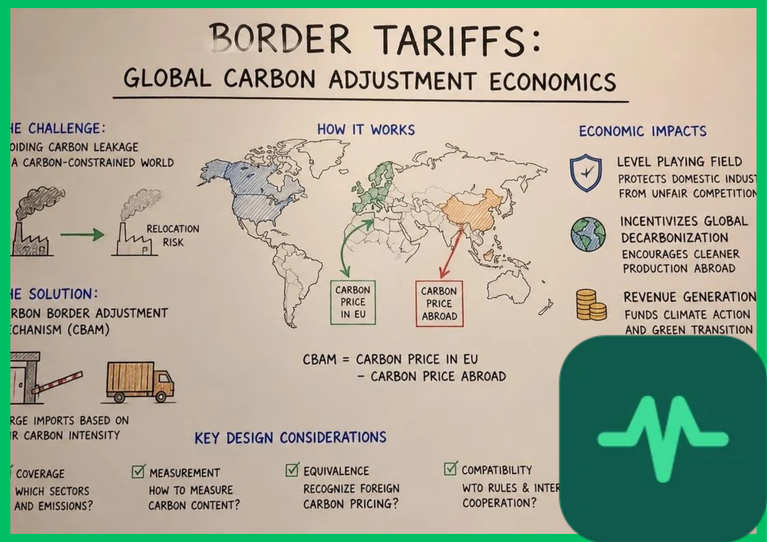
Carbon Leakage Mechanics and Industrial Competitiveness
The foundational economic driver necessitating border adjustment mechanisms is the structural imbalance between asymmetric regional carbon pricing tiers. Heavy industrial manufacturing processes require intensive thermal energy inputs and chemical reactions that generate unavoidable carbon dioxide ( ) emissions. For instance, primary aluminum smelting demands large electrical energy inputs, while virgin steel production via blast furnaces utilizes metallurgical coke as a chemical reductant, releasing roughly
 per metric ton of crude steel produced.
When domestic industrial emitters face escalating carbon allowance purchase requirements under cap-and-trade frameworks, their operational marginal costs increase relative to foreign competitors operating in unpriced jurisdictions. Economic modeling published by energy economists and environmental resource groups demonstrates that unmitigated carbon pricing triggers carbon leakage rates ranging from 15% to 40% in energy-intensive, trade-exposed (EITE) sectors. Industrial facilities downsize domestic production capacity and expand manufacturing operations abroad, exporting emissions without achieving true decarbonization. Border adjustment tariffs eliminate this economic incentive by imposing an equivalent financial charge on imported goods based on their embedded carbon content.
Embedded Emissions Accounting and Industrial Benchmarking
Calculating border adjustment financial obligations requires rigorous quantification of embedded greenhouse gas emissions associated with imported products. Embedded emissions are classified into two distinct analytical categories:
- Direct Emissions: Comprise on-site scope 1 emissions generated directly by industrial manufacturing processes, chemical reactions, and fossil fuel combustion within plant boundaries (e.g., calcination of limestone during cement clinker production or reduction of iron ore in blast furnaces).
- Indirect Emissions: Comprise scope 2 emissions generated by the off-site generation of electricity, steam, or heating consumed during the manufacturing process.
Regulators and industrial auditors utilize standardized product carbon footprint methodologies aligned with ISO 14067 and international industrial benchmarking data. Importers must declare the specific mass of embedded greenhouse gases—expressed in metric tons of  equivalent per metric ton of product (
 )—utilizing verified facility-specific data or, in the absence of primary data, conservative default emission values pegged to the worst-performing industrial installations in exporting countries.
Emissions Trading Systems Integration and Carbon Pricing Equivalence
A carbon border adjustment mechanism functions as the trade-policy counterpart to domestic emissions trading systems (ETS). Under an ETS, industrial installations surrender carbon allowances for every ton of greenhouse gas emitted. To prevent double punishment or violation of international trade rules, border adjustment tariffs are structured to apply a financial levy equal to the difference between the carbon price paid in the country of origin and the domestic carbon price established by the importing jurisdiction's internal market.
If an exporting facility operates within a foreign jurisdiction that has implemented an equivalent mandatory carbon pricing system or carbon tax, the corresponding financial burden is deducted from the border adjustment liability. This architectural design creates a powerful economic incentive for exporting nations to establish domestic carbon pricing instruments and industrial decarbonization mandates. By implementing comparable carbon pricing frameworks, trading partners retain carbon revenues domestically rather than remitting tariff payments at the border.
Technical Data Specifications of CBAM and Carbon Pricing Parameters
| Carbon Adjustment & Economic Parameter | Engineering & Regulatory Specification Standard |
|---|---|
| Core Target Industrial Sectors | Iron/steel, aluminum, cement, fertilizers, hydrogen, electricity |
| Embedded Emissions Accounting Metric | Scope 1 (direct process) and Scope 2 (indirect electrical)  |
| Global Carbon Leakage Mitigation Target | Reduction of leakage displacement down to 10% to 15% |
| Carbon Price Benchmark Index | Weekly domestic ETS allowance auction clearing settlement price |
| Default Emission Verification Standard | ISO 14067 product carbon footprint and primary facility telemetry |
| Trade Compliance Alignment Framework | World Trade Organization (WTO) non-discrimination rules |
| Exemptions / Equivalency Thresholds | Verified domestic carbon pricing mechanisms matching import jurisdiction |
Macroeconomic Trade Impacts and Global Supply Chain Restructuring
Implementing global carbon adjustment mechanisms induces profound structural shifts across international supply chains and commodity trading routes. Exporters in developing and emerging industrial economies face immediate compliance reporting obligations, requiring plant-level energy audits, continuous emissions monitoring systems (CEMS), and supply chain traceability frameworks to verify primary fuel inputs and electricity carbon intensities.
Macroeconomic simulations evaluated by international energy agencies indicate that border adjustments reorient global trade flows toward low-carbon manufacturing hubs. Heavy industries utilizing low-carbon electrolytic hydrogen, electric arc furnaces powered by renewable microgrids, and carbon capture, utilization, and storage (CCUS) gain a decisive competitive advantage in international markets. Conversely, high-carbon producers relying on subcritical coal combustion face severe tariff penalties, accelerating the retirement or technological retrofitting of inefficient industrial assets worldwide.
The Final Take
Mastering carbon border adjustment mechanism economics establishes the essential regulatory framework required to prevent industrial carbon leakage and harmonize global emissions pricing. Citing IEA reports and international economic research, pricing embedded greenhouse gas emissions equalizes competitive pressures between domestic and foreign heavy industries. By coupling internal emissions trading systems with transparent border carbon tariffs, global markets drive widespread industrial decarbonization without sacrificing economic competitiveness.



Comments (0)
Login to leave a comment.
No comments yet. Be the first to share your thoughts!