
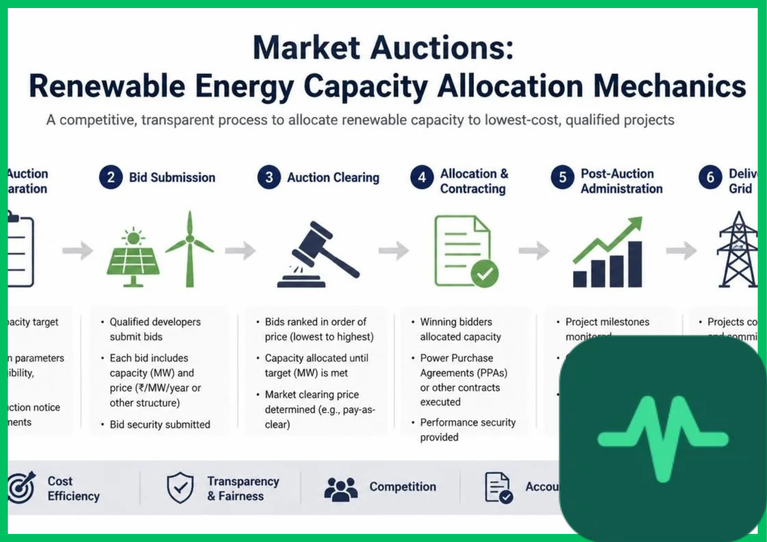
Competitive Bidding Structures and Auction Clearing Mechanics
The foundational economic mechanism driving modern renewable energy deployment is competitive bidding. Regulatory authorities and system operators issue structured procurement tenders soliciting specific gigawatt-scale capacity blocks. Developers submit sealed bids detailing strike prices ( ) and proposed commercial operation dates. Auction clearing mechanics diverge primarily between pay-as-bid formats and uniform-price auction frameworks.
In a uniform-price auction format, all winning bidders receive the marginal clearing price, which is established by the highest accepted bid required to satisfy total procurement volume targets. This format incentivizes developers to bid their true marginal cost of generation, as bidding below actual costs risks financial loss while bidding above the clearing price risks exclusion from the procurement queue. Conversely, under a pay-as-bid structure, winning developers receive their exact submitted strike price. While pay-as-bid formats reduce immediate short-term procurement costs for procuring entities, they encourage strategic bidding behaviors where developers inflate bids to hedge against regulatory and grid integration uncertainties.
Auction design efficiency also incorporates pre-qualification criteria, financial completion bonds, and penalty structures for delayed commercial operation dates. Requiring stringent site-control proof, environmental impact assessments, and grid interconnection feasibility studies filters out speculative placeholder bids, ensuring high realization rates across awarded renewable energy pipelines.
Locational Marginal Pricing (LMP) and Transmission Congestion
Integrating variable renewable energy (VRE) into transmission grids requires incorporating locational marginal pricing (LMP) into auction design and market settlement rules. Electric power grids feature physical transmission bottlenecks where high-capacity generation zones—such as remote wind corridors or desert solar regions—produce surplus electricity that exceeds local transmission line ampacity limits.
Locational marginal pricing establishes node-specific electricity prices composed of three distinct economic components: energy cost, transmission congestion cost, and transmission loss cost. The LMP at node  is formulated mathematically as:

where  represents the system-wide marginal cost of energy,
 represents the marginal cost of transmission congestion at node
 , and
 represents marginal transmission losses.
When renewable generation exceeds regional transmission capacity, local congestion drives nodal prices down—sometimes into negative pricing territory. Efficient auction design structures locational capacity auctions to account for these nodal price variations, directing capital investments toward optimal geographic nodes with unconstrained transmission headroom or incorporating transmission upgrade cost-allocation rules directly into procurement frameworks.
Technical Data Specifications of Renewable Energy Capacity Auctions
| Capacity Auction Parameter | Economic & Market Specification Standard |
|---|---|
| Primary Procurement Mechanism | Competitive sealed-bid auctions replacing feed-in tariffs |
| Auction Clearing Formats | Uniform-price vs. pay-as-bid pricing structures |
| Locational Pricing Components | Energy cost ( ), congestion (  ), and losses (  ) |
| Contract-for-Difference (CfD) Term | 15 to 20 years revenue certainty duration |
| Pre-Qualification Bond Standard | Financial completion bonds and strict site-control metrics |
| VRE Capacity Realization Rate | 85% to 95% successful project commissioning benchmark |
| Negative Pricing Settlement Rule | Bidders exposed or protected via indexed CfD collars |
Long-Term Power Purchase Agreements and Revenue Certainty
Securing project financing for multi-million-dollar utility-scale renewable energy installations requires long-term revenue visibility. Wholesale spot market electricity prices exhibit extreme volatility driven by fossil-fuel price swings, meteorological fluctuations, and sudden demand spikes. Capacity auctions mitigate this merchant risk by pairing winning auction allocations with long-term power purchase agreements (PPAs) or two-sided contract-for-difference (CfD) mechanisms spanning 15 to 20 years.
Under a two-sided contract-for-difference framework, a government agency or state-backed counterparty establishes a fixed administrative strike price. When wholesale market clearing prices fall below the strike price, the counterparty pays the renewable generator the financial difference. Conversely, when wholesale market prices exceed the strike price during high-demand or high-fuel-cost intervals, the renewable generator refunds the excess revenue back to the counterparty. This symmetrical financial stabilization mechanism shields independent power producers from merchant price volatility while protecting electricity consumers from excessive price spikes, lowering the weighted average cost of capital (WACC) for clean energy investments.
Grid Curtailment Risk Mitigation and Nodal Integration
As global renewable energy capacity growth accelerates variable renewable energy penetration, unmanaged transmission congestion induces severe grid curtailment. Curtailment forces system operators to disconnect or throttle wind turbine and solar photovoltaic generation during intervals when supply exceeds local transmission capacity, wasting clean energy output and damaging project economics.
Efficient capacity auction design mitigates curtailment risk by linking procurement volumes directly with transmission expansion roadmaps and mandatory battery energy storage system (BESS) co-location mandates. Auctions incorporate locational multipliers or explicit deliverability requirements, requiring developers to prove firm transmission interconnection rights before entering commercial operation. By aligning capacity auctions with transmission infrastructure buildouts, system operators minimize curtailment losses and maximize the net effective load-carrying capability (ELCC) of procured renewable assets.


Comments (0)
Login to leave a comment.
No comments yet. Be the first to share your thoughts!