Factories pumped greenhouse gases into the atmosphere. Power plants burned coal without accounting for the environmental damage left in their wake. The cost of pollution was externalized. This is absorbed silently by global ecosystems and future generations. Know this: that era is coming to an end.
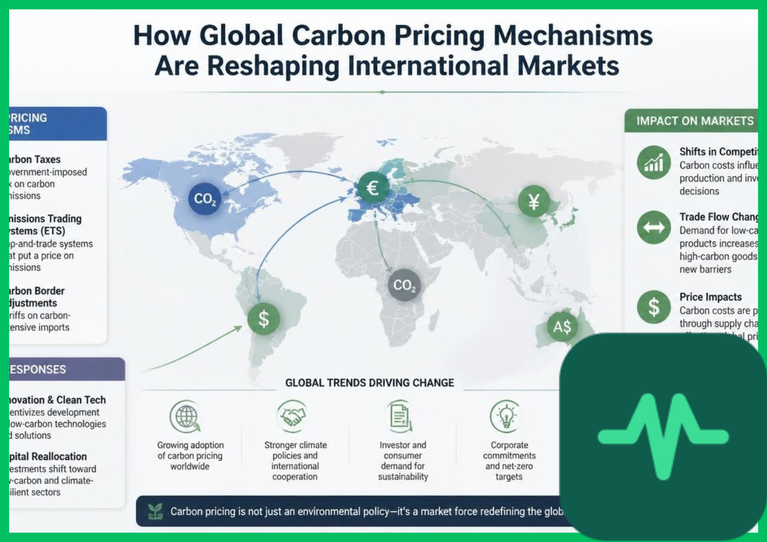
Global carbon pricing mechanisms are transforming international markets. By placing a direct financial value on greenhouse gas emissions, governments and international bodies are turning pollution into a costly business liability.
Carbon pricing has evolved from a theoretical policy debate into a powerful economic driver.
Here is how emissions trading works and how market forces are penalizing pollution.
The Core Principles of Carbon Pricing
At its heart, carbon pricing is simple: polluters must pay for every ton of carbon dioxide they emit into the atmosphere.
This approach uses market forces to drive environmental change. Instead of telling businesses exactly how to run their operations, carbon pricing lets the free market find the cheapest, most efficient ways to cut emissions.
When pollution carries a heavy financial penalty, companies have an immediate incentive to innovate. Energy efficiency becomes profitable. Clean technology adoption accelerates.
Carbon pricing generally takes two primary forms: carbon taxes and cap-and-trade systems.
Cap-and-Trade vs. Carbon Taxes
A carbon tax sets a direct price on carbon emissions. Governments charge businesses a fixed fee for every ton of greenhouse gas they release. If a factory burns fossil fuels, its tax bill rises in direct proportion to its emissions.
A cap-and-trade system takes a different route, relying on market-driven volume limits.
Under a cap-and-trade framework, a governing body sets a strict legal limit—a cap—on total industrial emissions across the economy. That cap drops lower year by year.
Companies receive or purchase specific emissions allowances. If a clean, efficient factory emits less carbon than its allowance permits, it can sell its surplus credits on an open exchange to a heavier polluter who exceeded their limit.
This creates a liquid market where emissions have a real-time financial price. Clean businesses are rewarded with extra revenue, while heavy polluters face rising operating costs.
Cross-Border Adjustments and Global Trade
As different regions implement carbon pricing at varying speeds, a new challenge emerges: carbon leakage.
If one country imposes strict carbon costs on its manufacturers, heavy industries might simply pack up and move their factories to nations with lax environmental rules. Global emissions do not drop; they just relocate.
To stop this loophole, international markets are adopting cross-border carbon pricing adjustments.
These trade policies place an import fee on goods entering from regions without equivalent carbon pricing. If an imported product comes from a high-emission manufacturing process, it faces an extra tariff at the border.
This mechanism levels the playing field, protects domestic industries that invest in clean tech, and encourages trading partners to clean up their own production lines.
The Economic Shift Toward Decarbonization
Carbon pricing mechanisms are rewriting the rules of global business. How?
Here are what is happening.
- Financial markets now factor carbon liability into every major industrial valuation.
- Investors track corporate emissions footprints closely, steering capital away from carbon-heavy dinosaurs and toward agile, low-emission innovators.
When pollution hits a company's bottom line, environmental stewardship stops being a public relations slogan. It becomes a core financial survival strategy.

Comments (0)
Login to leave a comment.
No comments yet. Be the first to share your thoughts!