Gusts of wind howl across the neighborhood.
Suddenly, the lights flicker and die.
A quiet chill rolls through your living room.
For a tense moment, you wonder how long you will sit in the dark while utility crews race to repair damaged transmission lines miles away.
Then, a soft hum rises from your garage.
Your home battery storage system kicks on automatically.
The lights pop back on, the heat hums quietly, and your refrigerator keeps running without missing a beat.
You feel an immense wave of relief.
You are not just keeping your own home safe.
Right this second, your battery is sharing a small stream of stored solar energy with your neighbors down the street, helping stabilize the entire local power grid during the storm.
For over a century, electrical grids operated on a top-down, rigid command structure.
A handful of massive, centralized fossil-fuel power plants burned coal or gas to supply electricity across entire regions.
When demand spiked, utilities fired up more dirty coal boilers.
When demand dropped, they vented excess energy into the sky.
That old energy model is wasteful, fragile, and heavily polluting.
We cannot build a clean energy future while relying on a brittle, centralized grid that breaks down under extreme weather.
What if every home with solar panels and a battery became part of a massive, flexible power plant?
What if thousands of neighborhood batteries worked together as an invisible digital network?
A quiet, brilliant energy revolution is connecting our homes across the globe.
According to global renewable energy reports from the International Energy Agency (IEA), resource protection frameworks from the United Nations Environment Programme (UNEP), efficiency benchmarks from ENERGY STAR, and academic smart grid research, virtual power plants with home battery storage are changing our electrical grid.
By linking thousands of decentralized residential batteries into an intelligent software network, we stabilize power grids and share clean energy on demand.
Here is how virtual power plants work, why aggregated solar batteries change grid economics, and how weaving the grid secures our sustainable future.
The Brittle Fragility of Centralized Power Grids
To understand why virtual power plants matter so much, you have to look at the mounting stress facing traditional electrical grids.
Climate change brings violent storms, intense heatwaves, and freezing blizzards that knock out power lines with terrifying frequency.
When millions of air conditioners or electric heaters switch on simultaneously during a heatwave, traditional grids struggle to keep up.
Historically, utility companies solved high demand by building massive new gas-fired peaker plants that sit idle most of the year, costing billions of dollars and polluting our air.
Skeptics once argued that relying on small, rooftop solar installations and household batteries was too chaotic for professional grid operators to manage.
Smart grid software engineers and electrical researchers proved those skeptics wrong.
You do not need giant central power stations if you connect thousands of small storage units with lightning-fast digital software.
Scattered energy becomes a unified powerhouse.
What Is a Virtual Power Plant?
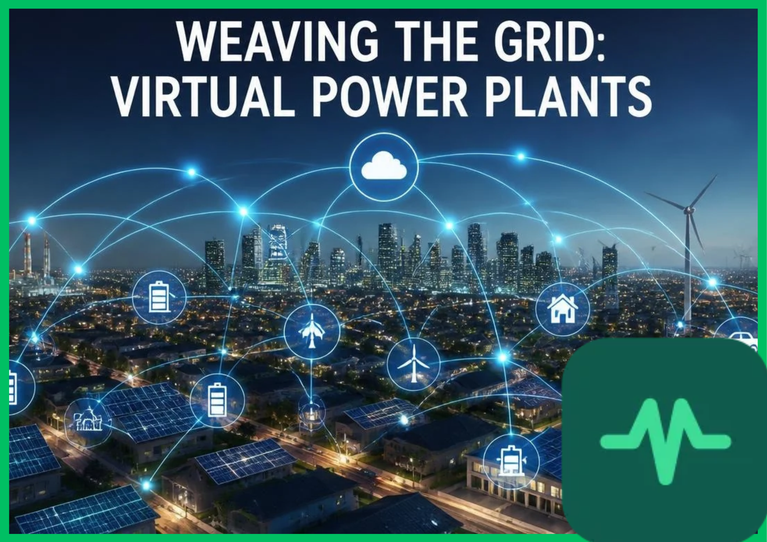
A virtual power plant is an advanced cloud-based software network that aggregates thousands of individual residential solar systems, home battery storage units, and smart appliances, coordinating them in real time to function as a single, large-scale power plant for the regional electrical grid.
Instead of physical generators housed in a smoky industrial building, a virtual power plant lives in the digital cloud.
The network operates through seamless coordination:
- Surplus Storage: When the sun shines brightly during midday, millions of rooftop solar systems generate more electricity than homes can use, storing the surplus energy safely in home batteries.
- Cloud Coordination: Intelligent software monitors regional grid demand second by second, communicating securely with participating household batteries via local Wi-Fi.
- Instant Discharge: When a sudden surge in electricity demand hits the neighborhood, the cloud software draws a tiny, harmless fraction of stored power from thousands of homes simultaneously.
- Grid Stabilization: That combined discharge injects megawatts of clean electricity right where it is needed, preventing blackouts without burning a single drop of fossil fuel.
You never notice your battery contributing.
Your home stays comfortable while supporting the entire community.
The Science of Decentralized Energy and Load Sharing
How can a scattered network of household batteries act with the precision and reliability of a professional utility power plant?
It comes down to distributed energy resources and advanced cloud algorithms.
Academic smart grid research shows that aggregating thousands of small residential batteries creates a fast-responding resource that can ramp up power delivery in milliseconds—much faster than traditional coal or gas turbines can spin up.
When regional grids experience extreme stress, virtual power plants share peak demand loads across entire cities.
Furthermore, participating homeowners earn financial incentives or credits from their utility companies for sharing their stored solar energy during critical moments.
According to ENERGY STAR and international appliance efficiency evaluations, smart home energy systems optimize battery charging cycles automatically, ensuring that household storage lasts for decades while maintaining emergency backup reserves for local storms.
Energy becomes democratic, local, and resilient.
Environmental Integrity and Community Resilience
The environmental benefits of virtual power plants extend far beyond preventing neighborhood blackouts or earning household energy credits.
They provide the ultimate safety net for high shares of variable renewable energy.
According to UNEP resource governance frameworks, decentralizing power generation reduces the need to clear pristine natural land for massive transmission corridors and giant utility-scale solar farms.
When communities generate and store their own clean power locally, transmission losses drop and regional energy independence skyrockets.
According to IEA clean energy roadmaps, scaling up virtual power plants is an essential pillar to achieve global net-zero emissions targets.
When every home with a battery helps stabilize the wider grid, our entire civilization grows stronger and cleaner.
Overcoming Regulatory and Software Integration Realties
Scaling virtual power plants from pioneering utility pilot programs into universal global infrastructure involves navigating real-world regulatory hurdles.
For decades, electrical market rules were written exclusively for massive, centralized utility monopolies, making it difficult for homeowners to sell stored solar energy back to the grid.
Forward-thinking energy regulators, software developers, and utility companies are updating market rules, establishing secure communication protocols, and creating open API standards so any household battery can plug into the virtual network.
As digital smart meters spread and software platforms mature, virtual power plants are transitioning successfully from experimental tech trials into standard utility operations worldwide.
Weaving Our Grid Toward a Sustainable Future
Virtual power plants prove that human engineering can transform scattered household batteries into a powerful, unified force for grid stability.
We no longer have to accept that keeping our lights on requires relying on fragile, centralized fossil-fuel power stations.
By connecting rooftop solar and home storage systems through intelligent cloud software, we build an invisible safety net that protects our neighborhoods during storms and powers our daily lives with clean energy.
We step away from vulnerable power monopolies, embracing a smart, decentralized, and enduring standard of energy resilience.
Through brilliant smart grid software, rigorous academic research, and a deep respect for our shared environment, weaving the grid secures a clean, reliable, and sustainable future for every community on Earth.
Comments (0)
Login to leave a comment.
No comments yet. Be the first to share your thoughts!