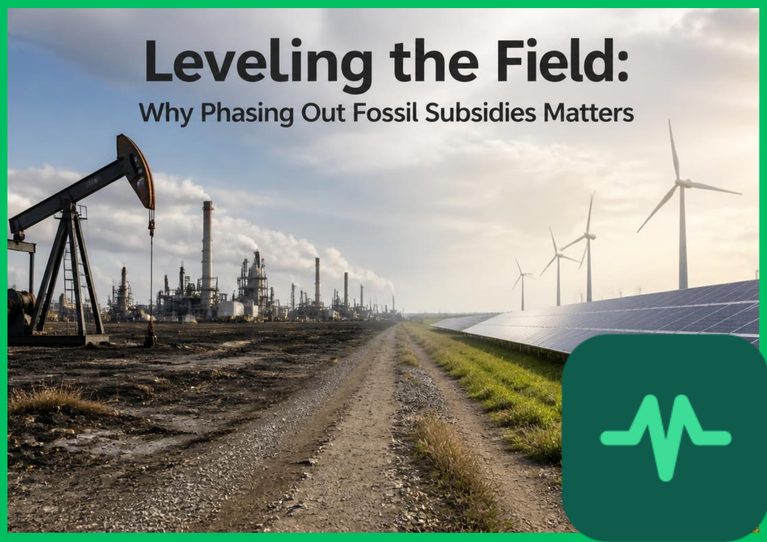
You rarely think about the invisible economic currents shaping the price of the energy that powers your life.
For generations, global energy markets operated on an uneven playing field. While clean, renewable energy sources like wind and solar fought to scale up from scratch, traditional fossil fuels received massive financial backing.
Billions of dollars in public funds poured into oil, gas, and coal industries every year, artificially lowering their cost at the pump and in power plants.
That artificial financial support distorts reality.
According to energy tracking data from the International Energy Agency (IEA), environmental governance reports from the United Nations Environment Programme (UNEP), efficiency benchmarks from ENERGY STAR, and academic economic research, those subsidies lock our global economy into a dirty past.
Phasing out inefficient fossil fuel subsidies is one of the most powerful economic steps we can take.
Here is how artificial price supports distort global markets, why they block clean energy adoption, and how leveling the field creates a sustainable future.
The Illusion of Cheap Fossil Fuels
To understand why subsidy reform matters, you have to look at how artificial price supports mask true economic and environmental costs.
When a government hands out direct financial transfers, tax breaks, or price controls to lower the cost of oil, gas, or coal, it sends a false signal to the market.
It makes polluting fossil fuels look artificially cheap compared to clean energy technologies.
Consumers look at their monthly bills and assume oil and gas are naturally inexpensive.
In reality, those low prices are an illusion subsidized by public money.
Academic economic studies and IEA market analyses reveal that global fossil fuel consumption subsidies regularly soar past hundreds of billions—and at times exceed a trillion dollars—annually.
IEA - International Energy Agency
This massive financial injection keeps dead-end infrastructure alive.
It encourages wasteful energy consumption, discourages efficiency investments, and pumps millions of metric tons of greenhouse gases into the atmosphere without accounting for the true damage to our global climate.
Blocking the Clean Energy Transition
The most damaging consequence of fossil fuel subsidies is the barrier they erect against clean technology.
When energy markets are rigged to favor oil, gas, and coal, innovative clean tech solutions face an uphill battle.
Imagine trying to race a bicycle while your competitor drives a car fueled by free gas supplied by the state.
That is the unfair race renewable energy faced for decades.
Solar farms, wind turbines, electric heat pumps, and advanced energy storage systems require upfront capital investments.
When fossil fuels receive heavy state backing, clean technologies take longer to achieve cost parity, slowing down deployment rates.
According to UNEP resource assessments and academic transition studies, maintaining fossil subsidies locks society into a high-emission trap.
We cannot transition toward a sustainable clean energy future while simultaneously paying to keep polluting industries artificially cheap.
Reallocating Public Funds for Social Good
A common concern raised against fossil fuel subsidy reform is the impact on everyday households. When fuel prices shift, ordinary people feel the financial squeeze.
However, economic research shows that broad, untargeted fossil fuel subsidies are remarkably inefficient at helping vulnerable populations.
IEA
The lion's share of broad fuel subsidies benefits wealthier segments of society who consume more energy, drive larger vehicles, and own larger homes.
IEA
Smart subsidy reform does not mean abandoning people in need. It means shifting support from fuels to families.
By phasing out inefficient fossil subsidies, governments free up massive fiscal space.
Those public funds can be reallocated directly into targeted social safety nets, household energy efficiency upgrades, public transit networks, and direct financial grants for low-income communities.
Instead of subsidizing a barrel of oil that gets burned and lost forever, governments can invest in home insulation and solar panels that lower utility bills permanently.
Leveling the Playing Field for Clean Innovation
Leveling the playing field unleashes the true power of market innovation.
When fossil fuel subsidies disappear, energy prices reflect their actual production and environmental realities.
Clean technologies—which have no fuel costs and zero tailpipe emissions—suddenly compete on fair, transparent terms.
Investors redirect capital away from declining fossil extraction and into scalable clean infrastructure, modernizing electrical grids, and closed-loop manufacturing.
Efficiency becomes an economic priority for industries and households alike, driving down total energy demand without sacrificing human comfort.
Building a Transparent, Sustainable Economy
Phasing out fossil fuel subsidies requires political courage, clear communication, and careful, targeted support for vulnerable groups.
It is an essential step toward a resilient global economy.
We must stop paying to pollute our own atmosphere.
By removing artificial props from outdated industries and leveling the playing field, we allow clean energy to thrive on its own merits.
Through honest pricing, smart fiscal policy, and sustainable innovation, we build a clean, equitable world that honors both our economies and our shared planet.


Comments (0)
Login to leave a comment.
No comments yet. Be the first to share your thoughts!