You shiver as your bare feet hit the cold floor.
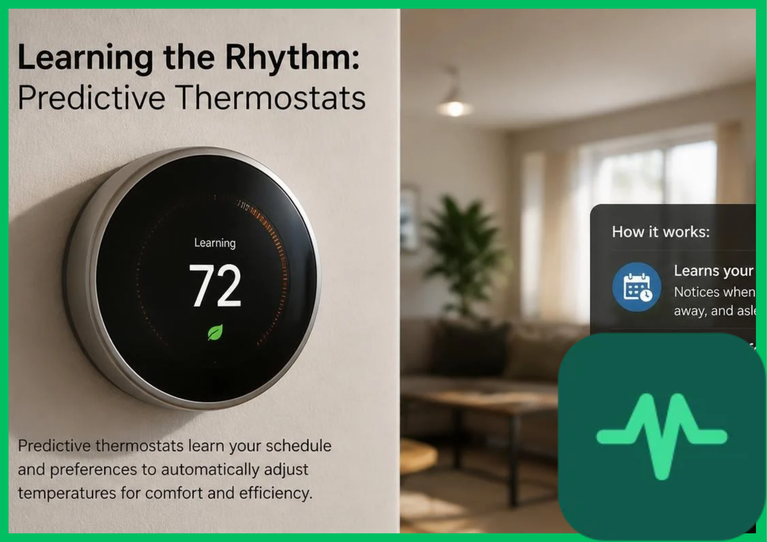
You look over at the wall thermostat.
It sits there like a silent, blank-faced plastic box.
It has no idea you are awake. It has no idea you are cold.
It only clicks on to blast the furnace when the room temperature finally drops past a rigid, programmed threshold.
By the time the radiators hiss to life and warm the air, you are already dressed, shivering, and heading out the front door.
You spent energy heating an empty room, and you were uncomfortable when you needed warmth the most.
For generations, controlling home climate meant wrestling with clumsy dials and confusing instruction manuals.
We programmed schedules that never matched our chaotic daily lives.
When your plans changed and you stayed out late, your heater kept running in an empty house for hours, burning gas and electricity for nobody at all.
That waste hurt our monthly budgets.
It also pumped massive amounts of unnecessary carbon pollution into our shared atmosphere.
We cannot build a clean energy future while heating and cooling empty homes by accident.
What if your thermostat could learn your habits like a roommate who knows your daily routine?
What if automated climate control adjusted temperatures before you even realized you needed them?
A quiet, brilliant digital revolution is transforming our walls.
According to global energy reports from the International Energy Agency (IEA), resource protection frameworks from the United Nations Environment Programme (UNEP), efficiency benchmarks from ENERGY STAR, and academic building automation research, smart thermostat learning algorithms are changing our domestic lives.
By using machine learning to predict your schedule and optimize heating cycles in real time, we eliminate household energy waste without lifting a finger.
Here is how predictive thermostats work, why automated climate control efficiency changes home economics, and how learning the rhythm secures our sustainable future.
The Clumsy Schedules of Traditional Thermostats
To understand why smart thermostat learning algorithms matter so much, you have to look at how old-school programmable thermostats failed us.
Decades ago, engineers introduced programmable timers to help homeowners save energy.
The theory sounded reasonable.
You set a schedule for when you wake up, leave for work, return home, and go to sleep.
In practice, those schedules were a disaster.
Programming a tiny digital interface with flashing buttons was so frustrating that most people gave up, leaving their heating running at full blast twenty-four hours a day.
When life interrupted the rigid schedule—a snow day, a sudden trip, or a late meeting at the office—the thermostat kept right on heating an empty house.
Skeptics once argued that automated climate gadgets were complicated toys that offered little real-world value.
Software engineers and building scientists proved the skeptics wrong.
You do not need to program a schedule if your device learns your rhythm on its own.
Smart technology adapts to you, rather than forcing you to adapt to a machine.
What Is a Smart Thermostat Learning Algorithm?
A smart thermostat learning algorithm is an intelligent software routine embedded in connected wall thermostats that uses occupancy sensors, location tracking, and historical usage patterns to build a dynamic predictive schedule for home heating and cooling.
Instead of asking you to program a rigid timeline, the device watches quietly as you move through your week.
It notices when you wake up on Monday mornings.
It registers when your footsteps quiet down at night.
It connects to your phone via local Wi-Fi to sense when your household leaves the property, automatically dialing back the heating or air conditioning to save energy.
When you start heading back home, the thermostat checks outdoor weather conditions, calculates how long your specific heating system takes to warm the rooms, and turns the furnace on just in time to greet you with perfect comfort at the front door.
You never touch a button.
The software learns your lifestyle and orchestrates your home climate in the background.
The Science of Predictive Scheduling and Energy Savings
How does a software algorithm running on a wall-mounted screen reduce household electricity and gas consumption so dramatically?
It comes down to predictive thermal modeling and behavioral energy optimization.
Academic building automation research shows that most homes waste up to 15% to 20% of their annual heating and cooling energy simply by conditioning empty rooms during unoccupied hours.
Predictive thermostat scheduling eliminates that waste instantly by anticipating transitions before they happen.
Instead of waiting for you to feel cold and cranking the heater to maximum power—which forces your furnace to burn fuel inefficiently—a smart thermostat applies gentle, gradual heating curves.
According to ENERGY STAR and international appliance efficiency evaluations, homes equipped with learning thermostats reduce annual heating and cooling energy use by over 10% to 12%.
Over the lifetime of the device, those savings pay for the hardware many times over while keeping tons of carbon emissions out of the air.
Environmental Integrity and Global Climate Action
The environmental benefits of predictive thermostats extend far beyond lowering family utility bills or making hallways feel comfortable on winter mornings.
They form an essential puzzle piece for global grid decarbonization.
According to UNEP resource governance frameworks, optimizing residential energy use is one of the fastest, most affordable ways to reduce peak electrical demand without building new power plants.
When millions of homes coordinate their heating and cooling cycles through smart algorithms, regional power grids experience a smooth, flattened demand curve.
That stability allows utility companies to avoid firing up dirty, fossil-fueled peaker plants during extreme weather events.
According to IEA clean energy roadmaps, scaling up smart residential automation is a crucial step to integrate variable renewable energy sources into our everyday infrastructure.
When every home runs with digital intelligence, our entire society grows more resilient.
Overcoming Setup and Digital Realties
Upgrading an older home with a smart learning thermostat involves navigating real-world electrical hurdles.
Many traditional homes feature old two-wire thermostat setups that lack the continuous power wire required by glowing digital screens and Wi-Fi radios.
Homeowners and electricians solve these challenges by installing C-wires or using power extender kits included with modern devices, bridging the gap between vintage wiring and modern software.
As digital standards harmonize across global manufacturers and installation guides become simpler, learning thermostats are transitioning from specialty gadget store items into standard residential hardware across the world.
Learning Our Rhythm Toward a Sustainable Future
Smart thermostat learning algorithms prove that digital innovation can bring quiet harmony to our daily lives and our planetary climate.
We no longer have to accept that keeping our homes comfortable requires wasting energy or wrestling with confusing programming buttons.
By connecting occupancy sensors, weather feeds, and predictive software, our walls learn our habits and care for our comfort automatically.
We step away from energy waste, embracing a smart, intuitive, and enduring standard of domestic living.
Through brilliant software engineering, rigorous academic research, and a deep respect for our shared environment, learning the rhythm secures a clean, comfortable, and sustainable future for every household on Earth.



Comments (0)
Login to leave a comment.
No comments yet. Be the first to share your thoughts!