Every single model promises superior performance, sleek design, and modern convenience.
Yet, when you look at the price tags and feature lists, a critical question arises: how do you actually know which appliance will save you money over its lifetime?
Manufacturers make bold claims about power savings. Marketing brochures use confusing jargon and complicated numbers.
For decades, navigating that marketplace felt like guessing in the dark.
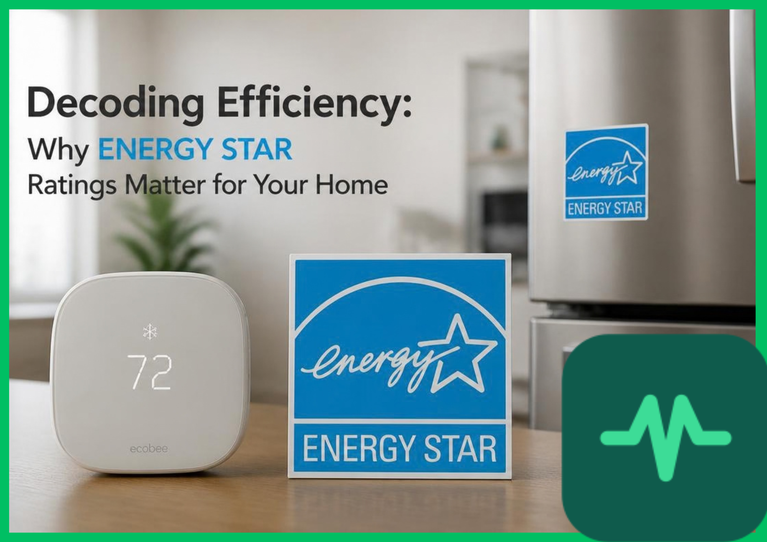
That confusion is cleared by a simple, universally recognized blue label.
According to tracking data from international energy reports, academic consumer research, and efficiency standards like ENERGY STAR, certified high-efficiency ratings remove the guesswork from appliance shopping.
Here is why ENERGY STAR ratings matter, how they work, and why they form the baseline for smart household energy management.
The True Cost of Running an Appliance
To understand why efficiency ratings matter, you have to look past the initial purchase price of any household machine.
Every appliance you bring home carries two distinct costs.
The first cost is what you pay at the register. The second—and often overlooked—cost is what you pay to run that machine every single day over its ten-to-fifteen-year operating lifespan.
A cheap refrigerator or clothes dryer might look attractive on a store receipt. If that same appliance consumes twice as much electricity as an efficient model, it drains your wallet month after month.
Over time, the cumulative electricity costs far outweigh any initial savings at the checkout counter.
Furthermore, producing unnecessary electricity drives up demand on regional power grids, increasing fossil fuel consumption and carbon emissions.
We needed a transparent, independent standard to measure true operational efficiency.
What Is the ENERGY STAR Standard?
The ENERGY STAR program provides that transparent standard.
Created as a government-backed symbol for energy efficiency, the program sets strict, science-based criteria that appliances must meet to earn certification.
Products cannot simply claim to be efficient. They must prove it through rigorous laboratory testing.
Independent engineering evaluations test each appliance across simulated real-world conditions, measuring water consumption, standby power draw, and active electricity use.
Only models that rank in the top tier of energy performance earn the right to display the blue label.
Whether you are buying a heat pump water heater, a modern clothes washer, or a quiet dishwasher, the label guarantees that the machine delivers peak performance while minimizing power waste.
How Efficiency Ratings Translate to Real Savings
The numbers behind certified high-efficiency appliances tell a compelling financial and environmental story.
According to energy efficiency research and global utility data, replacing older, standard-efficiency appliances with certified models reduces household energy use for those specific devices by 20% to 50%.
For example, a modern certified refrigerator uses less electricity annually than a traditional 60-watt light bulb left burning continuously.
Certified clothes washers use high-pressure spray jets and precise drum movements to clean clothes thoroughly while using up to 40% less water and 25% less electricity per load.
When you scale those savings across millions of households worldwide, the cumulative impact reduces millions of metric tons of greenhouse gas emissions every year.
Efficiency is not a sacrifice; it is smart engineering that saves money while protecting natural resources.
Beyond Appliances: A Holistic View of Home Energy
ENERGY STAR ratings extend far beyond kitchen and laundry appliances.
The standard covers entire building systems, including windows, doors, roofing materials, commercial HVAC equipment, and residential lighting.
When homeowners choose certified building materials and appliances, they construct a cohesive ecosystem of efficiency.
Academic research on residential energy use confirms that homes built or upgraded with certified components maintain superior indoor thermal comfort while consuming a fraction of the energy required by legacy buildings.
You no longer have to guess which products deliver on their promises.
Making Smarter Choices for a Sustainable Future
Purchasing decisions shape the future of our global energy economy.
When you look for certified efficiency labels, you vote with your wallet for cleaner manufacturing and lower energy consumption.
You protect your household budget from unpredictable utility price spikes, reduce your environmental footprint, and invest in durable, high-performance technology.
Decoding efficiency is simple. By letting trusted ratings guide your choices, you transform everyday household routines into powerful steps toward a sustainable future.

Comments (0)
Login to leave a comment.
No comments yet. Be the first to share your thoughts!