The air feels heavy, stale, and stuffy.
Condensation beads up like morning dew along the cold glass of your window pane.
You realize the house has been sealed tight all night to keep the warmth inside.
You feel a quiet pang of worry in your chest.
You want your home to stay cozy and warm.
Yet you know that breathing trapped indoor air filled with moisture, cooking odors, and invisible pollutants is bad for your family's health.
For generations, keeping a house healthy meant opening windows to let fresh air rush inside.
The moment you cracked that window open, a freezing gust of winter wind swept through the room.
All your expensive heat rushed straight out into the cold night.
Your heating system kicked on immediately, burning extra gas or electricity to replace the warmth you just lost.
We faced a frustrating trade-off.
You could either seal your home tightly to save energy and breathe stale air, or throw your windows open for fresh air and watch your utility bills skyrocket.
We cannot build a healthy, energy-efficient future by forcing families to choose between clean air and warm rooms.
What if your house could swap out stale indoor air for fresh outdoor air without losing a single degree of warmth?
What if an invisible guardian inside your walls could capture the heat from outgoing air and transfer it directly to the incoming breeze?
A quiet, brilliant technological revolution is transforming our homes.
According to global energy reports from the International Energy Agency (IEA), resource protection frameworks from the United Nations Environment Programme (UNEP), efficiency benchmarks from ENERGY STAR, and academic building physics research, whole house heat recovery ventilation systems are changing our domestic environment.
By using advanced heat exchangers to warm incoming outdoor air with outgoing stale air, we achieve pristine indoor air quality without wasting thermal energy.
Here is how heat recovery ventilation works, why residential air exchangers change home comfort economics, and how breathing deep secures our sustainable future.
The Invisible Trap of Airtight Buildings
To understand why whole house heat recovery ventilation systems matter so much, you have to look at how modern construction changed our living spaces.
For decades, builders constructed drafty houses.
Cold winter air leaked constantly through unsealed window frames, door gaps, and wooden floorboards.
That natural leakage kept indoor air surprisingly fresh, but it wasted immense amounts of heating and cooling energy.
Modern building standards changed everything.
Today, builders wrap homes in high-performance insulation, airtight membranes, and triple-pane windows to lock indoor temperatures in place.
That airtight shell saves energy, but it traps moisture, carbon dioxide, cooking fumes, and indoor chemical vapors inside.
Without active ventilation, indoor air quickly becomes unhealthy.
Skeptics once argued that sealing homes tight was a mistake.
Building scientists proved that airtight construction is essential—provided you pair it with smart, balanced ventilation.
You need a machine that breathes for your house.
What Is a Heat Recovery Ventilator?
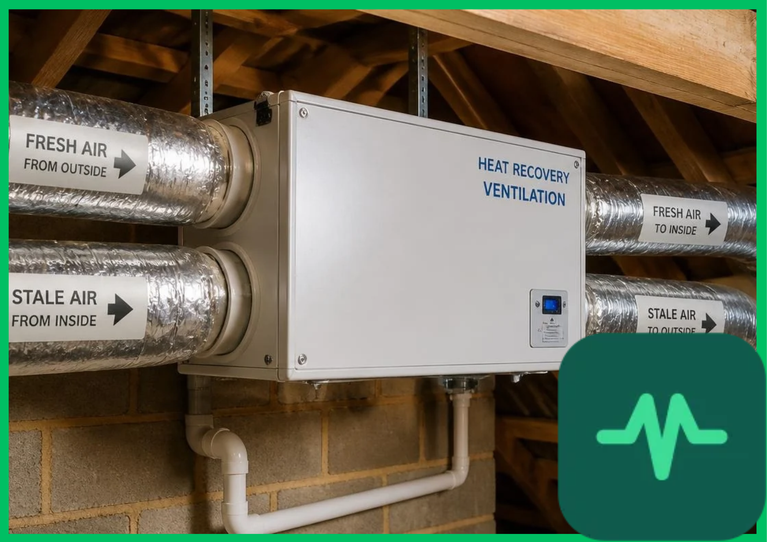
A whole house heat recovery ventilation system—often called an HRV—is a balanced mechanical air exchanger that pulls fresh outdoor air into your home while expelling stale indoor air, passing both air streams through a specialized core where thermal energy transfers from one stream to the other without letting the airs mix.
Instead of blowing raw, freezing winter wind straight into your living room, the system acts as a thermal bridge.
Two small, quiet electric fans run continuously inside a compact metal box usually installed in your basement or utility room.
One fan draws stale, humid air out of kitchens and bathrooms, pushing it through a complex honeycomb core made of plastic or aluminum plates.
At the same time, the second fan pulls fresh outdoor air through the other side of that same core.
As the two air streams pass right past each other separated by thin microscopic walls, the outgoing warm air gives its heat to the incoming cold air.
By the time the fresh outdoor air enters your living spaces, it has absorbed up to 80% to 90% of the warmth from the outgoing air.
You get a constant supply of fresh outdoor air, while your indoor temperature stays completely stable.
The Science of Thermal Efficiency and Air Exchange
How can a ventilation box recover thermal energy so efficiently without mixing stale odors with fresh incoming air?
It comes down to thermodynamic heat transfer and balanced airflow dynamics.
Academic building physics research shows that balanced ventilation systems maintain neutral air pressure inside a home.
If you pull more air out than you push in, you create a partial vacuum that sucks unconditioned outside air through cracks in your walls, ruining your thermal efficiency.
An HRV balances incoming and outgoing air volumes with absolute precision.
Furthermore, the physical separation of the air streams ensures that dust, carbon dioxide, and household odors leave the building entirely while only heat transfers across the plates.
According to ENERGY STAR and international appliance efficiency evaluations, running an HRV consumes very little electricity—typically no more than a standard lightbulb—while saving thousands of kilowatt-hours of heating energy every single year.
Lower energy waste means lower utility bills and a smaller carbon footprint.
Environmental Integrity and Indoor Health
The benefits of heat recovery ventilation extend far beyond saving energy or stopping window condensation.
They protect human health and transform indoor air quality.
According to UNEP resource governance frameworks, maintaining pristine indoor air quality is vital for public health, especially as urban populations spend over 90% of their time indoors.
When an HRV filters out pollen, particulate matter, and urban smog from incoming outdoor air while continuously flushing away indoor allergens, respiratory health improves dramatically.
According to IEA building efficiency roadmaps, scaling up advanced ventilation systems in residential housing is an essential pillar to achieve net-zero carbon building standards worldwide.
When homes breathe cleanly and efficiently, our entire society thrives.
Overcoming Installation and Maintenance Realties
Upgrading a home with a whole house heat recovery ventilation system involves navigating real-world installation considerations.
Running ventilation ductwork through finished walls or ceilings in older homes requires careful planning by HVAC professionals.
Homeowners and builders solve these challenges by planning duct runs during initial construction or utilizing compact, decentralized wall-mounted heat recovery units in retrofitted spaces.
As manufacturing techniques improve and quiet, high-efficiency core designs enter the global market, heat recovery ventilation is transitioning from a luxury green upgrade into standard residential building code across the world.
Breathing Our Way Toward a Sustainable Future
Whole house heat recovery ventilation systems prove that human engineering can solve complex environmental challenges with elegant simplicity.
We no longer have to accept that keeping our homes warm requires breathing stale indoor air or throwing our heating energy out an open window.
By using intelligent heat exchangers to warm incoming fresh air with outgoing thermal energy, we create healthy, breathable, and ultra-efficient living spaces.
We step away from energy waste, embracing a smart, balanced, and enduring standard of domestic architecture.
Through brilliant building physics, rigorous academic research, and a deep respect for our shared environment, breathing deep secures a clean, healthy, and sustainable future for every household on Earth.
Comments (0)
Login to leave a comment.
No comments yet. Be the first to share your thoughts!