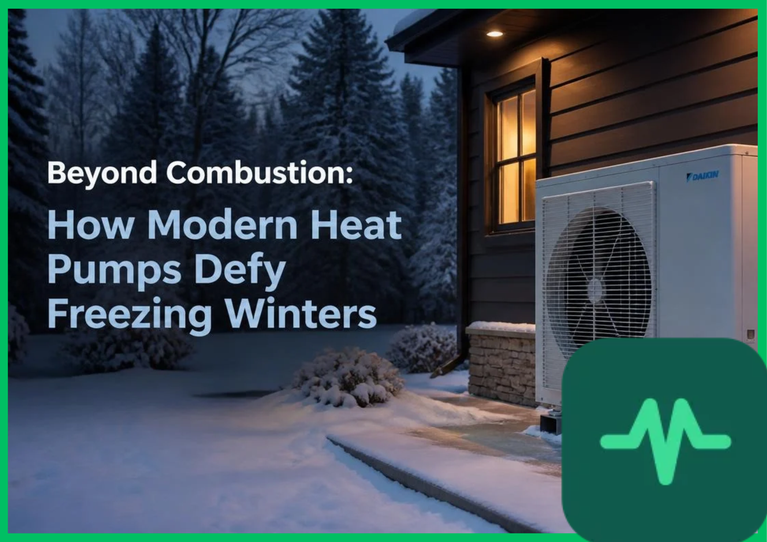
The wind howls across the dark yard. Frost clings tightly to the windowpanes.
You step inside, shedding your heavy coat, and instantly feel a wave of comfortable warmth wrap around you.
Your home is cozy and snug.
Now think about what happens behind the scenes to create that comfort.
For generations, humanity relied on combustion to stay warm through freezing weather. We burned coal in basement furnaces, piped natural gas into burners, or used heating oil to create fire.
We accepted that warming a home required burning a fossil fuel and sending thick smoke out of a chimney.
That old, combustion-based model carries a heavy environmental price. Every time a furnace burns gas or oil, it pumps carbon pollution straight into our shared atmosphere.
We need a completely different way to heat our living spaces.
A quiet thermal revolution is happening in homes and engineering laboratories across the globe.
According to global heating reports from the International Energy Agency (IEA), environmental efficiency frameworks from the United Nations Environment Programme (UNEP), appliance standards from ENERGY STAR, and thermodynamic academic research, modern heat pumps are transforming how we fight the cold.
By moving thermal energy rather than burning fuel, these systems defy freezing winters with astonishing efficiency.
Here is how heat pump efficiency ratings work, why advanced vapor-compression cycles capture warmth from freezing air, and how home heating electrification secures our sustainable future.
The Hidden Waste of Combustion Heating
To understand why heat pumps represent such a profound shift, you have to look at the basic math of a traditional combustion furnace.
When you burn natural gas or heating oil in an old furnace, you create fire inside a metal chamber.
That fire heats air or water, which is then blown through ducts or pumped through radiators to warm your rooms.
Even the best modern gas furnaces max out at roughly 90% to 98% efficiency.
That means for every unit of fuel you burn, a small percentage of energy escapes up the flue as waste heat.
More importantly, you are consuming a finite fossil fuel and creating direct greenhouse gas emissions right inside your basement.
For decades, skeptics argued that electric heating systems were inefficient in sub-zero weather. They claimed that when outdoor temperatures plummet, electrical resistance heaters consume too much power to be practical.
They were looking at the wrong technology.
Modern heat pumps do not create heat by burning fuel or wasting electricity on pure resistance. They move heat from one place to another.
The Thermodynamics of Moving Heat
How can a machine extract warmth from outdoor air when the thermometer drops below freezing?
It sounds like magic, but it is pure thermodynamics.
Even when outside air feels bitterly cold—at temperatures of -15°C or -20°C (approx. 5°F to -4°F)—thermal energy still exists in that air. Absolute zero, where all thermal motion stops, sits far lower at -273.15°C (approx. -459.67°F).
As long as the air outdoors is warmer than absolute zero, a heat pump can find and harvest heat.
The core system relies on a closed-loop refrigeration cycle filled with a specialized working fluid called a refrigerant.
This fluid has a very low boiling point.
When the liquid refrigerant flows through the outdoor evaporator coil, it absorbs ambient thermal energy from the cold outside air, turning from a liquid into a low-pressure gas.
An electric compressor then squeezes that gas tightly.
When you compress a gas, its temperature rises rapidly.
That hot, pressurized gas flows indoors into the condenser coil, releasing its captured warmth into your living space through your home's distribution system.
The refrigerant expands, cools down, and loops back outside to absorb more heat.
You put electrical energy into running the compressor and fans, but the heat pump moves three to four times more thermal energy than the electrical energy it consumes.
That efficiency multiplier changes everything.
Understanding Heat Pump Efficiency Ratings
When evaluating heating systems, engineers look closely at specific performance metrics.
Traditional heating efficiency maxes out below 100%. Modern heat pumps routinely achieve efficiencies of 300%, 400%, or higher.
Academic thermodynamic studies and ENERGY STAR testing protocols measure this performance using two primary metrics:
- Coefficient of Performance (COP): The ratio of thermal energy delivered to the electrical energy consumed. A COP of 3.5 means the system delivers 3.5 units of heat for every 1 unit of electricity used.
- Seasonal Energy Efficiency Ratio (SEER) and Heating Seasonal Performance Factor (HSPF): Metrics that track heating and cooling efficiency across an entire annual climate cycle, accounting for shifting seasonal weather.
As engineering advanced, manufacturers introduced cold-weather heat pumps equipped with variable-speed inverter compressors and enhanced vapor injection.
These modern units maintain high coefficient of performance ratings even when winter temperatures dive deep below freezing, delivering reliable indoor warmth without skipping a beat.
Home Heating Electrification and Climate Goals
Transitioning from fossil-fuel furnaces to heat pumps is one of the most impactful steps society can take to curb carbon pollution.
Buildings account for a massive share of global energy consumption and direct emissions.
When homes heat water and living spaces by burning natural gas or oil, they lock communities into carbon-heavy habits.
By pairing heat pumps with electrical grids powered by wind, solar, and hydroelectric generation, we sever the tie between winter warmth and fossil combustion.
According to IEA clean energy roadmaps, widespread home heating electrification slashes residential carbon footprints dramatically.
Furthermore, because modern heat pumps are reversible, the exact same system provides efficient air conditioning during scorching summer heatwaves, protecting families from extreme weather year-round.
UNEP environmental reports highlight that upgrading building envelopes alongside heat pump installations maximizes energy conservation, lowering utility bills while reducing strain on regional power grids.
Defying the Cold With Clean Engineering
Modern heat pumps prove that human ingenuity can replace old, polluting habits with elegant, highly efficient technology.
We no longer have to accept that surviving a freezing winter requires burning fossil fuels in a basement furnace.
By harnessing advanced vapor-compression cycles, high coefficient of performance ratings, and clever thermodynamics, heat pumps extract warmth from freezing outdoor air to keep our homes safe and comfortable.
We step away from combustion, embracing a clean and sustainable approach to indoor climate control.
Through scientific innovation and smart engineering, heat pumps defy the winter chill and light our way toward a resilient energy future.


Comments (0)
Login to leave a comment.
No comments yet. Be the first to share your thoughts!