 ) within lithium-ion cells generates substantial joule heating (
 ) during high C-rate charge and discharge cycles. If thermal energy is not extracted effectively, localized temperatures exceed optimal operational thresholds (
 to
 [
 to
 ]), accelerating capacity fade, degrading solid electrolyte interphase (SEI) layers, and triggering irreversible thermal degradation. Maintaining strict thermal equilibrium across the battery pack architecture requires advanced cooling typologies, including phase change materials, dielectric liquid immersion, and custom thermal conductive plates.
Joule Heating Mechanics and Cell Degradation Realities
The foundational thermodynamic challenge governing electric motorcycle battery packs is internal heat generation driven by electrochemical kinetics and electrical resistance. Total heat generation ( ) within a lithium-ion battery cell is formulated mathematically by Bernardi's equation:


where  represents electrical current,
 denotes open-circuit voltage,
 is operating terminal voltage,
 is absolute temperature, and
 represents the entropy change coefficient of the electrochemical reactions. The first term accounts for irreversible joule heating resulting from internal DC resistance, while the second term captures reversible entropic heat absorbed or released during intercalation and de-intercalation of lithium ions within the electrode matrix.
When electric motorcycles draw high discharge currents (exceeding  to
 ) during aggressive acceleration, irreversible joule heating dominates. Operating temperatures exceeding
 (
 ) accelerate parasitic side reactions at the anode-electrolyte interface, causing rapid electrolyte decomposition and lithium inventory loss. Conversely, operating below
 (
 ) increases internal resistance drastically, inducing lithium plating on graphite anodes. Consequently, maintaining tight cell temperature uniformity (
 [
 ] across the entire pack) is mandatory to prevent localized hot spots and premature cell aging.
Cooling System Typologies: Air, Liquid, and Phase Change Materials
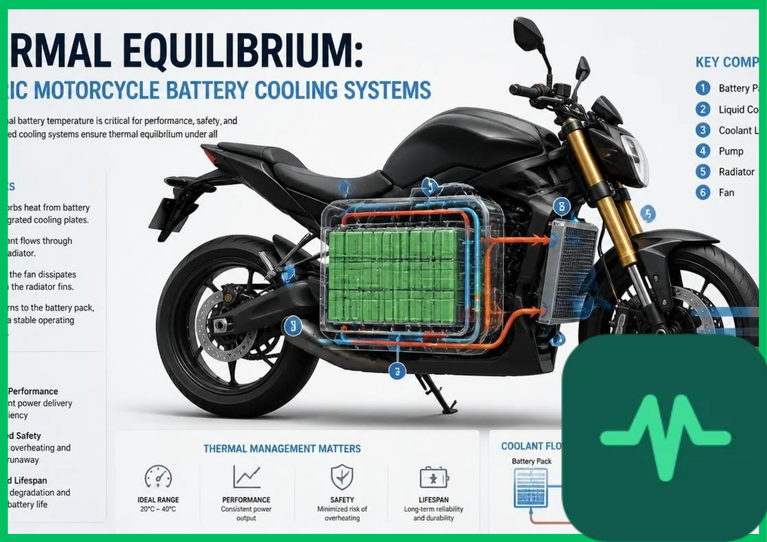
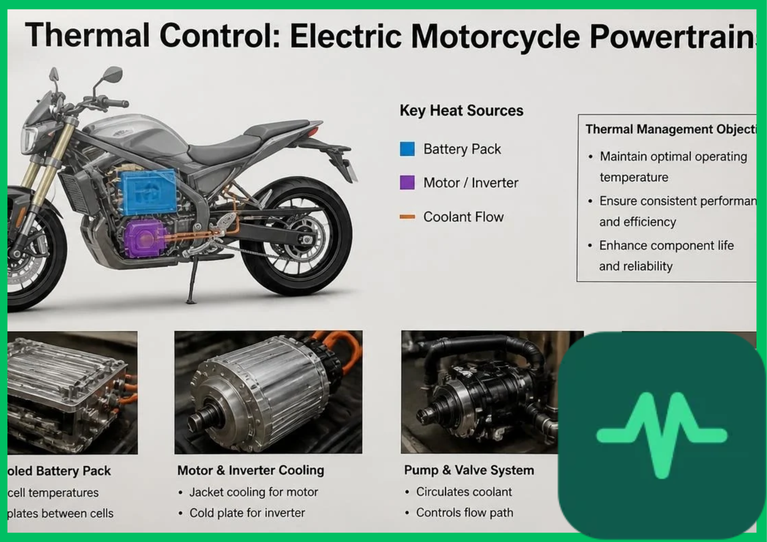
Engineering effective thermal management systems requires balancing gravimetric and volumetric weight constraints unique to electric motorcycles, where auxiliary cooling mass directly reduces vehicle operational range and agility. Manufacturers deploy three primary thermal management architectures:
- Passive Air Cooling: Utilizes ambient airflow forced through internal channels between cylindrical (18650 or 21700) or pouch cells. While lightweight and mechanically simple, air cooling exhibits low specific heat capacity (
 ) and poor convective heat transfer coefficients (
 ), making it insufficient for high-power electric motorcycles operating in hot ambient environments.
- Active Liquid Cooling: Employs thermally conductive cooling plates or serpentine channels clamped directly against cell housings, circulating a water-glycol mixture or specialized dielectric coolant. Liquid coolants provide superior volumetric heat capacity (
 ) and high convective heat transfer coefficients (
 ), enabling precise temperature regulation during fast-charging and heavy-load conditions.
- Phase Change Materials (PCMs): Incorporates paraffin waxes, organic fatty acids, or salt hydrates encased around battery cells. PCMs absorb large quantities of thermal energy as latent heat during isothermal phase transitions (solid-to-liquid), buffering temperature spikes during peak loads without requiring parasitic electrical power pumps.
Technical Data Specifications of Battery Cooling Parameters
| Battery Thermal Management Parameter | Engineering Specification Standard |
|---|---|
| Optimal Cell Operating Temperature |  to  (  to  ) |
Maximum Allowable Temperature Gradient ( ) |  (  ) across pack modules |
| Water-Glycol Coolant Specific Heat Capacity |  thermal absorption metric |
| Dielectric Fluid Breakdown Voltage |  electrical insulation threshold |
| Phase Change Material Latent Heat Capacity |  to  thermal buffer |
| Forced Liquid Convective Heat Transfer |  to  |
| Maximum Fast-Charging Thermal Load |  to  heat rejection requirement |
Dielectric Liquid Immersion and Thermal Interface Materials
Advanced high-performance electric motorcycle powertrains increasingly adopt direct dielectric liquid immersion cooling to maximize thermal transfer efficiency. In an immersion-cooled battery pack, cells are submerged fully in a non-conductive synthetic hydrocarbon or fluorocarbon fluid. Because the coolant makes direct contact with cell casing surfaces, thermal contact resistance is virtually eliminated, yielding heat transfer coefficients exceeding  . Dielectric fluids must possess high electrical breakdown strength (
 ), low dynamic viscosity, and high chemical stability to prevent short circuits and material degradation over multi-year operational lifespans.
For indirect liquid cooling architectures, thermal interface materials (TIMs)—such as silicone-based thermal pads, ceramic-filled epoxy adhesives, or gap filler putties—are inserted between prismatic or pouch cell faces and aluminum cooling plates. High-performance TIMs exhibit thermal conductivities ranging from  to
 , minimizing thermal contact resistance caused by microscopic surface asperities and air gaps between solid interfaces.
Thermal Runaway Prevention and Venting Gas Management
Beyond routine thermal regulation, battery cooling systems serve a critical safety function: mitigating and containing thermal runaway propagation. When an internal short circuit, mechanical crush, or severe overcharging event breaches a lithium-ion cell separator, exothermic reactions cascade rapidly, elevating local temperatures above  (
 ) and releasing toxic, flammable gases (including hydrogen, carbon monoxide, and short-chain hydrocarbons).
Thermal management systems incorporate aerogel insulation blankets, mica sheets, or intumescent coatings between cell groupings. These fire-resistant thermal barriers inhibit heat transfer from a failing cell to adjacent modules, preventing cascading thermal runaway across the entire pack. Furthermore, integrated pressure-relief venting plenums channel toxic off-gases safely away from the rider compartment and exhaust them through designated flame-arresting vent valves, complying with rigorous global electric vehicle safety standards.
The Final Take
Mastering electric motorcycle battery thermal management ensures the operational longevity, structural safety, and high-rate performance of electric two-wheeler energy storage systems. Citing IEA electric mobility research and automotive engineering literature, managing joule heating through liquid cooling plates, phase change materials, and dielectric immersion maintains tight temperature uniformity. By balancing rigorous thermal equilibrium with advanced runaway containment, battery cooling architectures establish an indispensable foundation for high-power electric motorcycle engineering.
Comments (0)
Login to leave a comment.
No comments yet. Be the first to share your thoughts!