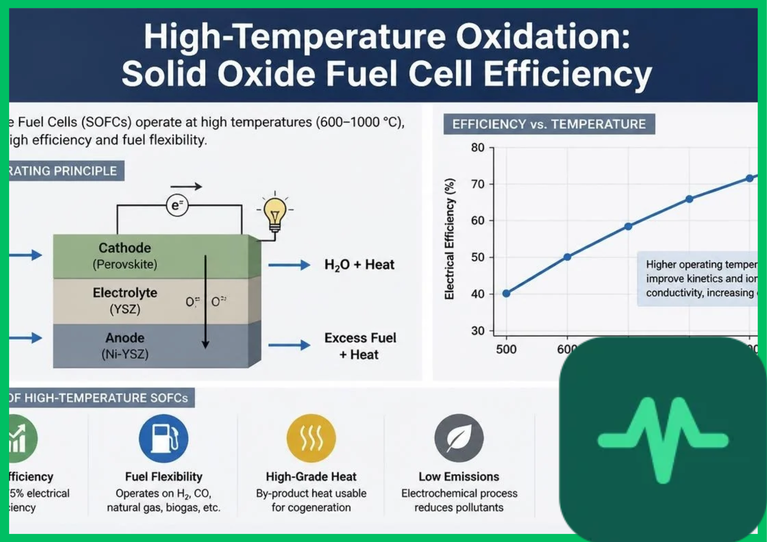
 to
 (
 to
 ). Unlike low-temperature proton exchange membrane (PEM) fuel cells that require pure hydrogen and precious metal catalysts, high-temperature solid oxide fuel cells utilize dense ceramic electrolytes—such as yttria-stabilized zirconia (YSZ)—to conduct oxygen ions (
 ) across the cell matrix. This high-temperature operational envelope eliminates noble-metal catalyst dependency, accelerates electrochemical reaction kinetics, and enables internal reforming of natural gas, biogas, or green synthetic fuels directly within the cell stack, driving electrical conversion efficiencies beyond 60% in standalone operation and exceeding 85% in integrated combined heat and power (CHP) configurations.
Ceramic Electrolyte Ion Conduction and Nernst Potential
The foundational physical principle governing solid oxide fuel cell performance is oxygen ion conduction through dense ceramic crystal lattices at elevated temperatures. The SOFC architecture consists of a porous ceramic anode (typically a nickel-yttria-stabilized zirconia cermet [Ni-YSZ]), a dense gastight electrolyte membrane (YSZ), and a porous ceramic cathode (typically lanthanum strontium manganite [LSM]).
When gaseous fuel (hydrogen or carbon monoxide) is fed across the anode compartment while ambient air flows across the cathode, oxygen molecules ( ) at the cathode triple-phase boundaries (TPBs) absorb electrons from the external circuit and dissociate into oxygen ions:
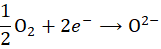
These oxygen ions migrate through vacancies in the crystal lattice of the YSZ ceramic electrolyte membrane driven by chemical and electrical potential gradients. Upon reaching the anode interface, oxygen ions oxidize hydrogen fuel, releasing electrons back into the external circuit to generate electrical power:

The theoretical open-circuit voltage ( ) generated by this electrochemical reaction is defined by the Nernst equation:
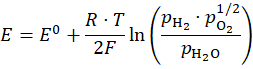
where  represents the standard reversible cell potential,
 is the universal gas constant,
 is absolute temperature,
 is the Faraday constant, and
 terms denote partial pressures of respective reactant and product gases. Operating at high temperatures (
 to
 [
 to
 ]) minimizes activation polarization losses and maximizes ionic conductivity through the YSZ electrolyte, bypassing the sluggish low-temperature kinetic barriers that afflict acidic polymer membranes.
Internal Hydrocarbon Reforming and Fuel Flexibility
A major thermodynamic advantage of solid oxide fuel cells over low-temperature fuel cell systems is intrinsic fuel flexibility and internal reforming capability. Because SOFCs operate at high thermal thresholds, endothermic steam methane reforming (SMR) and water-gas shift (WGS) reactions occur directly within the porous nickel-YSZ anode structure without requiring external catalytic reformer reactors.
When natural gas ( ) and steam (
 ) are injected into the anode, internal reforming reactions proceed simultaneously with electrochemical oxidation:


The endothermic heat absorbed by internal methane reforming offsets the exothermic electrical resistance heating ( ) generated during current transmission, stabilizing stack thermal equilibrium and eliminating the thermal gradients that induce mechanical stress and ceramic cracking. Furthermore, SOFC systems oxidize carbon monoxide (
 ) directly as an active fuel reactant alongside hydrogen, enabling seamless integration with synthetic gas derived from biomass gasification or industrial waste streams.
Technical Data Specifications of SOFC Parameters
| Solid Oxide Fuel Cell Parameter | Engineering Specification Standard |
|---|---|
| Operating Temperature Envelope |  to  (  to  ) |
| Ceramic Electrolyte Composition | Yttria-Stabilized Zirconia ( doped with  ) |
| Anode Cermet Material Structure | Nickel-YSZ ( ) porous active matrix |
| Cathode Catalyst Material | Lanthanum Strontium Manganite ( ) |
Standalone Electrical Efficiency ( ) | 55% to 65% lower heating value (LHV) baseline |
| Integrated CHP Total Efficiency | 85% to 92% electrical and thermal recovery yield |
| Area-Specific Resistance (ASR) | 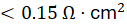 at  (  ) |
Ohmic Polarization, Activation Losses, and Degradation Mechanisms
Despite exceptional electrical conversion efficiencies, commercializing high-temperature solid oxide fuel cells requires managing severe material degradation modes driven by extreme thermal and chemical operating environments. Total operating cell voltage ( ) deviates from the theoretical Nernst potential due to three primary polarization losses:


- Ohmic Polarization (
 ): Governed by ionic resistance across the ceramic electrolyte and electronic resistance through interconnect plates. Manufacturers reduce ohmic resistance by tape-casting ultrathin electrolyte membranes (
 to
 [
 ]) supported on thick anode substrates.
- Activation Polarization (
 ): Caused by sluggish charge-transfer kinetics at triple-phase boundaries, mitigated by nanostructured electrode infiltration.
- Degradation Modes: Long-term operation induces nickel particle coarsening (agglomeration) within the anode cermet, chromium poisoning of cathode active sites from stainless steel interconnect vaporization, and thermal expansion mismatch stresses between ceramic layers during thermal cycling startups and shutdowns.
Cogeneration Combined Heat and Power (CHP) Integration
Because solid oxide fuel cells reject high-grade thermal energy ( to
 [
 to
 ]), they serve as prime movers for integrated combined heat and power (CHP) microgrids and industrial trigeneration plants. Exhaust thermal energy recovered from the SOFC stack can drive secondary bottoming cycles, including organic Rankine cycle (ORC) turbines, absorption chillers for facility cooling, or steam generators for district heating networks.
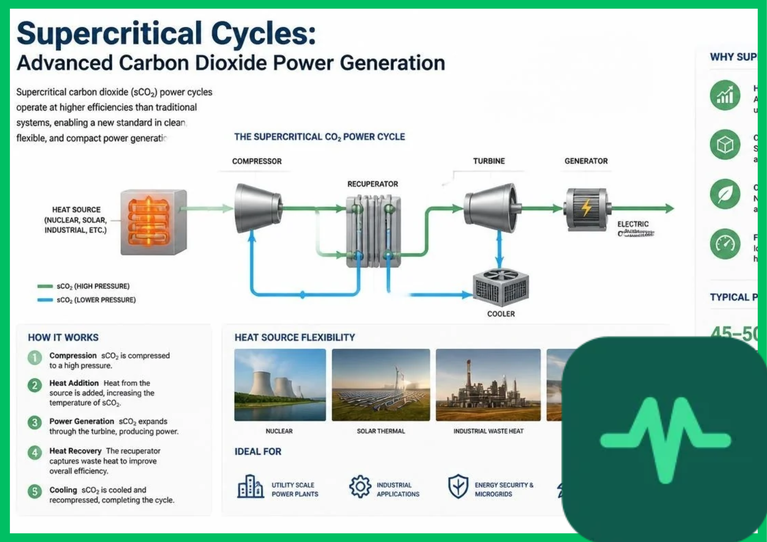
Advanced hybrid configurations couple SOFC stacks directly with closed-loop supercritical carbon dioxide ( ) power cycles or gas turbine expanders. In these hybrid systems, pressurized anode and cathode exhaust gases undergo catalytic combustion in an afterburner, driving a gas turbine expansion stage before thermal recuperation. Hybrid SOFC-gas turbine systems achieve net electrical conversion efficiencies exceeding 70%, establishing an benchmark in stationary thermal power generation.
The Final Take
Mastering solid oxide fuel cell electrical efficiency advances stationary power generation by uniting ceramic ion conduction with direct internal hydrocarbon reforming. Citing IEA advanced technology roadmaps and electrochemical literature, high-temperature YSZ electrolyte operation eliminates noble-metal constraints and achieves electrical conversion efficiencies above 60%. By mitigating degradation mechanisms and integrating high-grade cogeneration heat recovery, solid oxide fuel cells establish an essential technical foundation for efficient, flexible stationary clean energy systems.



Comments (0)
Login to leave a comment.
No comments yet. Be the first to share your thoughts!