 ) within solid carbonate mineral matrices, transforming conventional concrete manufacturing into a carbon-negative industrial process. According to United Nations Environment Programme (UNEP) building sector assessments and International Energy Agency (IEA) industrial decarbonization reports, global cement and concrete production generates approximately 2.8 gigatons of carbon dioxide annually, representing roughly 7% to 8% of global anthropogenic greenhouse gas emissions. Traditional Portland cement manufacturing requires calcining limestone at extreme temperatures exceeding
 (
 ), releasing stoichiometric
 directly from calcium carbonate decomposition. Mineralizing captured carbon dioxide into manufactured aggregates and concrete blocks reverses this dynamic, locking carbon permanently into stable, insoluble crystalline rock.
Reactive Aggregate Chemistry and Carbonation Kinetics
The fundamental chemical mechanism underlying mineral carbonation relies on the exothermic reaction between alkaline metal ions (primarily calcium and magnesium) and dissolved carbonate species to form stable carbonate minerals. When industrial byproducts—such as basic oxygen furnace (BOF) steel slag, stainless steel slag, or coal fly ash—are exposed to carbon dioxide under controlled thermodynamic conditions, reactive calcium silicates undergo accelerated carbonation.
The primary mineral phases in steel slag include dicalcium silicate ( or
 ) and tricalcium silicate (
 or
 ). During accelerated carbonation curing, these calcium-bearing phases react with dissolved carbonic acid (
 ), precipitating calcium carbonate (
 ) in either calcite, aragonite, or vaterite polymorphs:


This precipitation reaction is thermodynamically favorable with a high negative Gibbs free energy change ( ), ensuring permanent chemical fixation. Unlike physical adsorption or biological sequestration, mineralized carbonates possess geological stability half-lives exceeding millions of years, eliminating any risk of carbon reversal back into the atmosphere.
Accelerated Carbonation Curing and Aggregate Manufacturing
Industrial manufacturing of carbon-negative concrete blocks and aggregates replaces traditional steam-curing kilns with closed-loop carbonation chambers. Raw aggregate feeds—comprising crushed steel slag, recycled concrete aggregate (RCA), or industrial silicate tailings—are placed inside sealed batch reactors and subjected to high-purity or flue-gas  streams.
Process engineering parameters are strictly controlled to maximize reaction kinetics:
- Gas Pressure and Concentration: Operating at pressures ranging from
 to
 (
 to
 ) with
 concentrations varying from 15% (direct flue gas) to 99% (pure captured streams).
- Moisture Content Optimization: Water acts as an essential reaction medium, dissolving gaseous
 into aqueous bicarbonate (
 ) and carbonate (
 ); optimal moisture content ranges between 8% and 14% by dry aggregate weight.
- Thermal Regulation: Managing exothermic reaction heat release to maintain reactor core temperatures between
 and
 (
 to
 ), preventing premature moisture evaporation that halts carbonate precipitation.
This accelerated mineralization cycle achieves structural green strength within hours, bypassing the 28-day curing intervals required by traditional hydraulic cement binders.
Microstructural Densification and Mechanical Performance
Integrating mineralized aggregates into concrete mix designs delivers substantial structural and mechanical enhancements. As calcium carbonate precipitates within the porous interfacial transition zones (ITZ) of the aggregate matrix, microstructural densification occurs.
Scanning electron microscopy (SEM) and mercury intrusion porosimetry (MIP) verify that accelerated carbonation reduces total open porosity by 15% to 35% compared to untreated aggregates. Needle-like calcium silicate hydrate (C-S-H) gels interlock with newly formed rhombohedral calcite crystals, filling capillary voids and reducing internal permeability to aggressive water and chloride ion penetration.
Consequently, structural concrete blocks manufactured with carbon-mineralized aggregates exhibit a 15% to 30% increase in early-stage compressive strength (measured in megapascals,  ), while sequestering between
 and
 of pure
 per metric ton of finished aggregate (
 to
 per short ton).
Technical Data Specifications of Mineralization Parameters
| Technical Parameter | Engineering Specification Range |
|---|---|
| Reactor Operating Pressure |  to  (  to  ) |
| Reactor Temperature Range |  to  (  to  ) |
| Optimal Aggregate Moisture | 8% to 14% water content by dry weight |
| Sequestration Capacity |  to  per metric ton (  ) |
| Compressive Strength Gain | 15% to 30% increase over control specimens |
| Porosity Reduction | 15% to 35% decrease in capillary pore volume |
In-Situ Mineralization Versus Ex-Situ Aggregate Curing
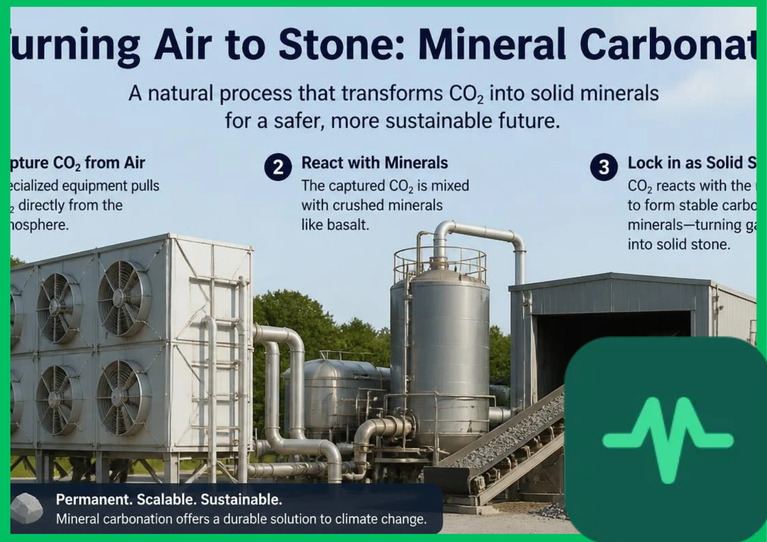
Mineral carbonation operates across two distinct industrial modalities: ex-situ aggregate manufacturing and in-situ geological mineralization. While ex-situ manufacturing processes industrial byproducts in controlled factory batch reactors to produce high-value structural aggregates, in-situ carbon mineralization injects supercritical  dissolved in water directly into deep underground mafic and ultramafic rock formations, such as basalts and peridotites.
In-situ injection projects—such as the CarbFix initiative studied extensively in academic geosciences literature—dissolve captured  into water at depths of
 (
 ). This acidic carbonated water reacts with subsurface calcium, magnesium, and iron silicate minerals, precipitating solid carbonate rocks within two years. However, ex-situ structural aggregate production offers immediate commercial utility by directly displacing mined natural sand and gravel quarries while embedding carbon into concrete building materials.
Life-Cycle Assessments and Global Scalability
Quantitative life-cycle assessments (LCAs) published by UNEP and academic construction research consortia confirm that deploying carbon mineralization technologies across global supply chains eliminates net carbon emissions from concrete block production. By substituting energy-intensive virgin quarried aggregates with reactive industrial byproducts locked with captured  , the construction sector achieves true carbon negativity. As industrial point-source capture infrastructure scales, mineral carbonation aggregates establish a permanent, scalable market for captured greenhouse gases, transforming anthropogenic carbon liabilities into durable structural stone.

Comments (0)
Login to leave a comment.
No comments yet. Be the first to share your thoughts!