Solid-Electrolyte Interphase (SEI) Layer Growth and Anode Degradation
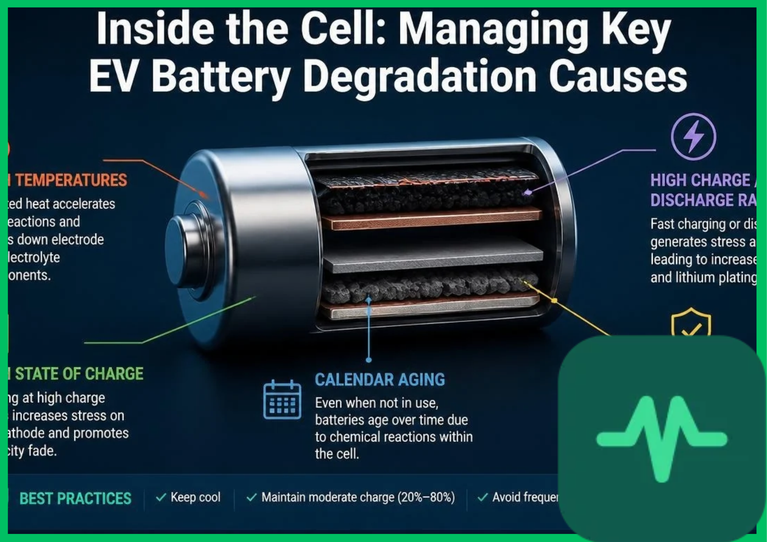
The primary driver of capacity fade in lithium-ion cells is the continuous evolution and thickening of the solid-electrolyte interphase (SEI) layer on the graphite or silicon-graphite anode surface. During initial formation cycles, reduction of organic carbonate solvents (such as ethylene carbonate) on the anode creates a passivating film that permits lithium-ion transport while preventing continuous electrolyte decomposition. However, mechanical stress from volume expansion during lithiation continuously fractures this passivating layer, exposing fresh carbon surfaces to the liquid electrolyte.
This continuous repair cycle consumes active lithium ions and depletes liquid electrolyte inventory, accelerating capacity loss and impedance rise. Furthermore, operating cells at low ambient temperatures or applying high C-rates during charging induces lithium plating. When the local anode potential drops below  versus
 , lithium ions deposit as metallic dendrites on the graphite surface rather than intercalating into the lattice structure. These metallic dendrites pierce polymer separators, causing internal short circuits and permanent cell failure.
Electrolyte Salt Decomposition and Hydrolysis Pathways
Beyond solvent reduction, the supporting lithium salt—most commonly lithium hexafluorophosphate ( )—undergoes temperature-sensitive thermal decomposition and chemical degradation.
 exists in a dynamic chemical equilibrium with lithium fluoride (
 ) and phosphorus pentafluoride (
 ).
 acts as a strong Lewis acid, reacting aggressively with trace moisture (
 ) contaminants present within the cell assembly to generate corrosive hydrofluoric acid (
 ).
The presence of hydrofluoric acid accelerates transition metal dissolution from the cathode, degrades the structural integrity of aluminum current collectors, and damages the SEI layer. Elevated storage temperatures above  (
 ) exponentially accelerate these salt decomposition pathways, causing severe gassing, internal pressure buildup, and irreversible power fade.
Thermal Stress and Arrhenius Kinetics in Operating Cells
Operating temperature serves as a dominant catalyst for acceleration factors in battery degradation kinetics. According to Arrhenius reaction rate theory, the rate of parasitic chemical side reactions doubles for every  (
 ) increase in cell temperature. Operating lithium-ion batteries consistently above
 (
 ) accelerates thermal degradation, electrolyte oxidation at the cathode surface, and transition metal dissolution.
Conversely, sub-zero operation below  (
 ) spikes internal electrical resistance, exacerbating overpotential and promoting catastrophic lithium plating during high-power regenerative braking or fast-charging sessions. Industrial thermal management systems must maintain active liquid-cooling or phase-change cooling loops to constrain cell core temperatures within an optimal thermal window of
 to
 (
 to
 ), thereby minimizing both high-temperature aging and low-temperature kinetic polarization.
High-Voltage Stress and Cathode Phase Transitions
Cathode chemistry dictates upper voltage cutoff thresholds and structural stability limits. High-nickel layered transition metal oxides, such as Lithium Nickel Manganese Cobalt Oxide ( or NMC811), offer high specific energy density but suffer from severe lattice distortion when charged beyond
 to
 .
| Phase Transitions | Charging past  triggers anisotropic lattice contraction, oxygen release from the crystal lattice, and phase transitions from hexagonal to monoclinic structures. |
| Transition Metal Dissolution | Acidic species generated by trace moisture hydrolysis attack active cathode surfaces, dissolving manganese ( ), cobalt (  ), and nickel (  ) ions into the electrolyte. |
| Migration and Poisoning | Dissolved transition metal cations migrate across the porous separator and deposit onto the graphite anode, catalyzing further electrolyte reduction and accelerating SEI growth. |
Mitigating cathode degradation requires precise upper-voltage clamping and doping strategies, such as aluminum or zirconium substitution, which stabilize the host crystal framework against irreversible structural collapse.
Mechanical Stresses and Volume Expansion Coefficients
Intercalation mechanics induce continuous mechanical stress throughout the internal jelly-roll or stacked-electrode architecture. As lithium ions insert into and extract from active material hosts, lattice dimensions expand and contract cyclically.
| Graphite Anode Expansion | Experiences a volumetric expansion of approximately 10% to 13% during full lithiation. |
| Silicon-Graphite Composite Expansion | Exhibits volume expansion coefficients exceeding 300%, generating extreme mechanical shear stress across current collectors and separator membranes. |
| Cathode Material Stress | Layered transition metal oxides undergo anisotropic volume changes of 2% to 4%, causing micro-cracking along primary and secondary particle boundaries. |
These mechanical fractures expose unreacted interior surfaces to the electrolyte, driving secondary SEI formation and continuous capacity loss. Advanced cell designs incorporate elastic binders, carbon-nanotube conductive networks, and controlled external mechanical pre-load pressure to absorb volumetric expansion and prevent delamination.
Advanced Battery Management Systems (BMS) Mitigation Strategies
Mitigating degradation pathways relies on sophisticated algorithmic control executed within the battery management system. Modern BMS architectures monitor coulomb efficiency, internal resistance shifts using electrochemical impedance spectroscopy (EIS), and open-circuit voltage relaxation profiles in real time.
To suppress calendar aging—degradation occurring independently of usage when cells sit idle at high voltage—the BMS restricts maximum state of charge (SoC) to 80% or 85% during prolonged parking or low-demand operations. Furthermore, multi-stage constant-current constant-voltage (CC-CV) fast-charging protocols dynamically taper charging currents as terminal voltage approaches critical polarization thresholds, preventing high-voltage lithium plating.
Empirical Research and Environmental Standards
Empirical studies published by academic research consortia and environmental guidelines established by the United Nations Environment Programme (UNEP) emphasize that optimizing battery lifespan directly reduces lifecycle carbon emissions and critical mineral depletion. Prolonging functional EV battery longevity from 10 years to 15 years cuts cumulative greenhouse gas footprints associated with mining and refining by over 30%. Implementing rigorous thermal management, state-of-charge window restrictions, and advanced BMS algorithms ensures that lithium-ion cells maintain over 80% nominal capacity retention across thousands of rigorous operational cycles.


Comments (0)
Login to leave a comment.
No comments yet. Be the first to share your thoughts!