You plug in your car, expecting lightning-fast speeds.
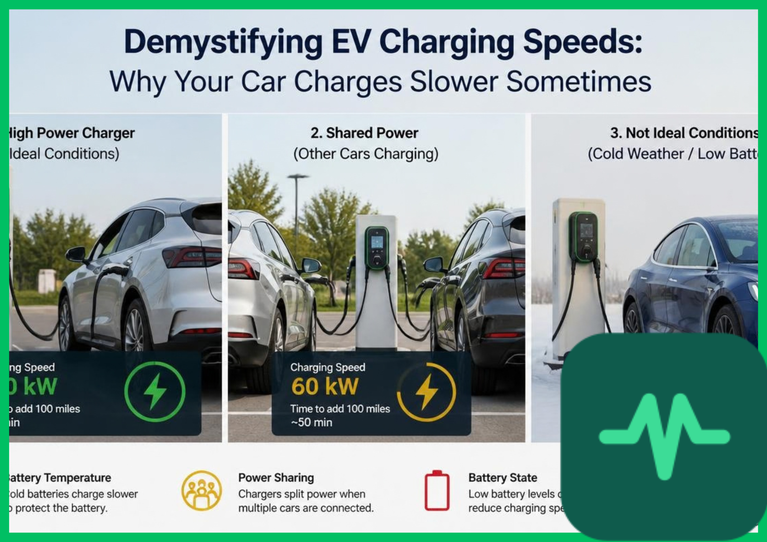
You check your dashboard display after a few minutes, only to see your vehicle charging at a much lower rate—say, 80 kilowatts.
Frustration sets in. Why is your car charging so slowly when plugged into such a powerful station?
This common scenario reveals a fundamental misunderstanding of how electric vehicle charging speeds work.
Plugging an EV into a fast charger does not mean your car accepts maximum power indefinitely.
Here is a look at the thermal, chemical, and electrical rules that govern how quickly an EV battery accepts energy.
The Myth of Constant Charging Speed
Many people assume charging an EV battery works like filling a bucket with water from a garden hose. You turn the valve wide open, water rushes in at maximum speed, and it pours steadily until the bucket fills to the brim.
Lithium-ion batteries do not work that way.
An EV battery is a complex chemical system, not an empty container. Pouring electricity into it too aggressively generates intense internal heat and chemical stress.
To protect the battery from permanent damage, your vehicle's onboard battery management system strictly controls how much electricity enters the pack at any given second.
Understanding the Charging Power Curve
When you plug an electric vehicle into a Level 3 DC fast charger, your car follows a specific electrical profile known as a charging power curve.
- The Starting Surge: If your battery is running low (around 10% to 20% capacity) and the temperature is right, the vehicle accepts maximum electrical power. The charging speed hits its peak.
- The Tapering Curve: As the battery fills up and approaches 80% capacity, the chemical cells become packed with lithium ions. To prevent internal stress and overheating, the battery management system commands the charger to slow down. Power tapers off gradually.
- The Final Stretch: The last 20% of a charge takes the longest, trickling power in slowly to ensure every cell reaches maximum capacity safely.
Trying to fast-charge an EV from 80% to 100% is like trying to cram luggage into an overstuffed suitcase; it takes twice as long and requires immense care.
Thermal Management and Ambient Temperature
Temperature plays a massive role in determining your actual charging speed.
If you drive your electric vehicle hard on a freezing winter morning and immediately plug it into a fast charger without pre-conditioning the battery pack, the charging speed will crawl.
Cold lithium ions cannot move quickly through the internal electrolyte highway; forcing high-voltage current into a freezing battery damages the cell structure permanently.
To protect itself, the car's thermal management system uses incoming electricity to warm the battery up before allowing fast charging to begin.
Conversely, driving long distances in extreme summer heat can overheat the battery pack, forcing the vehicle to throttle charging speeds downward to let its cooling systems catch up.
Understanding these power curves and thermal rules helps you charge smarter, optimize your road trips, and protect your battery's long-term health.
Comments (0)
Login to leave a comment.
No comments yet. Be the first to share your thoughts!