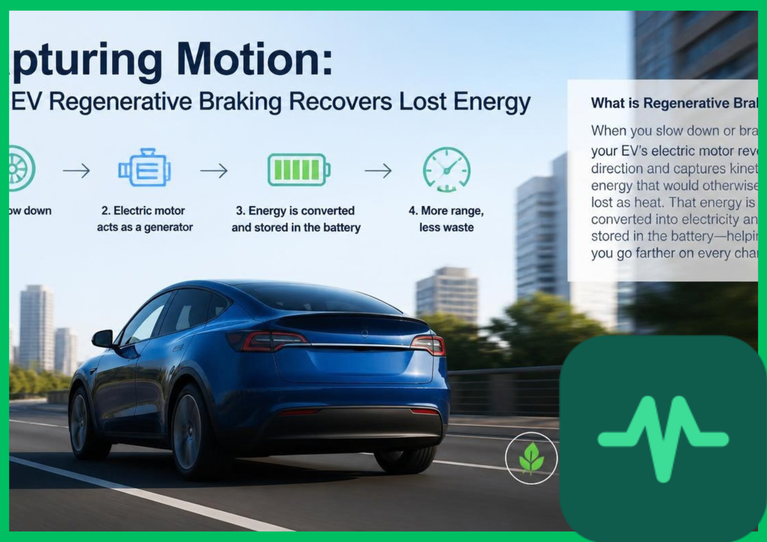
In a traditional gasoline-powered car, that moment represents pure waste. You push the brake pedal, pressing heavy friction pads against steel brake rotors. The forward momentum of your vehicle is converted into intense heat and friction dust, venting waste energy straight into the atmosphere.
In an electric vehicle, lifting your foot off the pedal triggers a completely different physical process.
Instead of wasting your vehicle's momentum, the electric motor reverses its role, capturing your forward motion and pumping electricity back into your battery pack.
It is called regenerative braking, and it is one of the most brilliant efficiency innovations in modern transportation.
Here is how kinetic energy recovery systems work to boost your driving range.
The Physics of Kinetic Energy
To understand regenerative braking, you have to understand what kinetic energy is.
Any moving object possesses kinetic energy. The heavier the object and the faster it travels, the more kinetic energy it holds.
When you accelerate an electric vehicle, electricity from your battery turns the motor, converting electrical energy into mechanical kinetic motion.
When you want to stop, that kinetic energy must go somewhere.
In a traditional car, friction brakes turn that motion into thermal waste heat.
In an electric vehicle, the electric motor can operate in reverse. When you decelerate, the vehicle's forward momentum forces the motor's rotor to spin. That mechanical rotation turns the electric motor into an electrical generator.
How Motor Reversal Recovers Power
An electric motor and an electric generator are fundamentally the same machine operating in opposite directions.
When you apply power, electricity creates a magnetic field that spins the motor.
When you lift your foot off the accelerator, the rolling momentum of the wheels spins the motor rotor through that magnetic field.
This process induces an electrical current in the motor windings, creating magnetic resistance that slows the vehicle down smoothly.
Instead of venting that energy as heat, the system captures that induced electrical current and routes it back through the inverter into your battery pack.
You literally recharge your battery every time you slow down.
One-Pedal Driving and Daily Efficiency
Regenerative braking does more than just recover energy; it transforms how you drive.
Many electric vehicles feature adjustable regenerative braking levels, enabling a technique known as one-pedal driving.
When you lift your foot off the accelerator, the heavy electrical resistance of the regenerative motor slows the car down to a complete stop automatically, requiring zero use of the physical brake pedal during normal daily commuting.
This system captures up to 70% of the kinetic energy that would otherwise be lost during deceleration.
In heavy stop-and-go city traffic, regenerative braking extends your driving range significantly, proving that slowing down does not have to mean wasting power.
Comments (0)
Login to leave a comment.
No comments yet. Be the first to share your thoughts!