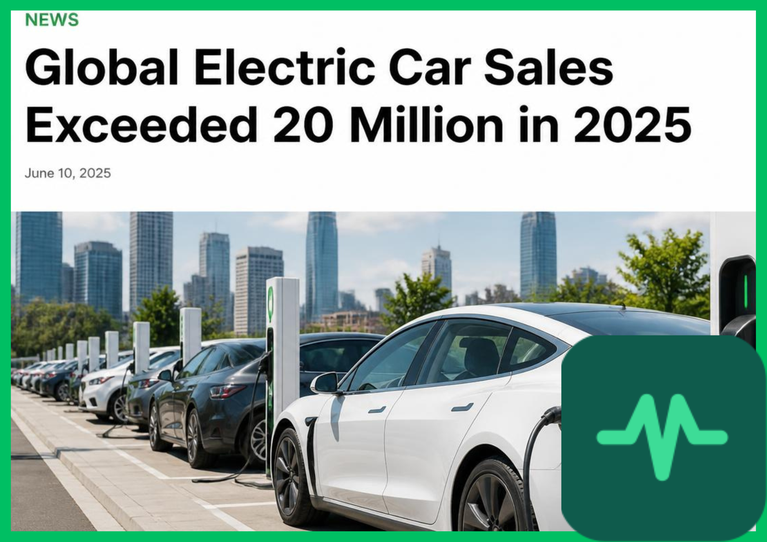
Global Electric Car Sales Reached a New Record
Global electric car sales reached a major milestone in 2025.
More than 20 million electric cars were sold worldwide during the year. According to the International Energy Agency (IEA), sales increased by about 20% compared with 2024.
As a result, electric cars accounted for about one in every four new cars sold globally. The result shows how quickly electric vehicles are moving into the mainstream.
Just a few years ago, electric cars were still a small part of the global automotive market. Now, they are becoming a major part of the industry.
However, the growth is not happening at the same speed everywhere. China remains far ahead of most markets. Europe also recorded strong growth. Meanwhile, several emerging markets are beginning to move much faster.
The latest figures therefore show that the future of electric mobility will not be shaped by one region alone.
China Continues to Lead the Global EV Market
China remains the world's largest electric-car market.
In 2025, more than 13 million electric cars were sold in China. That means China accounted for roughly six out of every ten electric cars sold globally.
The country's electric-car sales share also reached almost 55% of new car sales. This is a significant change for the automotive industry.
Electric cars have become a normal choice for many Chinese consumers. At the same time, Chinese automakers have expanded their electric-car ranges.
Competition has also increased. As more companies compete for buyers, manufacturers have been pushed to offer different models and price points.
Therefore, China's position in global electric car sales is not simply about the number of vehicles sold. It is also about manufacturing, technology and competition.
Europe Records Strong Growth
Europe was another major source of growth in 2025. Electric-car sales in the region increased by more than 30%, reaching about 4.2 million vehicles.
Electric cars represented approximately 28% of all new car sales in Europe. The increase followed stronger emissions requirements and changes in the European automotive market. This shows how government policy can influence global electric car sales.
When governments introduce policies that encourage lower-emission vehicles, manufacturers have stronger reasons to expand their electric models.
Consumers also gain more choices. However, European markets are not identical. Some countries have moved much faster than others. Norway, for example, has a very high level of electric-car adoption, while other European markets are still developing.
The United States Is Moving More Slowly
The United States presents a different picture. Electric-car sales remained relatively stable in 2025. The IEA reports that electric cars accounted for just under 10% of total US car sales during the year. Sales also dropped sharply in the final quarter following policy changes, including the ending of federal EV tax credits.
This highlights an important point. Global electric car sales can grow strongly even when individual markets slow down. The global market is becoming more diverse. Growth in one region can partly offset slower growth in another.
Emerging Markets Are Becoming More Important
The electric-car story is no longer limited to China, Europe and the United States. Emerging markets are becoming an increasingly important part of global electric car sales.
Outside the three major markets, electric-car sales reached about 2 million vehicles in 2025, compared with 1.3 million in 2024. That represents growth of almost 50%.
Electric-car sales in emerging and developing economies outside China increased by about 80%, reaching almost 1.2 million vehicles.
The availability of lower-cost electric models, many imported from China, has helped drive this growth. This could become one of the biggest trends in the next stage of electric mobility.
Southeast Asia Is Moving Quickly
Southeast Asia recorded particularly strong growth. Electric-car sales in the region more than doubled in 2025.
Electric cars accounted for nearly 20% of new car sales across the region. Vietnam, Indonesia and Thailand were among the main drivers of growth. Vietnam was especially notable. Electric cars accounted for almost 40% of new car sales in the country in 2025.
Thailand also recorded strong growth, with electric cars reaching nearly one-quarter of new car sales. Indonesia saw electric-car sales more than double as well.
These results show that global electric car sales are increasingly being influenced by markets that were once considered secondary EV markets.
Latin America Is Also Growing
Latin America recorded another major increase. Electric-car sales grew by approximately 75% in 2025, reaching more than 350,000 vehicles.
Brazil and Mexico accounted for more than three-quarters of the region's sales growth. Brazil sold around 180,000 electric cars in 2025. Mexico's electric-car sales tripled.
Other countries, including Colombia, Uruguay and Costa Rica, also recorded growth.
Therefore, Latin America could become an increasingly important market for global electric car sales.
More Than 100 Countries Recorded Growth
The expansion is not limited to a small group of countries.
According to the IEA, more than 100 countries recorded growth in electric-car sales in 2025. In about one-third of those countries, electric cars represented at least 10% of new car sales.
This is an important sign of broader adoption. It suggests that electric mobility is becoming a global trend rather than a technology concentrated in a few wealthy markets.
However, the reasons for growth vary. In some countries, government incentives are important. In others, lower vehicle prices are driving demand. Fuel prices, charging availability and the number of available models can also influence consumer decisions.
Chinese Automakers Are Changing the Market
Another major development is the growing international role of Chinese automakers. China produced nearly 75% of the world's electric cars in 2025, according to the IEA.
Chinese electric-car exports also exceeded 2.5 million vehicles during the year. Outside Europe and the United States, Chinese-made electric cars accounted for about 55% of EV sales in 2025.
This is particularly important for emerging markets. Lower-cost Chinese models are giving consumers in several countries more electric-car choices. At the same time, traditional automakers face stronger competition.
EV Growth Is Creating New Demand
The rise in global electric car sales affects much more than car manufacturers.
It is creating demand across several industries.
These include:
- Battery manufacturing
- Charging infrastructure
- Electricity generation
- Grid infrastructure
- Critical minerals
- Vehicle software
- Battery recycling
- Automotive manufacturing
As more EVs enter the market, charging networks will need to expand. Electricity systems will also need to handle additional demand.
Meanwhile, battery manufacturers will need more raw materials and production capacity.
Therefore, the growth of electric cars is creating a much wider economic shift.
Electric Cars Could Also Affect Oil Demand
Electric vehicles can also influence the global oil market. The IEA estimates that the global EV fleet avoided around 1.7 million barrels of oil demand per day in 2025.
That number could grow as more electric vehicles enter the world's roads. This is particularly important for countries that rely heavily on imported oil.
More electric vehicles could reduce exposure to changes in global oil prices over time.
However, the impact will depend on how quickly EV adoption grows and how electricity is produced.
Affordability Will Shape the Next Stage
Despite the strong growth, challenges remain. The next phase of global electric car sales will depend heavily on affordability. An electric car can be attractive because of lower running costs. However, its purchase price can still be a barrier in some markets.
This is particularly important in developing economies. If EVs remain too expensive, adoption may remain concentrated among higher-income consumers.
Therefore, affordable electric models could become increasingly important.
Charging infrastructure will also matter. Consumers need confidence that they can charge their vehicles when necessary.
What Happens Next?
The IEA expects global electric car sales to continue growing in 2026. The agency projects around 23 million electric-car sales in 2026, which would represent about 28% of total global car sales.
Europe is expected to record strong growth. China is also expected to expand, although at a slower rate than in previous years.
Meanwhile, emerging markets could continue to grow rapidly as more affordable electric models become available.
EcoGreenPulse View
The latest global electric car sales figures show that the EV transition is becoming increasingly broad.
China remains the dominant market. Europe is accelerating. The United States is moving more slowly.
At the same time, Southeast Asia and Latin America are becoming important growth centres.
This means automakers cannot rely on a single strategy. They need vehicles for different markets and income levels.
Governments also have an important role to play. Policies can influence vehicle prices, charging infrastructure, manufacturing and consumer adoption.
Ultimately, the next stage of electric mobility will be about making EVs affordable, practical and widely available.
Conclusion
Global electric car sales exceeded 20 million in 2025, marking another major milestone for the automotive industry.
Electric cars accounted for about one-quarter of new car sales worldwide. China remained the clear leader, while Europe recorded strong growth. Meanwhile, Southeast Asia, Latin America and other emerging markets showed that electric mobility is expanding beyond the traditional major markets.
The growth also creates new demand for batteries, charging networks, electricity and critical minerals.
However, challenges remain. Affordability, charging infrastructure, electricity supply and government policy will all influence the next stage of adoption.
Even so, the direction is becoming clearer. Electric cars are no longer a niche part of the automotive market. They are becoming a major part of the global transport system.
And as global electric car sales continue to rise, their impact will increasingly extend beyond cars and into energy, technology, manufacturing and international trade.
Source: International Energy Agency, Global EV Outlook 2026. Read the IEA Global EV Outlook 2026
Comments (0)
Login to leave a comment.
No comments yet. Be the first to share your thoughts!