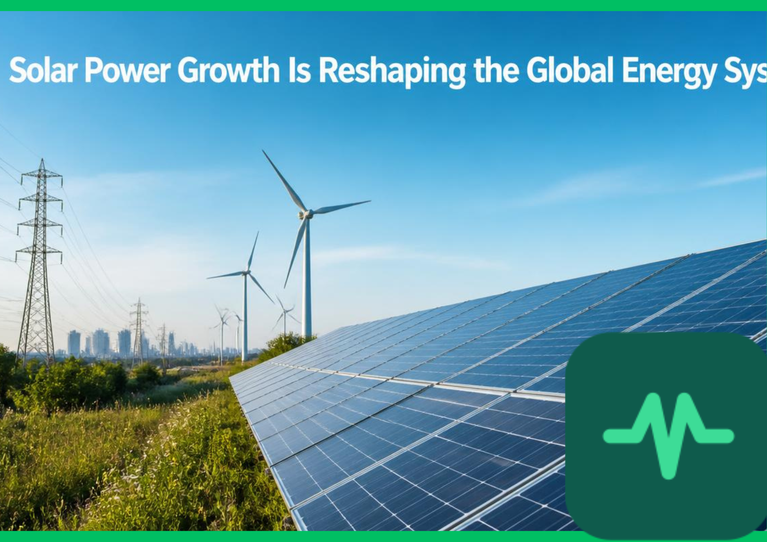
Solar Power Growth Reaches Another Major Milestone
Solar power growth is changing the global energy system at a rapid pace.
In 2025, solar PV reached another major milestone. According to the International Energy Agency (IEA), global solar PV capacity additions surpassed 600 gigawatts (GW) for the first time. This pushed total installed solar PV capacity to about 2,800 GW worldwide.
IRENA's latest renewable-capacity statistics tell a similar story. The agency reports that the world added 692 GW of renewable power capacity in 2025. Solar accounted for about 511 GW of that increase, or roughly three-quarters of all new renewable capacity.
These figures show why solar power growth has become one of the most important developments in the global energy market.
However, the story is about more than the number of solar panels being installed.
Solar is also changing the way countries produce electricity, plan their grids and think about energy security.
Solar Became the Largest Source of New Renewable Capacity
The strongest sign of solar power growth is its share of new renewable capacity.
IRENA's 2026 statistics show that solar added approximately 511 GW during 2025. Wind added about 159 GW. Therefore, solar was responsible for almost three times as much new capacity as wind.
This is important because renewable energy capacity is expanding across several technologies.
Hydropower remains a major part of the world's renewable electricity system. Wind also continues to grow. However, solar is currently expanding at a much faster rate.
There are several reasons for this.
Solar projects can be built at many different scales. A country can develop a very large solar farm. At the same time, businesses can install rooftop systems, while households can use smaller systems for their own electricity needs.
As a result, solar can fit into both large and small energy projects.
Solar Electricity Is Growing Too
Capacity alone does not tell the entire story. The amount of electricity generated by solar is also increasing quickly.
The IEA reports that global solar PV generation increased by about 600 terawatt-hours (TWh) in 2025. This was the largest annual increase in electricity generation ever recorded for a single source, excluding unusual rebound years following major economic shocks.
Global solar PV generation reached nearly 2,700 TWh in 2025. Solar therefore produced more than 8% of global electricity during the year.
This is a major change. Solar power was once a relatively small part of the global electricity system. Now, it is large enough to influence worldwide electricity trends.
The IEA also reports that solar PV alone met around 70% of the increase in global electricity generation in 2025. That gives a clear picture of the scale of solar power growth.
China Is Driving Much of the Expansion
China remains central to the global solar market. The IEA reports that around 55% of the increase in global solar PV generation in 2025 took place in China. However, growth was broad-based across many other markets as well.
China's role matters for several reasons. The country has a large domestic electricity market. It also has a major solar manufacturing industry. As a result, China influences both the supply and demand sides of the solar industry.
The scale of Chinese deployment also affects global technology costs, supply chains and competition. Nevertheless, it would be wrong to describe solar power growth as a China-only story.
Countries across Asia, Europe, the Americas, the Middle East and Africa are also adding solar capacity.
More Countries Are Building Solar
The expansion of solar is becoming increasingly widespread. According to the IEA, 30 countries installed more than 1 GW of solar PV in 2025. That was almost twice the number recorded in 2020.
This matters because it shows that solar power growth is spreading beyond a small group of leading markets. Countries with different economies and energy systems are finding different reasons to invest in solar.
Some want to reduce emissions. Others want to improve energy security. Some want to reduce their dependence on imported fuels. Others see solar manufacturing, installation and related services as opportunities for economic development.
Therefore, the reasons for solar power growth are not identical everywhere.
Solar Can Support Energy Security
Energy security has become an increasingly important issue. Countries that depend heavily on imported fuels can be exposed to changes in international energy prices and supply disruptions.
Solar offers a different model. Once a solar system is installed, it does not require a continuous supply of imported fuel to produce electricity.
That does not mean solar systems are completely independent of global supply chains. Solar panels, inverters, batteries and other equipment still require materials and manufacturing.
However, solar can reduce a country's exposure to some fuel-related risks. This is one reason why solar power growth is becoming relevant to energy policy as well as climate policy.
Solar Growth Creates a New Grid Challenge
There is also a challenge. Solar panels produce electricity when sunlight is available. Electricity demand, however, does not always follow the same pattern.
For example, a solar system may produce large amounts of electricity during the middle of the day. Demand can remain high later in the evening when solar output falls.
Therefore, rapid solar power growth creates a greater need for flexible electricity systems.
The IEA says the global electricity system will need faster and more efficient expansion of grids and system flexibility as solar and wind continue to grow.
That means solar growth will increasingly be connected to other technologies.
These include:
- Battery storage
- Electricity grids
- Smart meters
- Demand response
- Energy-management software
- Flexible generation
- Interconnected power systems
So, while solar panels are important, they are only one part of the larger system.
Battery Storage Could Become More Important
Battery storage is particularly relevant to solar power growth. A battery can store electricity when solar generation is high. The stored electricity can then be used later. This can help reduce some of the problems created by the timing difference between solar production and electricity demand.
However, batteries are not the only answer. Countries will also need stronger transmission networks and better electricity planning.
The IEA expects solar PV and wind to account for an increasing share of global electricity generation. Their combined share is projected to rise from around 17% currently to 27% by 2030.
That level of growth will require major changes in electricity infrastructure.
What Solar Power Growth Means for Africa
Africa deserves special attention. The continent has large solar resources, yet many countries still have low levels of electricity access and limited generation capacity.
This creates an unusual situation.
Africa can potentially use solar to expand electricity supply while also improving access to modern energy.
However, solar power growth alone will not solve the continent's electricity challenges.
Countries need investment in transmission and distribution networks. They also need affordable financing, skilled workers, reliable regulation and suitable energy policies.
Off-grid solar can also play a role in areas where extending traditional electricity networks is difficult or expensive.
Therefore, Africa's solar opportunity is not simply about building large solar farms.
It can include rooftop systems, mini-grids, battery systems, commercial solar projects and utility-scale plants.
Solar Power Growth Is Also Creating New Businesses
The expanding solar market is creating opportunities throughout the clean-energy value chain.
These opportunities include:
| Solar manufacturing | Companies produce panels, cells and related equipment. |
| Installation | Solar companies install systems for homes, businesses and utilities. |
| Energy storage | Batteries can help customers store excess solar electricity. |
| Software | Digital systems can monitor and manage solar installations. |
| Financing | Financial companies can develop payment models for solar customers. |
| Maintenance | Solar systems require monitoring, repairs and long-term servicing. |
Therefore, solar power growth is not only an energy story. It is also a technology and business story.
Solar Is Becoming More Important to Electricity Markets
The IEA expects solar PV generation to continue increasing rapidly.
According to Electricity 2026, solar PV generation is expected to overtake wind and nuclear generation globally in 2026. It is also expected to overtake hydropower by 2029.
The agency expects solar PV to contribute more than 600 TWh per year on average to global renewable-electricity growth through 2030.
If this forecast develops as expected, solar will become an even more important part of the global electricity system.
This will have consequences for utilities, governments, investors and consumers.
The Next Stage of Solar Power Growth
The first major stage of solar development focused on making solar technology cheaper and deploying more capacity.
The next stage will be more complex.
Countries will need to figure out how to integrate large amounts of solar electricity into their grids.
They will need better storage.
They will need stronger transmission networks.
They will need smarter electricity markets.
They will also need to make sure that the benefits of solar reach households and businesses rather than remaining concentrated in a small number of markets.
This means the success of solar power growth should not be measured only by gigawatts installed.
The quality of the electricity system matters too.
EcoGreenPulse Analysis
The latest data leaves little doubt that solar power growth has become one of the defining trends in the global energy transition.
IRENA's figures show that solar accounted for about 511 GW of the 692 GW of renewable capacity added in 2025. Meanwhile, IEA data shows that solar PV generation increased by about 600 TWh during the same year.
Those numbers are significant because they show both sides of the market. Capacity is expanding. Electricity generation also is expanding.
However, the next challenge is integration. Solar can grow rapidly, but electricity grids must grow with it. Storage must also expand.
Energy markets need to become more flexible.
And countries need policies that allow investment to continue.
Therefore, the future of solar power growth will not depend only on how many panels manufacturers can produce.
It will also depend on how effectively countries can build the infrastructure around those panels.
Conclusion
Solar power growth has moved from being a promising clean-energy trend to becoming a central part of the global electricity system.
In 2025, solar accounted for roughly three-quarters of new renewable capacity added worldwide, according to IRENA. At the same time, IEA data shows that solar PV recorded its largest-ever annual increase in electricity generation.
The trend is likely to continue.
However, the next phase will require more than solar panels.
It will require batteries, stronger grids, smart energy systems and better electricity-market planning.
Solar story is becoming much bigger. This means a lot for consumers, businesses and governments.
It is no longer simply about producing clean electricity. It is about building an electricity system that can use that clean electricity efficiently, reliably and affordably.
And that is why solar power growth is likely to remain one of the most important EcoGreenPulse stories to watch through the rest of this decade.
Sources
- International Renewable Energy Agency, Renewable Capacity Statistics 2026.
- International Renewable Energy Agency, Renewable Capacity Highlights 2026.
- International Energy Agency, Global Energy Review 2026.
- International Energy Agency, Global Energy Review 2026 — Solar PV and Wind.
- International Energy Agency, Electricity 2026.
Editorial note: The article above is original editorial writing based on the cited primary sources. The statistics and source-attributed claims have been kept separate from the article's own analysis.
Comments (0)
Login to leave a comment.
No comments yet. Be the first to share your thoughts!