The summer sun beats down fiercely on your back.
You look at your rows of delicate green crops.
The leaves are drooping under the scorching midday heat, gasping for water as dry winds sweep across the soil.
You feel a quiet pang of worry in your chest.
Farmers work tirelessly to feed our global family.
For generations, farming operated on a harsh, zero-sum rule.
Land was either used to grow food to sustain human life, or it was covered in solar panels to generate clean electricity.
Food versus energy.
As the world demands more renewable power to fight climate change, solar developers buy up fertile farmland, paving over rich soil with glass and steel.
Farmers face an impossible choice.
Sell their land to energy companies and stop growing food, or watch their crops wither away under escalating climate heatwaves.
We cannot solve our energy crisis by starving our communities.
What if we didn't have to choose between food and power?
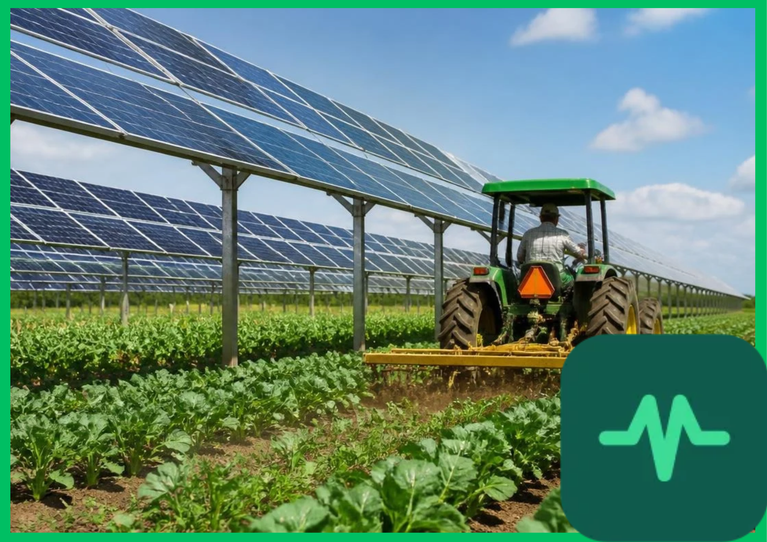
What if the exact same patch of land could grow a bountiful harvest of crops below while generating clean electricity above?
A quiet, brilliant agricultural revolution is taking root across the globe.
According to global clean energy and agriculture reports from the International Energy Agency (IEA), resource protection frameworks from the United Nations Environment Programme (UNEP), efficiency benchmarks from ENERGY STAR, and academic agronomy research, agrivoltaics land dual use is changing our farming horizon.
By raising solar panels high above farm fields, we protect delicate crops from scorching heatwaves while harvesting clean solar electricity from the exact same soil.
Here is how agrivoltaics works, why dual-use farming changes rural economics, and how harvesting both secures our sustainable future.
The False Choice Between Food and Clean Power
To understand why agrivoltaics matters so much, you have to look at the land-use conflict shaking rural communities worldwide.
Traditional utility-scale solar farms require vast acreage.
Energy developers clear fields, grade the earth, and cover the soil in dark photovoltaic panels.
Local farmers watch productive agricultural land get locked away under glass, threatening local food security and tearing apart rural traditions that span generations.
Skeptics argued that solar power and farming could never mix.
They claimed panels would block too much sunlight, choke crop growth, and turn fertile valleys into industrial zones.
Agronomists and innovative farmers refused to accept that limitation.
They looked at how plants actually grow.
Most crops do not need baking all day under direct, blinding sunlight.
In fact, many leafy greens, berries, tomatoes, and root vegetables suffer from heat stress and excessive evaporation when baked by unrelenting summer sun.
Shade changes everything.
What Is Agrivoltaics and Land Dual Use?
Agrivoltaics is an innovative agricultural and engineering practice that combines crop cultivation with photovoltaic solar power generation on the exact same piece of land, mounting solar panels high enough on elevated steel structures to let farming tractors, workers, and shade-loving plants thrive underneath.
Instead of flattening the field and blocking plant life, agrivoltaics integrates solar technology into working ecosystems.
Solar panels sit several meters or roughly 10 feet to 15 feet above the ground.
They track the sun or tilt at optimized angles, casting moving patterns of partial shade across the crops below.
That shade shields plants from damaging ultraviolet radiation and lowers ambient soil temperatures.
Meanwhile, moisture evaporating from the damp crop soil cools the solar panels from underneath, making the photovoltaic cells run more efficiently and generate extra electricity.
Food grows below. Clean power flows above.
The land works twice as hard, creating a symbiotic loop of agricultural and energy productivity.
The Science of Plant Transpiration and Microclimate Shielding
How does sharing a single field between crops and solar panels actually improve harvest yields while generating electricity?
It comes down to plant biology and microclimate thermodynamics.
Academic agronomy research shows that many valuable food crops thrive when shielded from midday heat stress.
When plants transpire, they release water vapor into the air.
Under elevated solar panels, that transpired moisture creates a cooler, more humid microclimate right above the soil.
Soil moisture retention increases by 20% to 30%, cutting irrigation water requirements dramatically in dry climates.
Farmers save precious water while growing healthier, more resilient vegetables.
According to ENERGY STAR and international agricultural efficiency evaluations, dual-use agrivoltaic farms maintain or increase total economic land productivity by over 60% compared to separating food and energy into distinct plots.
Farmers diversify their income, selling both food harvests and clean electricity to the local grid.
Environmental Integrity and Rural Economic Resilience
The environmental benefits of agrivoltaics extend far beyond saving irrigation water or boosting farm revenue.
They transform rural sustainability from the ground up.
According to UNEP resource governance frameworks, agrivoltaic systems protect topsoil from wind and water erosion, preserving soil health and preventing agricultural runoff into local rivers.
When solar installations double as active farmland, rural communities retain their cultural identity, keeping farming families on their land while participating in the clean energy transition.
According to IEA clean energy roadmaps, integrating agrivoltaics into global land-use strategies eliminates local opposition to solar developments, accelerating renewable energy deployment without threatening food security.
When farms become power generators, rural communities lead the green transition.
Overcoming Engineering and Operational Realties
Scaling agrivoltaics across global agricultural sectors involves navigating real-world operational hurdles.
Mounting solar panels high enough to clear modern farming combines and tractors requires reinforced steel structures and specialized installation engineering.
Farmers and solar developers work hand-in-hand to select crop varieties that thrive under partial shade, such as leafy greens, root vegetables, berries, and pollinator-friendly forage flowers for honeybees.
As agricultural universities publish successful field trials and equipment manufacturers design specialized compact tractors for shaded rows, agrivoltaic farming is transitioning successfully from experimental test plots into commercial mainstream agriculture.
Harvesting Both Toward a Sustainable Future
Agrivoltaics and farming prove that human ingenuity can harmonize food production with clean energy generation.
We no longer have to accept a destructive zero-sum choice between feeding our families and powering our world.
By raising solar panels high above the soil, we protect crops from climate heatwaves, save precious irrigation water, and harvest clean electricity from the exact same land.
We step away from land-use conflicts, embracing a smart, dual-use, and enduring standard of agricultural life.
Through brilliant agronomy, innovative engineering, and a deep respect for our planetary soil, harvesting both secures a well-fed, bright, and sustainable future for every person on Earth.


Comments (0)
Login to leave a comment.
No comments yet. Be the first to share your thoughts!