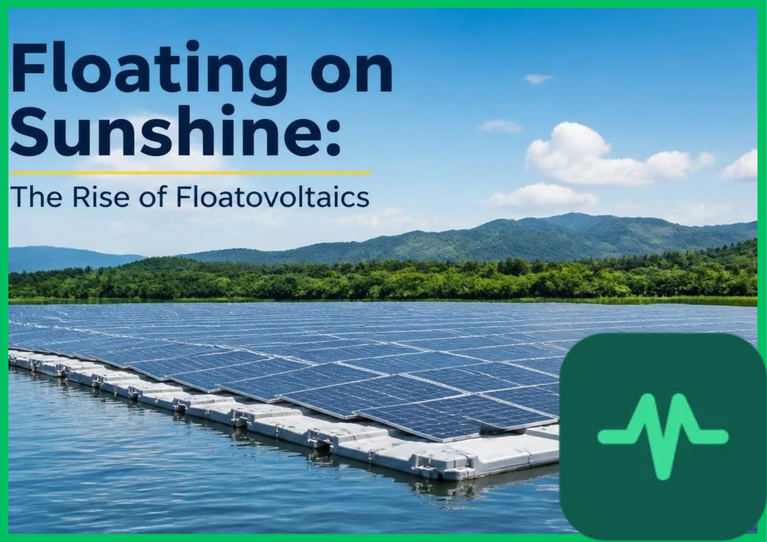
Light dances across the ripples. Out on the water, thousands of dark solar panels float peacefully, bobbing gently with the motion of the waves.
There are no clearing bulldozers here. There are no competing demands for fertile farmland or local forests.
For years, building large solar farms meant clearing vast stretches of open land.
Communities often pushed back, worried that clean energy projects would swallow up acreage needed for farming, housing, or natural ecosystems.
What if we looked away from dry land and turned our eyes toward the water?
A quiet, aquatic revolution is taking shape across lakes, reservoirs, and utility ponds around the globe.
According to global renewable energy reports from the International Energy Agency (IEA), water resource frameworks from the United Nations Environment Programme (UNEP), energy efficiency standards from ENERGY STAR, and academic photovoltaic research, floating solar panels are transforming clean energy.
By placing photovoltaic systems on top of calm bodies of water, we generate abundant electricity while conserving land and water alike.
Here is how floatovoltaics work, why water cooling boosts solar efficiency, and how aquatic clean energy secures our sustainable future.
The Land-Use Challenge of Modern Solar
To understand why floating solar matters, you have to look at the physical realities of land consumption.
Building a utility-scale solar farm requires significant acreage.
Developers need flat, clear land with easy access to transmission lines. As renewable energy targets expand rapidly worldwide, finding large, unencumbered plots of land becomes harder every year.
In densely populated regions or mountainous countries, flat land is scarce and expensive.
Using prime agricultural soil for solar arrays creates difficult trade-offs between food production and clean energy.
At the same time, human-made water bodies—like hydroelectric dams, irrigation reservoirs, water treatment ponds, and industrial retention basins—sit idle under the open sun.
They cover millions of square meters or acres of surface area, absorbing direct sunlight every single day.
Engineers asked a simple question: Why leave all that water surface empty?
Why not build solar arrays that float right on top?
What Are Floatovoltaics?
Floatovoltaics—commonly known as floating solar panels—are photovoltaic arrays mounted on specialized buoyant structures that float on the surface of water bodies.
Instead of being driven deep into dry soil with heavy concrete foundations, the entire system floats safely on high-density polyethylene pontoons.
Flexible anchoring lines secure the floating platform in place, allowing the array to rise and fall smoothly with changing water levels in reservoirs or lakes.
Submarine electrical cables run safely from the floating platform down to the lakebed and across to the shoreline, transmitting clean power directly into the regional electrical grid.
It is a brilliant marriage of solar engineering and aquatic infrastructure.
The Physics of Water Cooling and High Efficiency
The advantages of floating solar go far beyond saving land space.
Physics dictates a hidden weakness in traditional solar panels: heat.
When standard panels sit on dry land under a scorching summer sun, they absorb intense thermal energy. As photovoltaic cells heat up past 25°C (approx. 77°F), their electrical conversion efficiency drops steadily.
Panels get hot, and they produce less power.
Floatovoltaics solve that thermal problem naturally.
Water has a high specific heat capacity, meaning it absorbs and holds heat without warming up quickly.
As cool air sweeps across the water surface, it cools the underside of the floating solar panels continuously.
Academic photovoltaic research shows that floating panels run 5°C to 15°C (approx. 9°F to 27°F) cooler than land-based panels under the exact same sunlight.
Because they stay cooler, they generate up to 5% to 10% more electricity annually.
The water cools the panels, and the panels reward us with extra power.
Saving Precious Water Through Shading
Floating solar arrays deliver another massive environmental benefit: water conservation.
In arid regions and agricultural areas, water reservoirs suffer from severe evaporation losses driven by hot sun and dry winds. Millions of cubic meters or gallons of water vanish into the atmosphere every year.
When solar panels cover 30% to 50% of a reservoir's surface area, they cast a broad, protective shadow across the water below.
That shade blocks direct solar radiation and stops whipping winds from skimming across the surface.
According to UNEP water resource frameworks, floating solar arrays reduce evaporation rates beneath the panels by up to 70% to 90%.
Saving water in drought-prone regions is just as vital as generating electricity.
Furthermore, shading the water reduces algae blooms, improving raw water quality for municipal treatment plants and protecting aquatic ecosystems.
Scaling Up Clean Energy Through Hydro-Hybridization
The most exciting frontier for floating solar is hydro-solar hybridization.
Many hydroelectric dams feature large water reservoirs behind them.
During dry seasons or sunny afternoons, hydroelectric plants can supplement their water-driven power generation with floating solar arrays stationed directly on the reservoir.
According to IEA clean energy integration assessments, pairing solar generation with existing hydropower infrastructure maximizes the use of existing transmission lines, balancing variable solar output with steady hydro dispatchability.
ENERGY STAR efficiency standards highlight that utilizing existing water infrastructure avoids the environmental disruption of building brand-new transmission corridors across undisturbed land.
Floating Toward a Sustainable Future
Floatovoltaics prove that human ingenuity can solve complex resource challenges by looking at familiar spaces in new ways.
We no longer have to choose between saving land for agriculture and building the renewable energy infrastructure our planet desperately needs.
By placing solar panels on calm water bodies, we boost electrical efficiency through natural cooling, prevent massive water evaporation losses, and generate clean power without touching a single acre of fertile soil.
We step away from land-use conflicts, embracing an innovative, aquatic approach to clean energy.
Through brilliant engineering and thoughtful environmental stewardship, floating solar panels light our way toward a resilient, thriving, and fully renewable future.



Comments (0)
Login to leave a comment.
No comments yet. Be the first to share your thoughts!