Then, after a couple of seasons of heavy riding, you notice a troubling change.
Your battery indicator drops faster than it used to. Routes that used to leave you with 30% battery reserve now end with flashing red lights and a heavy, unassisted pedal home.
Lithium-ion battery degradation is an inevitable physical reality. But it happens much faster than it should when batteries are mishandled.
A high-quality e-bike battery is an expensive piece of advanced technology. Protecting it requires more than just plugging it into the wall when it dies.
Here is how to practice smart lithium-ion battery maintenance, protect your riding range, and keep your power source running strong for years.
How E-Bike Batteries Work
To protect your battery, you have to understand what happens inside it.
Modern e-bikes rely on lithium-ion battery packs. Inside that plastic or aluminum casing, dozens or hundreds of individual lithium-ion cells store electrical energy chemically.
During discharge, lithium ions flow from the negative electrode to the positive electrode, releasing electrical power. During charging, the process reverses.
This chemical dance is remarkably efficient, but it has boundaries. Extreme temperatures, overcharging, deep discharging, and poor storage habits stress the internal chemical structure, permanently reducing the battery's total holding capacity.
The Golden Rule: Avoid Extreme States of Charge
If you want your battery to last, change how you handle the charging cycle.
Many people treat e-bike batteries like smartphones: they ride until the bike dies completely, then plug it in overnight and charge it to 100%.
That routine is hard on lithium chemistry.
Deep discharges—letting your battery drop to zero percent repeatedly—stress the internal cells and accelerate capacity loss. Conversely, leaving a battery sitting at 100% charge for weeks while parked in a garage places high voltage stress on the internal cathode structure.
For optimal e-bike range preservation, aim for the sweet spot: keep your battery operating between 20% and 80% charge for your daily rides. Charge it up before a big trip, and unplug it when it hits full capacity rather than leaving it plugged in all night.
Temperature Control: Heat and Cold Management
Temperature is the silent killer of lithium-ion batteries.
Extreme heat is particularly destructive. If you leave your e-bike parked outside under a blazing summer sun or store your battery in a hot car trunk, the elevated temperature accelerates chemical degradation inside the cells.
Cold weather creates a different issue. When temperatures drop below freezing, internal resistance spikes. The chemical reactions slow down, causing your battery's available voltage to drop sharply.
You might notice your riding range cut in half on a freezing winter morning.
To protect your investment, bring your battery indoors when parking outside in extreme weather. Store your battery at room temperature—ideally between 10 degrees Celsius and 20 degrees Celsius (50 degrees Fahrenheit to 68 degrees Fahrenheit)—whenever possible.
Storage Habits for the Off-Season
If you live in a climate with harsh winters or take a long break from riding, how you store your battery matters immensely.
Never store a lithium-ion battery completely empty. If a battery sits uncharged for months, its internal self-discharge rate can drop voltage below a critical threshold, triggering the internal management system to lock the battery permanently for safety.
Nor should you store it fully charged at 100%.
The ideal storage charge is around 50% capacity. Place the battery in a cool, dry, fire-safe location indoors, and check on it every couple of months, topping it back up to 50% if the charge drifts downward.
Riding Habits That Preserve Range
Your charging habits are only half the battle. How you ride your e-bike dictates how hard your battery has to work.
To maximize your daily range:
- Use lower assistance levels on flat ground and reserve high power for steep hills.
- Maintain proper tire pressure. Soft tires create excessive rolling resistance, forcing the motor to draw extra current.
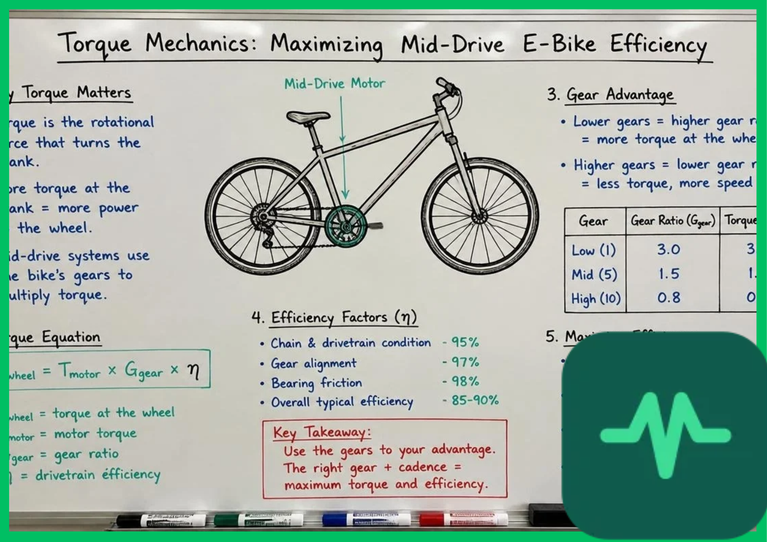
- Shift gears efficiently. Starting from a dead stop in a high gear places a massive electrical surge on the motor and battery. Always downshift before stopping, just like you would on a traditional bicycle.
By adopting these simple maintenance and riding habits, you will protect your battery's health, extend your riding range, and enjoy years of reliable electric assistance.

Comments (0)
Login to leave a comment.
No comments yet. Be the first to share your thoughts!