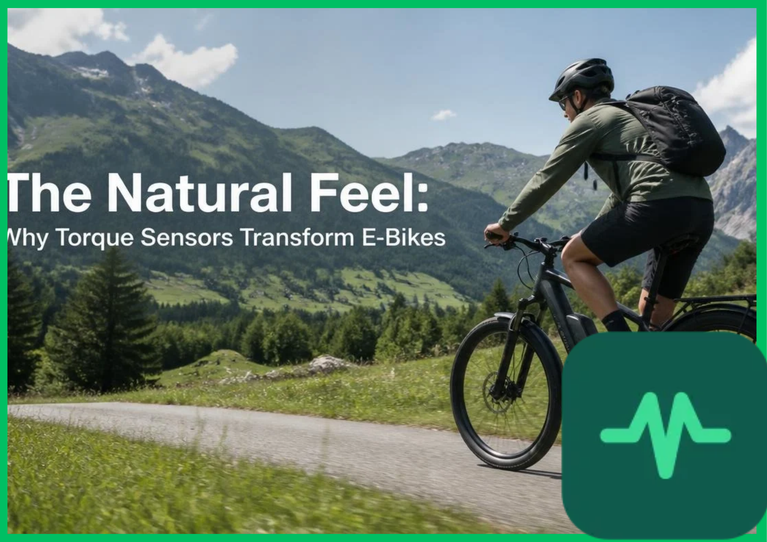
You grip the handlebars. You push your foot down against the pedal.
Instead of a jerky, robotic shove from behind, the bike responds instantly. It feels like your own legs suddenly gained superpowers.
The machine moves forward smoothly, matching your effort step for step.
That effortless connection changes everything.
For years, early electric bicycles felt awkward to ride. They lacked grace.
When you pedaled, you waited a second for the motor to react. When you stopped pedaling, the motor kept pushing for an uncomfortable moment.
That clumsy lag made riding feel unnatural.
If electric bikes are going to replace cars for millions of daily commuters around the globe, they cannot feel like awkward machines. They have to feel like real bicycles.
A quiet technological evolution is making e-bikes feel completely human.
According to global clean transport reports from the International Energy Agency (IEA), resource efficiency frameworks from the United Nations Environment Programme (UNEP), appliance efficiency standards from ENERGY STAR, and academic drivetrain research, torque sensor electric bicycles are transforming personal mobility.
By measuring rider effort instantly and adjusting power with absolute precision, advanced sensors bridge the gap between human muscle and electric power.
Here is how torque sensors work, why cadence-based systems feel unnatural, and how responsive motor tuning shapes our sustainable future.
The Clumsy Physics of Older E-Bikes
To understand why torque sensors matter so much, you have to look at how older electric bikes tried to help you ride.
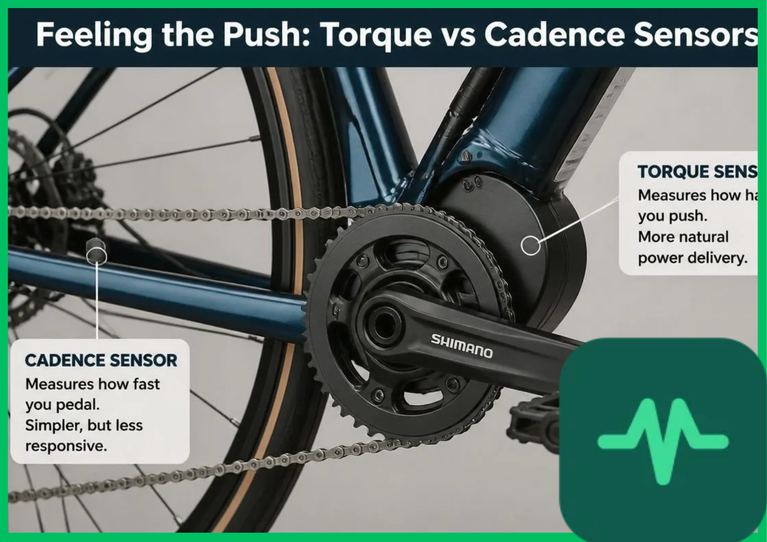
Most budget-friendly e-bikes rely on simple cadence sensors.
A cadence sensor is essentially a magnet ring attached to your bottom bracket alongside a small electronic reader.
The sensor has one job. It answers a single question: Are the pedals spinning?
If your feet are turning the cranks, the sensor tells the motor to turn on at a preset power level.
If your feet stop, the motor turns off.
That binary on-off system creates a frustrating riding experience.
Imagine approaching a tight corner on a city street. You stop pedaling to coast through the turn. Because of electronic lag, the motor keeps pushing for another full second.
You feel a sudden, unwanted surge of speed right when you want control.
When you start pedaling again from a standstill, you wait a frustrating moment while the system catches up.
Cadence sensors treat human riders like an on-off switch.
Human beings do not ride bikes like light switches. We ride with nuance, rhythm, and changing pressure.
We needed a sensor that understood human touch.
What Is a Torque Sensor?
A torque sensor takes a completely different approach to electric assistance.
Instead of checking whether your pedals are spinning, a torque sensor measures how hard you are pushing against them.
Inside the bottom bracket or crank axle, sensitive strain gauges or magnetic measuring rings detect microscopic bending forces every time your foot presses down.
If you press lightly on the pedals while cruising down a gentle hill, the sensor tells the motor to add a whisper of help.
If you hit a steep incline and mash your feet hard against the pedals to fight the grade, the sensor detects that heavy load instantly.
The motor roars to life, matching your muscle force with proportional electric power.
You push twice as hard. The motor gives you twice as much help.
The bicycle stops feeling like a motorized scooter and starts feeling like an extension of your own body.
The Science of Natural Acceleration and Control
The difference in ride quality is profound.
Academic drivetrain studies show that torque sensor electric bicycles reduce reaction lag to milliseconds.
When you start from a stop at a busy intersection, you want instant, predictable acceleration.
With a torque sensor, the moment your foot meets resistance, the bike moves forward smoothly without lunging or slipping.
When you navigate crowded pathways or tight pedestrian spaces, you control your speed entirely through foot pressure rather than twisting a handlebar throttle or braking against a running motor.
That precise control increases safety.
Furthermore, because the motor responds instantly to human input, low-speed maneuvers become remarkably graceful.
You turn tightly, balance on climbs, and navigate rough terrain with absolute confidence.
Saving Battery Range Through Responsive Tuning
Torque sensors do more than improve ride feel. They save energy and extend your battery life.
Cadence-controlled motors often pump out maximum power regardless of whether you are climbing a mountain or coasting on flat pavement, wasting valuable electricity.
According to ENERGY STAR efficiency metrics and academic battery research, torque-sensing systems sip power conservatively.
Because the motor only delivers power when the rider is actively working hard, it avoids unnecessary energy waste.
On a flat stretch with a tailwind, your legs do the work, and the motor rests. When a headwind hits or a hill rises, the motor steps in seamlessly.
That intelligent power management stretches your battery range significantly on every single charge, letting you travel longer distances without needing to plug in.
Riding Toward a Sustainable Future
Torque sensor technology proves that electric mobility does not have to sacrifice the pure joy of traditional cycling.
We no longer have to choose between the exercise of a human-powered bicycle and the convenience of an electric motor.
By combining sensitive strain measurements, natural pedal assist response, and smooth acceleration tuning, torque sensors elevate the humble e-bike into a sophisticated daily transport tool.
According to UNEP sustainable transport frameworks, making e-bikes intuitive and enjoyable encourages more people to replace car trips with electric bicycle commuting, cutting urban carbon emissions drastically.
IEA clean mobility reports highlight that scaling up efficient micro-mobility accelerates global energy decarbonization.
Whether you commute through crowded city streets or explore quiet country lanes, a torque-sensing e-bike transforms your journey.
Through brilliant engineering, intuitive design, and joyful human movement, torque sensors secure a cleaner, more sustainable future for our world.

Comments (0)
Login to leave a comment.
No comments yet. Be the first to share your thoughts!