Instantly, a quiet hum rises from the frame, and a smooth wave of power pushes you forward.
That seamless blend of human effort and electric assistance feels almost magical.
For urban commuters, recreational riders, and daily travelers, electric bikes transformed how we move through our towns and cities. They make steep hills feel flat and long distances manageable.
Behind that effortless glide, however, lies a vital piece of technology that shapes your entire riding experience.
According to urban transport assessments from the United Nations Environment Programme (UNEP), International Energy Agency (IEA) efficiency studies, and academic research on micromobility, the pedal-assist mechanism dictates how an e-bike responds to your body.
When shopping for an urban commuter bicycle, you will encounter two primary sensor technologies: cadence sensors and torque sensors.
Here is how pedal-assist mechanics work, what sets these two systems apart, and how to choose the right setup for your ride.
The Hidden Link Between Your Legs and the Motor
To understand why sensor choice matters so much, you have to look at how an e-bike communicates with its rider.
An electric bike is not a motorcycle. It does not move forward simply because you twist a throttle.
With standard pedal-assist systems, the motor only activates when your feet are actively turning the cranks.
The onboard computer needs to know two things: are your pedals moving, and how hard are you pushing?
The sensor answers those questions.
If the sensor is slow, sluggish, or poorly calibrated, the motor feels jerky, unpredictable, and disconnected from your natural rhythm.
If the sensor is tuned well, the motor becomes a natural extension of your own muscles, amplifying your strength without overriding your control.
Cadence Sensors: The Steady Push
Cadence sensors represent the traditional approach to e-bike pedal assistance.
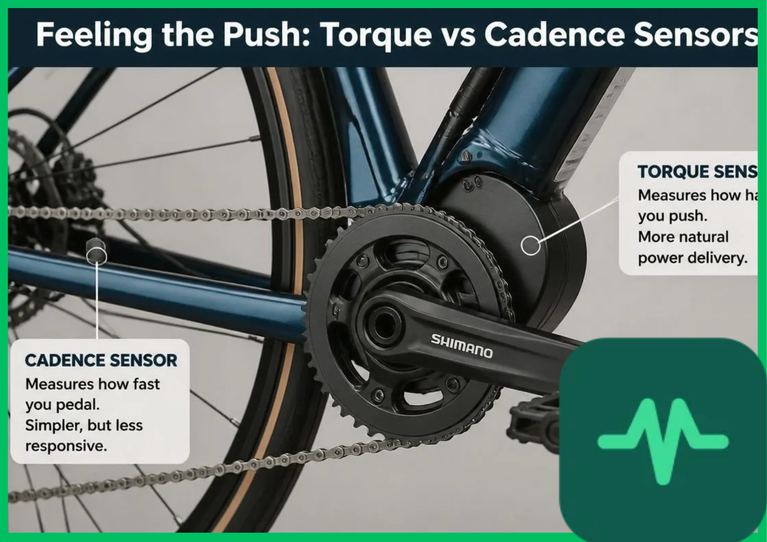
A cadence system uses a small ring of magnets mounted near the crankset and a stationary detector attached to the frame.
As you pedal forward, the magnets spin past the sensor. The system detects that your cranks are rotating and instantly signals the motor to turn on.
Think of a basic cadence sensor as an electronic on-off switch. Once your pedals complete a fraction of a rotation—often about a quarter turn—the motor delivers a pre-set level of power based on the assist setting you selected on your handlebar display.
The primary benefit of a cadence sensor is low effort. Because the system reacts to rotation rather than pressure, you do not need to stomp hard on the pedals to get full assistance. You simply keep your legs spinning at a comfortable rate, and the motor carries a major share of the workload.
This makes cadence-based e-bikes popular for relaxed cruising, casual neighborhood riding, and commuters who want to arrive at their destination without breaking a sweat.
The trade-off is feel. Because the motor responds to movement rather than force, there can be a brief lag when you start pedaling, followed by an abrupt surge of power.
When you stop pedaling, the motor may continue pushing for a fraction of a second before cutting out. In tight traffic or crowded pedestrian paths, that delay requires extra attention from the rider.
Torque Sensors: The Natural Bicycle Feel
Torque sensors take a completely different engineering approach. Instead of measuring whether your pedals are turning, a torque sensor measures how hard you are pressing on them.
Hidden inside the bottom bracket, chainring, or rear dropout, specialized strain gauges measure the physical force of your foot strike thousands of times every second.
When you push harder on the pedals—such as when accelerating from a stop or climbing a steep hill—the torque sensor detects that increased pressure and tells the motor to deliver more power instantly.
When you ease off your pedaling pressure, the motor scales back its assistance right away.
This creates a remarkably natural riding experience. The bike feels exactly like a traditional, unassisted bicycle, except your legs suddenly possess super-human strength.
If you want a gentle workout, you pedal lightly and receive minimal motor support. If you want speed, you push harder and the motor roars to life in direct proportion to your effort.
Academic mobility studies show that torque sensors excel in complex urban environments. When threading through tight spaces, waiting at busy intersections, or navigating slow-moving traffic, precise low-speed control matters. Because torque sensors respond to pressure rather than rotation speed, you can make micro-adjustments to your speed without surging forward unexpectedly.
Motor Efficiency and Battery Range
The choice between a torque sensor and a cadence sensor extends far beyond comfort; it directly impacts energy consumption.
Energy efficiency is a central focus of modern electrical research and appliance standards.
Because torque sensors match your exact pedaling effort, they draw power from the lithium-ion battery only when you actively demand it.
If you are coasting down a slight slope or cruising on flat pavement with light pedaling, the motor output drops to zero or near-zero.
Cadence systems, by contrast, tend to deliver a flat, uniform level of power whenever the pedals are spinning.
If you spin your legs lazily on a cadence bike, the motor still pushes with the full force of your selected assist level, consuming battery capacity faster.
Over the course of a long daily commute spanning 10 to 20 kilometers (approx. 6 to 12 miles), a well-tuned torque-sensing system often preserves battery range more effectively, stretching your mileage between charges.
Selecting the Right Ride for Your Lifestyle
Choosing between a torque sensor and a cadence sensor depends entirely on how you like to ride.
If your primary goal is effortless transportation—getting to work quickly without exerting heavy physical effort while enjoying a steady cruising speed—a reliable cadence-sensor e-bike is a practical, budget-friendly choice.
If you value precise low-speed handling, want your e-bike to feel like a traditional bicycle, or enjoy the cardiovascular engagement of a fitness ride, a torque-sensor model is worth every penny.
Do not judge an electric bicycle by its spec sheet alone. Always test ride different models to see how their pedal-assist mechanics handle starts, stops, and hills.
Finding the right sensor ensures that every journey remains safe, efficient, and deeply satisfying.

Comments (0)
Login to leave a comment.
No comments yet. Be the first to share your thoughts!