The wind rushes past you. The bike accelerates smoothly.
On a traditional bicycle, you pull hard on the brake levers to control your speed. Friction pads squeeze tightly against the metal wheel rims or disc rotors, turning all your forward momentum into heat energy that radiates harmlessly into the air.
That energy is gone forever.
For decades, that loss of kinetic energy was accepted as an unavoidable fact of transport physics.
A quiet engineering shift is changing how electric two-wheelers manage momentum.
According to urban transport reports from the United Nations Environment Programme (UNEP), International Energy Agency (IEA) efficiency studies, and academic research on electric vehicle powertrains, regenerative braking is transforming e-bikes.
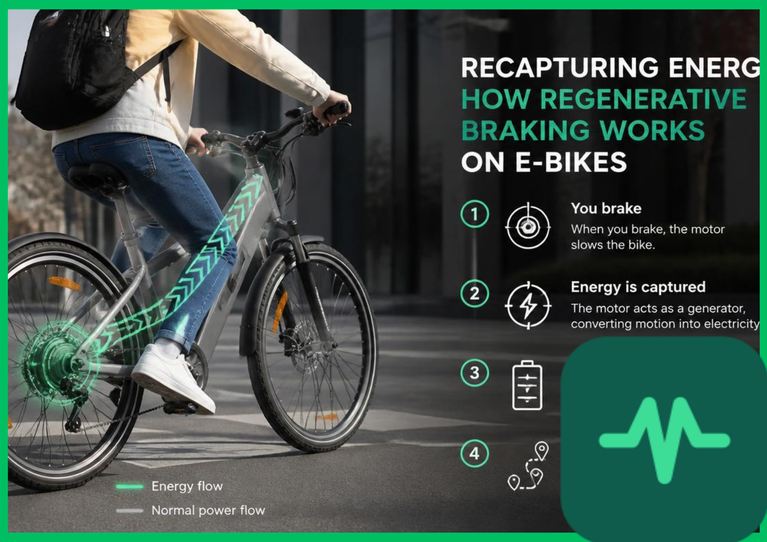
Instead of throwing away your kinetic energy as waste heat, regenerative braking captures that energy and pumps it right back into the battery.
Here is how energy recovery works, why electromagnetic physics make it possible, and how regenerative braking extends your riding range.
The Hidden Waste of Friction Braking
To understand why regenerative braking is such a brilliant innovation, you have to look at what happens when you slow down a heavy vehicle.
Moving mass carries kinetic energy.
When you accelerate an electric bicycle up to speed, energy from the lithium-ion battery converts into forward motion.
When you apply traditional mechanical brakes to stop, all that stored kinetic energy has to go somewhere.
Friction brakes convert movement back into thermal energy through physical rubbing.
If you descend a long, steep hill using only mechanical brakes, your brake pads and rotors grow dangerously hot, wearing down material quickly and wasting 100% of the energy you spent climbing up.
In heavy electric cars and trains, engineers solved this problem decades ago using regenerative braking.
Bringing that same technology down to compact e-bikes required clever miniaturization.
The Physics of Electromagnetic Reversal
The magic behind regenerative braking lies in the reversible nature of electric motors.
An electric motor does not just consume electricity to create motion; it can also consume motion to create electricity.
When you power the motor, electrical current creates a magnetic field that forces the rotor to spin.
When you activate regenerative braking, the process runs in reverse.
The mechanism relies on direct-drive hub motors.
When you engage the brake lever slightly—before the physical friction pads touch the rotor—the onboard motor controller reverses the electrical polarity.
The momentum of the rolling wheel forces the motor's internal rotor to spin against a controlled magnetic resistance.
That resistance slows the bicycle down smoothly, acting as a magnetic brake.
At the same time, the spinning rotor turns the motor into a generator.
It converts your forward kinetic energy back into electrical current, sending a rush of power surging back down through the wiring harness to recharge the lithium-ion battery pack.
Real-World Range Extension and Efficiency
Capturing kinetic energy sounds incredible on paper, but how much power do you actually recover in the real world?
Academic electric vehicle studies and IEA transport efficiency reviews show that the benefits depend heavily on your riding environment.
If you ride exclusively on flat, straight city streets with minimal stops, regenerative braking adds only a small percentage to your overall battery range.
The technology shines brightest in specific conditions:
- Rolling hills and steep descents
- Dense urban environments with frequent stop-and-go traffic
- Long commuter routes requiring regular speed adjustments
When you descend a long hill using regenerative braking, instead of wearing out your brake pads, you top up your battery pack.
You arrive at the bottom of the slope with more charge than when you started climbing.
In stop-and-go city traffic, capturing energy every time you slow down for a traffic light prevents electrical waste, stretching your total mileage between plug-in charges.
Engineering Challenges and Smart Controls
Implementing regenerative braking on a lightweight e-bike introduces unique engineering hurdles.
If a regenerative braking system engages too aggressively, it locks up the rear wheel, causing a skid on wet or gravel-covered pavement.
Safety is paramount.
Modern e-bikes use intelligent motor controllers equipped with advanced software algorithms.
These controllers modulate the braking force smoothly, ensuring that magnetic deceleration feels natural, gradual, and completely stable under all riding conditions.
Furthermore, the battery management system must regulate the incoming surge of electrical current carefully to protect the lithium-ion cells from overcharging stress.
Riding Toward a Smarter, Sustainable Future
Regenerative braking proves that efficiency in electric transport is about more than just building better batteries. It is about capturing every available joule of energy.
By turning deceleration from a wasteful friction chore into an energy-recovery opportunity, e-bikes become smarter and more self-sustaining.
We are redefining how urban mobility interacts with the laws of physics.
Through intelligent energy recovery, every stop and descent feeds your journey forward, lighting our path toward a truly efficient, zero-emission future.

Comments (0)
Login to leave a comment.
No comments yet. Be the first to share your thoughts!