Electric bicycles transformed urban commuting. They offer a clean, affordable, and joyful way to move through crowded streets without burning fossil fuels.
Yet, hidden inside the sleek frames of these machines lies a powerful energy source.
When treated with respect, lithium-ion batteries serve us brilliantly. When neglected or poorly manufactured, they carry real hazards.
Recent incident reports highlight that high-capacity e-bike battery safety is one of the most critical challenges facing modern urban transport.
According to tracking data from international energy groups, urban environment assessments from the United Nations Environment Programme (UNEP), and academic safety research, ensuring battery reliability is essential for the future of clean mobility.
Here is how modern safety protocols work, why proper certification matters, and how we protect riders on every journey.
The Growth and Challenges of Urban Micromobility
To understand why battery safety matters so much, you have to look at the explosive growth of urban micromobility.
Millions of riders worldwide swapped cars and crowded buses for e-bikes, cutting urban air pollution and easing traffic congestion.
These compact vehicles rely on dense packs of lithium-ion cells.
Those are the exact same chemistry types that power laptops, smartphones, and full-sized electric cars.
However, e-bike batteries operate under grueling physical conditions. They face constant vibrations, heavy mechanical stress, rain exposure, dust, and rapid charging cycles.
When a battery pack suffers from manufacturing defects, physical damage, or incompatible chargers, the consequences can be severe.
Academic safety studies and fire prevention reports reveal that compromised cells can experience internal short circuits, leading to rapid overheating.
We needed a universal standard to guarantee that every battery entering the market meets strict safety thresholds.
Decoding UL 2849 Certification Standards
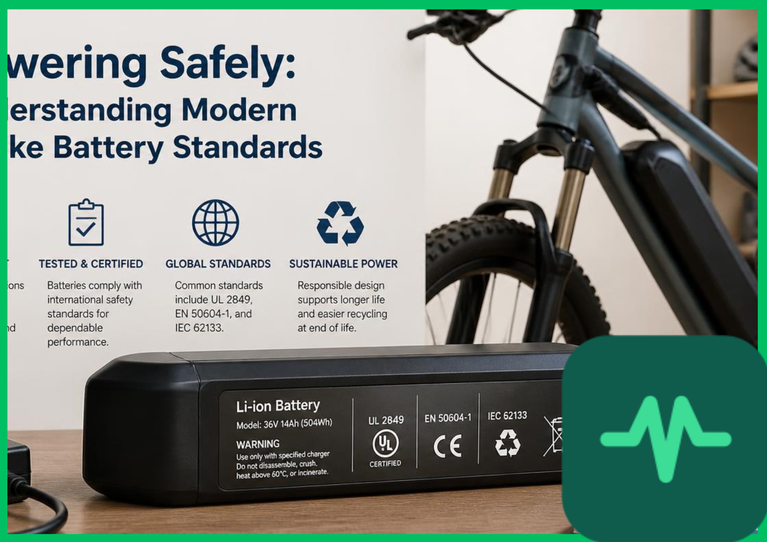
The gold standard for protecting riders and communities is rigorous third-party system certification.
Chief among these frameworks are recognized safety benchmarks like UL 2849 certification standards.
Many cheap e-bikes on the market advertise that they use individual cells from reputable brands like Samsung or Panasonic.
That claim sounds reassuring, but it misses a critical engineering truth. A good cell alone does not guarantee a safe bicycle.
Comprehensive standards test the entire electrical system as an integrated whole.
The charger, the wiring harness, the motor control unit, the battery management system, and the battery pack itself must work together flawlessly.
Independent laboratories test these systems against electrical overloads, short circuits, water ingress, and mechanical shocks.
When an e-bike carries full system certification, it proves that engineers designed every component to contain potential electrical faults before they ever reach the consumer.
Advanced Lithium-Ion Thermal Management
At the heart of every safe battery pack is advanced engineering designed to control heat.
Lithium-ion thermal management separates safe systems from dangerous ones.
During heavy riding up steep hills or rapid charging, batteries naturally generate warmth.
If heat builds up faster than the pack can dissipate it, a dangerous chain reaction called thermal runaway can begin.
During thermal runaway, a failing cell reaches high temperatures (exceeding 200 degrees Celsius or approx. 392 degrees Fahrenheit), triggering neighboring cells to overheat in a self-reinforcing loop.
Modern high-safety batteries prevent this hazard using intelligent Battery Management Systems (BMS).
The BMS acts as the brain of the pack, continuously monitoring voltage, current, and temperature across every individual cell group.
If the system detects a temperature spike or abnormal voltage drop, the BMS cuts power instantly, halting potential danger before it starts.
Cell Chemistry Upgrades and Long-Term Reliability
Safety is not just about electronic safeguards; it is rooted in the chemistry of the cells themselves.
Recent academic materials research highlights continuous cell chemistry upgrades aimed at improving thermal stability.
Manufacturers are shifting toward more stable cathode chemistries that resist degradation even under heavy physical stress and extreme ambient temperatures.
These advanced cells maintain structural integrity across wide thermal ranges—from freezing winter conditions (-10 degrees Celsius or 14 degrees Fahrenheit) to scorching summer heatwaves (40 degrees Celsius or 104 degrees Fahrenheit).
Furthermore, robust physical casings protect the delicate inner matrix from puncture impacts and moisture damage, ensuring long-term reliability over thousands of riding miles.
Protecting Your Ride Every Day
Achieving safety is a shared responsibility between manufacturers and riders.
Once you own an e-bike, your daily habits dictate the ongoing health of your battery.
Always use the original manufacturer-approved charger designed specifically for your system. Cheap generic fast chargers bypass internal safety controls and stress the cells.
Avoid leaving your battery charging unattended for hours, and store it at moderate ambient temperatures out of direct sunlight.
Regularly inspect your battery casing for any signs of physical cracking or swelling.
Riding Forward With Confidence
Urban micromobility holds the key to cleaner, quieter, more connected cities.
We do not have to sacrifice safety to enjoy the freedom of electric cycling.
By demanding rigorous safety standards, supporting advanced lithium-ion thermal management, and practicing smart charging habits, we protect our homes and communities.
Understanding battery safety ensures that every ride remains an effortless, joyful step toward a sustainable future.


Comments (0)
Login to leave a comment.
No comments yet. Be the first to share your thoughts!