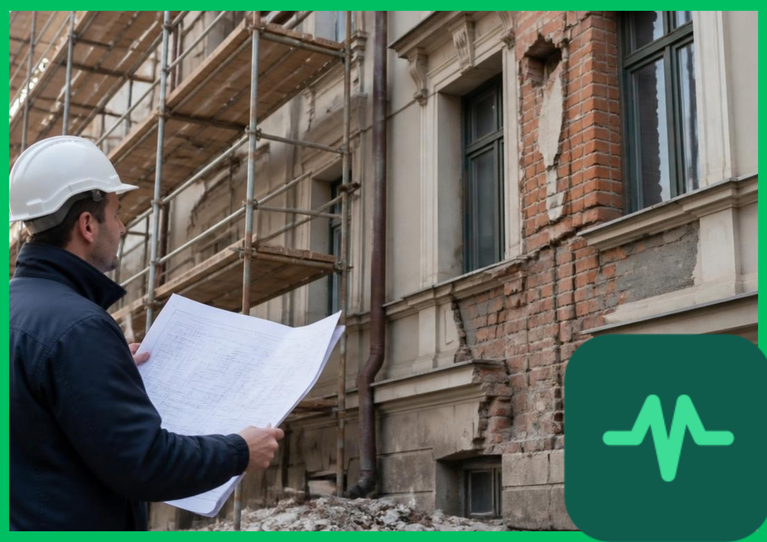
The problem starts with how long buildings last
A car gets replaced within a decade or two. A building can last fifty years, a hundred years, sometimes longer. This means mistakes made today don't just linger for a few years. They linger for generations.
An inefficient building built today could still be wasting energy well into the next century, long after better designs and materials have become the obvious, standard choice.
Why materials themselves are part of the problem
Buildings aren't just about the energy they use once finished. Making the materials that go into them, especially cement and steel, releases significant emissions before construction even begins.
This is called embodied carbon, and it's a genuinely tricky problem because it happens all at once, upfront, rather than spreading out gradually over a building's lifetime the way heating and cooling emissions do.
Why buildings involve so many separate decisions
A car comes from one factory, built as a single, complete product. A building involves dozens of separate decisions, made by different people, at different times. The architect chooses a design. A separate company supplies the concrete. Another installs the heating system.
This fragmented process makes it genuinely harder to coordinate improvements across an entire building, compared to a single factory simply deciding to build a more efficient product.
Why renovation is even harder than new construction
New buildings can be designed efficiently from scratch. Existing buildings present a much harder problem. Retrofitting an old building, adding insulation, replacing heating systems, upgrading windows, is often more expensive and disruptive than building something new from the ground up.
Yet most of the buildings that will exist even decades from now already exist today. This means renovation, not just new construction standards, has to be part of any genuine solution.
Why building codes vary so much around the world
Every country, and often every city, sets its own building codes and standards. Some regions have updated theirs to require strong energy performance. Others still allow older, less efficient construction methods.
This patchwork approach means progress happens unevenly, with some areas moving quickly while others lag considerably behind, based on differing regulations rather than differing technology alone.
Why cost remains a genuinely honest barrier
Building with better materials and better insulation often costs more upfront, even though it typically saves money over the building's lifetime through lower energy bills.
This upfront cost creates a genuine, honest barrier, especially for affordable housing projects, where every additional dollar spent during construction is a real, immediate concern that can't simply be waved away by pointing to distant future savings.
Why the scale of new construction makes this urgent
Cities around the world continue growing rapidly, meaning enormous amounts of new construction keep happening every single year. This creates urgency, since building inefficiently today locks in decades of wasted energy tomorrow.
At the same time, this scale of construction also represents a genuine opportunity. Getting new buildings right from the start avoids needing an expensive, difficult renovation later.
What genuine progress actually looks like
Despite these challenges, real progress has happened. Buildings have become measurably more energy efficient over the past decade, even as far more of them have been built.
Stronger building codes in various regions, growing use of on-site renewable energy, and gradually improving materials all represent real, working solutions, not just theoretical possibilities still waiting to be proven.
Why solving this requires patience alongside urgency
Unlike a software update that can roll out overnight, meaningful building improvements happen gradually, one construction project and one renovation at a time. This makes the sector frustratingly slow compared to faster-moving areas like clean energy generation.
Recognizing this reality doesn't mean accepting slow progress as good enough. It means understanding that genuine solutions require sustained, patient effort across many years, not a single dramatic breakthrough.
Why individual choices still genuinely matter here
Even within this larger, slow-moving system, individual decisions about materials, insulation, and heating systems in any single building genuinely add up over time. Every well-built building becomes part of the eventual solution, rather than part of the ongoing problem.
This is worth remembering if you're ever in a position to influence a building's construction or renovation, whether that's your own home or something larger.
The bottom line
Buildings remain one of the hardest sectors to clean up because of how long they last, how many separate decisions shape them, and how significant their material emissions are before they're even finished.
Real progress is happening, but the sector's fundamental complexity means solutions unfold gradually rather than overnight. Understanding this honest difficulty helps set realistic expectations, while also highlighting exactly why continued investment and attention here matter so much.

Comments (0)
Login to leave a comment.
No comments yet. Be the first to share your thoughts!