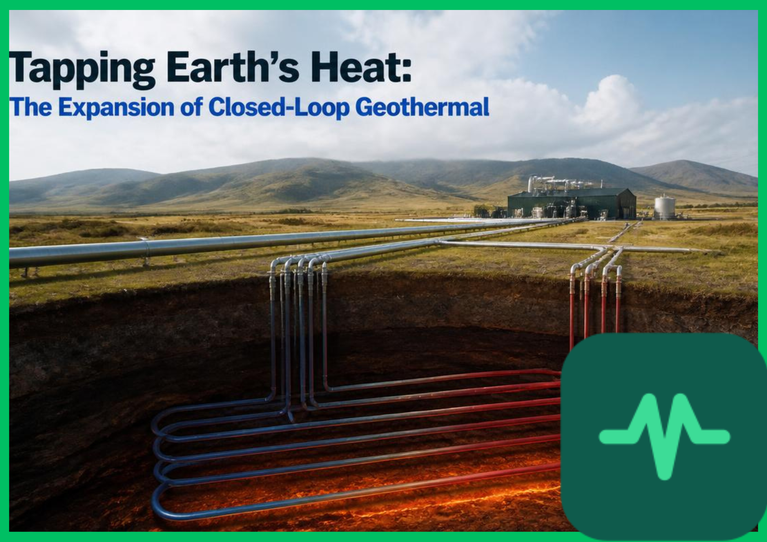
Beneath your feet, hidden miles down in the deep crust of the planet, lies a colossal, inexhaustible engine.
For centuries, harnessing that subterranean heat required a stroke of geological luck. Traditional geothermal power plants could only operate where nature provided naturally occurring hot water reservoirs, steam vents, and permeable rock formations near the surface.
If your region lacked those specific geological gifts, geothermal energy remained completely out of reach.
That limitation is vanishing.
According to reports from the International Energy Agency (IEA), academic energy studies, and advanced engineering trials, a new technology is breaking down geographic barriers.
It is called closed-loop geothermal.
Here is how subsurface heat extraction works, why enhanced geothermal scaling is changing the energy landscape, and how tapping Earth's heat provides continuous clean baseload power anywhere on the planet.
The Geographic Limits of Traditional Geothermal
To understand why closed-loop technology is a breakthrough, you have to look at how legacy geothermal energy worked.
Traditional power plants required three specific elements: intense underground heat, trapped water, and permeable rock formations.
Drilling teams searched for natural hydrothermal pockets. When they struck hot water or steam, they pumped those native fluids directly to the surface to spin turbine generators.
This approach worked wonderfully in volcanic regions like Iceland, New Zealand, or parts of western North America.
For the rest of the world, however, the subsurface geology was uncooperative. The rock was hot, but it was dry and tight, lacking the natural water pathways needed to transport thermal energy upward.
Furthermore, pumping native underground fluids to the surface often caused mineral scaling, corrosion, and pressure depletion in the reservoir.
Geothermal energy was locked to specific coordinates on the map.
Engineers needed a way to harvest underground heat without relying on natural underground water pockets.
What Is a Closed-Loop Geothermal System?
Closed-loop geothermal systems bypass the limits of traditional geology entirely.
Instead of pumping native groundwater or steam from deep rock formations, a closed-loop system isolates its working fluid completely.
The mechanism relies on a sealed network of deep boreholes.
Drilling crews bore deep down into hot dry rock—reaching depths of 3,000 to 5,000 meters (approx. 10,000 to 16,000 feet) or more, where temperatures soar.
Specialized steel casings and downhole heat exchangers form a continuous, sealed loop.
A clean working fluid—such as water or a specialized engineered fluid—is pumped down through the inner tubing.
As the fluid travels deep into the earth, it absorbs thermal energy conducted outward from the surrounding hot rock through the walls of the sealed wellbore.
The heated fluid then flows back up to the surface under high pressure, where its thermal energy is converted into electricity or channeled directly into district heating networks.
The fluid never touches the surrounding rock or mixes with native subsurface minerals. It circulates in a completely closed loop, returning underground to absorb more heat in an endless, continuous cycle.
The Power of Continuous Clean Baseload
The greatest advantage of closed-loop geothermal energy lies in its reliability.
Wind turbines spin only when the wind blows. Solar panels generate electricity only when the sun shines.
Both renewable sources require massive battery storage or grid balancing to manage inevitable weather fluctuations.
Geothermal energy operates differently.
The deep interior of the Earth provides a steady, unrelenting thermal output unaffected by weather, clouds, or time of day.
Academic energy studies confirm that closed-loop geothermal systems deliver continuous clean baseload power 24 hours a day, 365 days a year.
A single deep geothermal installation provides reliable electricity and thermal energy around the clock, stabilizing power grids and reducing the heavy reliance on fossil fuel peaking plants.
Enhanced Geothermal Scaling and Future Horizons
Scaling up closed-loop geothermal technology requires solving major engineering hurdles, primarily related to high drilling costs and deep rock mechanics.
Drilling miles into hard crystalline rock demands advanced rigs, high-temperature drill bits, and durable downhole materials.
Fortunately, innovations borrowed from the oil and gas sector—combined with rapid advancements in automated drilling and advanced thermal modeling—are driving down capital expenditures.
Furthermore, repurposing abandoned oil and gas wells into closed-loop geothermal heat exchangers offers a brilliant shortcut, slashing drilling costs while giving expired fossil fuel infrastructure a clean, sustainable second life.
As IEA transition roadmaps emphasize, next-generation geothermal energy holds vast untapped potential to supply a significant share of global clean electricity and industrial heating.
Unlocking an Inexhaustible Global Energy Source
Tapping Earth's heat changes our relationship with energy.
We stop relying on fleeting weather conditions or finite, polluting fossil fuels.
By scaling up closed-loop geothermal systems, we unlock an abundant, invisible power source right beneath our feet.
Wherever you stand on the globe, the Earth is radiating clean, endless warmth.
By building sealed subterranean heat exchangers, we harness that power safely, delivering reliable baseload electricity and securing a truly sustainable future for generations to come.
Comments (0)
Login to leave a comment.
No comments yet. Be the first to share your thoughts!