
For generations, human civilization burned coal, oil, and gas without counting the cost. We pumped billions of tons of carbon dioxide into the air.
Cutting emissions is no longer enough. Even if we stopped burning fossil fuels today, centuries of accumulated carbon would still linger in the atmosphere, warming our oceans and melting our polar ice.
We need to stop adding new pollution.
We also need to clean up the mess we already made.
What if we could build giant machines that pull carbon dioxide straight out of the open air?
What if we could scrub the sky clean like an air filter in a dusty room?
A quiet, brilliant technological revolution is rising across the globe.
According to global climate reports from the International Energy Agency (IEA), resource protection frameworks from the United Nations Environment Programme (UNEP), efficiency benchmarks from ENERGY STAR, and academic chemical research, direct air capture technology is changing our environmental horizon.
By using mechanical fans and chemical filters to capture atmospheric carbon and lock it away deep underground, we turn carbon removal into a reality.
Here is how direct air capture works, why engineered carbon removal changes climate math, and how scrubbing the sky secures our sustainable future.
The Hard Math of Atmospheric Carbon
To understand why direct air capture matters so much, you have to look at the sheer scale of our atmospheric challenge.
Carbon dioxide is a trace gas.
It makes up a tiny fraction of the air around us—roughly 420 parts per million.
That sounds like a small number.
Yet spread across the entire globe, that concentration adds up to trillions of tons of heat-trapping gas.
Capturing carbon straight from the open air is like trying to find a single grain of salt in an Olympic-sized swimming pool.
Early critics mocked the idea. They argued that filtering ambient air was too energy-intensive and too expensive to ever work at scale.
Scientists and chemical engineers refused to give up.
They knew that nature already scrubs carbon using forests and oceans, but those natural sinks are overwhelmed by human emissions.
We needed an artificial ally.
We needed machines that could accelerate carbon removal with industrial precision.
What Is Direct Air Capture Technology?
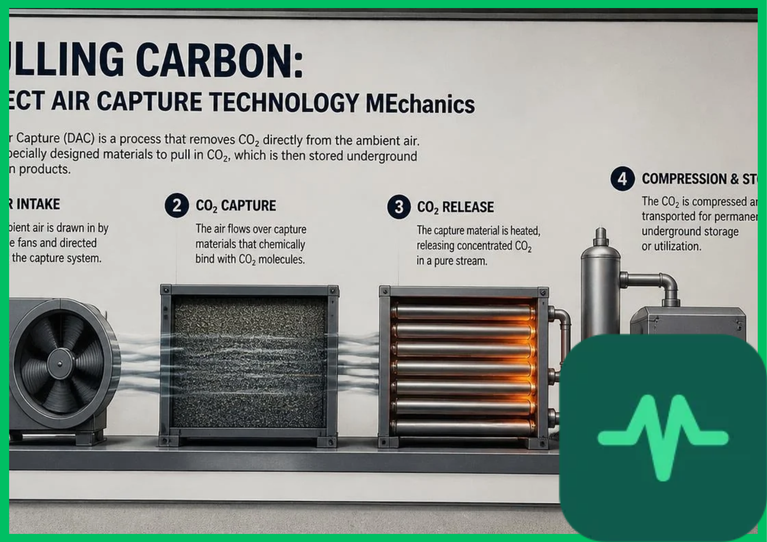
Direct air capture technology is an engineered industrial system that uses massive electric fans to pull ambient air through porous chemical filters or liquid solvent baths, capturing carbon dioxide molecules while releasing clean air back into the atmosphere.
Once the filters are saturated with carbon, the system seals shut.
Thermal energy heats the material up, releasing a pure, concentrated stream of carbon dioxide gas.
That captured carbon is compressed into a liquid state and pumped deep underground into basalt rock formations or saline aquifers.
Deep beneath the earth's crust, the carbon reacts with minerals over time, turning permanently into solid stone.
It is locked away from the atmosphere forever.
The air is scrubbed, the carbon is buried, and the cycle repeats endlessly.
The Science of Chemical Solvents and Solid Sorbents
How do chemical filters capture an invisible, dilute gas from the passing wind without consuming more energy than they save?
It comes down to advanced electrochemistry and materials science.
Academic chemical research shows that direct air capture systems rely on two primary technological approaches:
- Liquid Solvent Systems: Air passes through a tall tower where a liquid chemical solution—usually potassium hydroxide—washes over the air and binds with carbon dioxide molecules.
- Solid Sorbent Systems: Air blows through lightweight solid filter materials treated with chemical amines that grab carbon molecules like a microscopic sponge.
When heated to moderate temperatures—roughly 100°C or 212°F—the filters release the trapped carbon.
Engineers power these thermal regeneration cycles using waste heat from industrial plants or clean electricity from dedicated solar and geothermal arrays.
According to ENERGY STAR and international industrial efficiency evaluations, optimizing thermal recovery loops reduces total energy consumption by up to 40%, making large-scale carbon removal far more sustainable.
Environmental Integrity and Permanent Storage
The benefits of direct air capture technology extend far beyond pulling pollution out of the wind.
They provide a permanent safety net for hard-to-decarbonize industrial sectors like aviation, shipping, and steel manufacturing.
Some industrial processes cannot eliminate 100% of their emissions immediately.
Direct air capture neutralizes those residual emissions, achieving true net-zero balance across the global economy.
According to UNEP resource governance frameworks, carbon removal facilities must meet strict environmental integrity standards, ensuring that captured carbon is permanently sequestered underground rather than used to extract more oil through enhanced oil recovery.
According to IEA climate roadmaps, removing billions of tons of carbon dioxide annually is an essential pillar to stabilize global temperatures over the coming decades.
When humanity cleans up its historic pollution, our planetary climate begins to heal.
Overcoming Energy and Scaling Realties
Scaling direct air capture from pilot facilities to global gigaton-scale operations involves navigating real-world infrastructure hurdles.
These facilities require large amounts of clean energy and reliable access to suitable geological storage sites.
Governments and international investors are pouring capital into modular direct air capture hubs, building facilities near renewable energy parks and deep underground storage basins.
As manufacturing techniques scale up and chemical sorbents become more efficient, the cost of capturing a ton of atmospheric carbon drops steadily year by year.
Scrubbing Our Sky Toward a Sustainable Future
Direct air capture technology proves that human engineering can fix the damage we caused to our shared atmosphere.
We no longer have to accept that past carbon pollution will linger in the sky forever.
By pulling carbon dioxide straight from the wind and locking it away in stone, we turn the tide against climate change.
We step away from passive despair, embracing an active, scientific, and enduring standard of environmental stewardship.
Through brilliant chemical engineering, rigorous academic research, and a deep respect for our planetary climate, scrubbing the sky secures a clean, breathable, and sustainable future for every person on Earth.
Comments (0)
Login to leave a comment.
No comments yet. Be the first to share your thoughts!