
You look out across the rolling waves. The surface water feels warm and inviting under the bright sun.
Beneath that calm surface, hidden miles down in the dark abyss, the water turns freezing cold.
For over a century, humanity looked at the oceans as a source of food, transport, and coastal recreation.
We rarely viewed the open sea as an immense, living power plant.
When we wanted renewable energy from water, we built dams across rushing rivers or placed spinning turbines in coastal tides.
Those technologies are vital, but they depend entirely on rain, gravity, and the moon.
What if the ocean itself could generate continuous, twenty-four-hour clean electricity using nothing more than the natural temperature difference between the surface and the deep sea?
A quiet, brilliant energy frontier is expanding across tropical oceans worldwide.
According to global marine energy reports from the International Energy Agency (IEA), ocean governance guidelines from the United Nations Environment Programme (UNEP), energy efficiency frameworks from ENERGY STAR, and advanced academic oceanography research, ocean thermal energy conversion is changing our clean energy future.
By capturing deep ocean temperature gradients, marine power plants generate steady baseload electricity without burning a single drop of fossil fuel.
Here is how ocean thermal energy conversion works, why thermodynamic temperature differences drive clean power, and how sustainable aquatic energy secures our sustainable future.
The Hidden Power of Ocean Temperature Differences
To understand why ocean thermal energy conversion (OTEC) is so revolutionary, you have to look at the physics of our planet's largest solar collector.
The oceans cover over 70% of the Earth's surface.
Every single day, vast expanses of tropical ocean water absorb massive amounts of radiant energy from the sun.
The sun-drenched surface waters warm up, reaching temperatures of 25°C to 28°C (approx. 77°F to 82°F).
At the same time, cold water plunges from polar regions, flowing silently along the ocean floor into the deep abyss.
A thousand meters or roughly 3,280 feet below the surface, that deep water stays permanently cold, hovering near 4°C to 5°C (approx. 39°F to 41°F).
That creates a permanent, massive temperature difference of roughly 20°C (approx. 36°F) between the surface and the depths.
For generations, physicists knew that any time you have a sustained temperature difference, you can run a thermodynamic cycle to generate mechanical work and electricity.
The challenge was building a machine strong enough and efficient enough to capture that gentle thermal gradient.
What Is Ocean Thermal Energy Conversion?
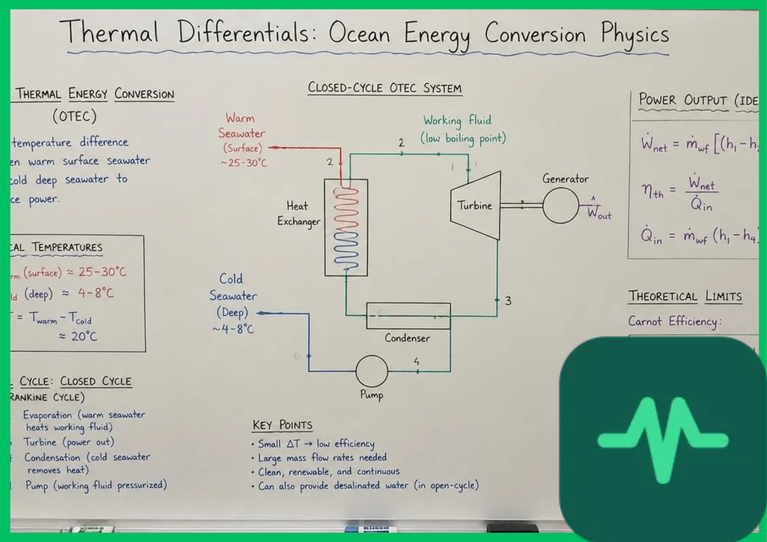
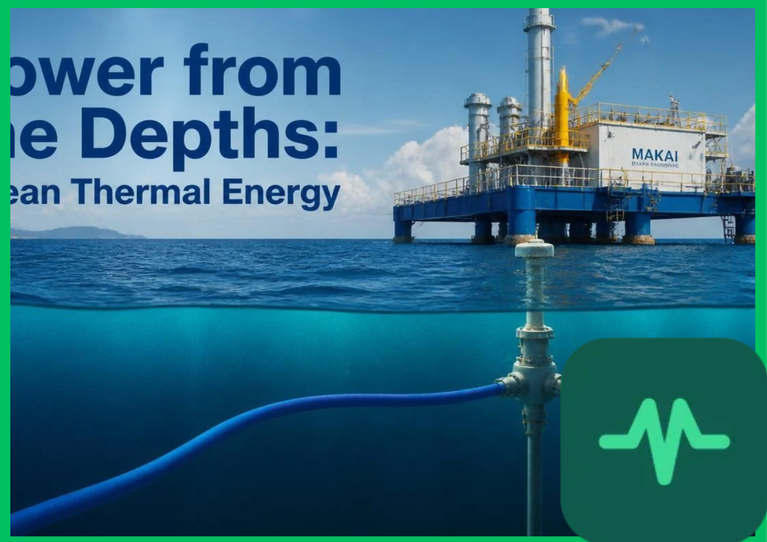
An ocean thermal energy conversion plant uses that natural temperature gap to boil and condense a working fluid in a continuous closed loop.
The engineering relies on basic thermodynamics and fluid mechanics.
There are two primary system designs used across the globe:
- Closed-Cycle Systems: Warm surface water pumps through a heat exchanger, boiling a specialized working fluid with a very low boiling point—such as ammonia—into a high-pressure gas. That gas spins a turbine, generating clean electricity. Cold deep-ocean water is then pumped up through a massive pipe to condense the gas back into a liquid, restarting the cycle.
- Open-Cycle Systems: Warm surface water enters a low-pressure vacuum chamber where it flashes directly into steam. That steam expands and spins a turbine. Cold deep water condenses the steam into pure, desalinated water, providing both clean electricity and fresh drinking water simultaneously.
Both systems run continuously, day and night, powered entirely by natural solar heat trapped in the sea.
The Physics of Thermodynamic Efficiency
The core challenge of OTEC technology lies in thermodynamic efficiency.
Unlike a coal-fired power plant or a nuclear reactor that runs on extreme temperatures of hundreds of degrees, an OTEC plant operates on a gentle temperature gradient of 20°C (approx. 36°F).
Because the temperature difference is small, the theoretical thermal efficiency is lower than combustion systems.
Academic oceanography research shows that overcoming this low efficiency requires pumping massive volumes of water through wide, durable intake pipes stretching deep into the ocean abyss.
Engineers design specialized lightweight composite pipes that withstand corrosive saltwater, extreme underwater pressure, and ocean currents.
When those large fluid volumes flow smoothly, the plant generates steady, reliable electricity without interruption.
According to IEA marine energy assessments, OTEC plants achieve a capacity factor exceeding 80% to 90%, providing dependable baseload power that rivals traditional thermal generation.
Providing Power, Fresh Water, and Sustainable Byproducts
The benefits of ocean thermal energy conversion extend far beyond electricity generation.
In many tropical island nations and coastal regions, fresh drinking water is scarce and expensive to produce.
Open-cycle OTEC systems produce pure, desalinated fresh water as a natural byproduct of steam condensation.
Furthermore, the cold, nutrient-rich deep ocean water pumped to the surface during power generation can be redirected to coastal aquaculture farms, boosting food production and supporting marine ecosystems.
According to UNEP marine governance frameworks, integrating OTEC facilities with coastal development protects local coral reefs and marine habitats by avoiding chemical pollution and thermal disruption.
ENERGY STAR efficiency guidelines highlight that utilizing natural temperature gradients requires zero fuel input, eliminating supply chain volatility and shielding communities from fluctuating fossil-fuel prices.
Harnessing the Abundant Energy of the Sea
Ocean thermal energy conversion proves that human ingenuity can find clean power in the most unexpected places.
We no longer have to accept that renewable energy is limited to windy days or sunny afternoons.
By capturing deep ocean temperature gradients, running thermodynamic closed cycles, and utilizing sustainable marine engineering, we tap into an endless reservoir of solar heat stored in the sea.
We step away from fossil combustion, embracing a continuous, weather-independent source of clean electricity and fresh water.
Through scientific persistence, brilliant marine engineering, and global vision, ocean thermal energy anchors a resilient, thriving, and fully sustainable future for our planet.

Comments (0)
Login to leave a comment.
No comments yet. Be the first to share your thoughts!