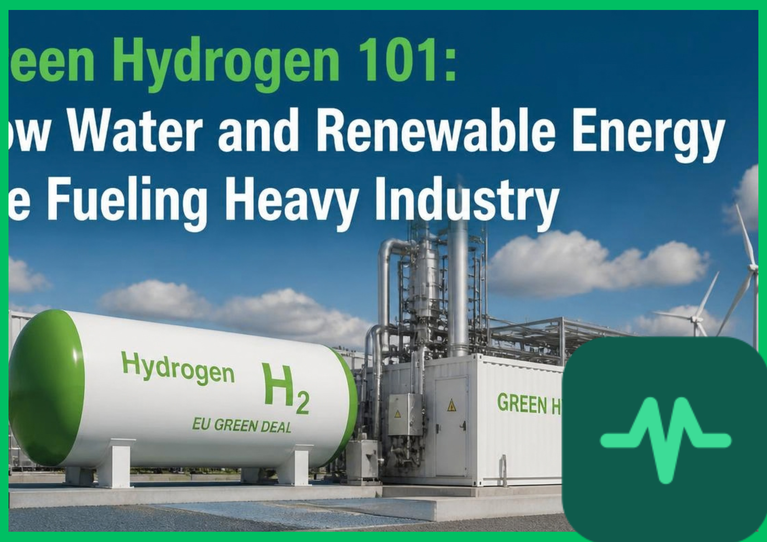
Consider passenger cars, homes, and small trucks. They fit neatly onto lithium-ion battery packs. This cannot be said of heavy cargo ships crossing oceans, long-haul freight jets, and massive steel manufacturing plants. They require immense energy density that batteries struggle to deliver.
What do we, then, need to these heavy industrial tools? We need a clean chemical fuel to power heavy industry.
Enter green hydrogen.
Green hydrogen is emerging as the zero-emission fuel of the future, created using nothing more than water and renewable electricity.
Here is how electrolysis works and how this clean fuel is decarbonizing our heaviest industries.
The Problem with Traditional Hydrogen
Hydrogen is the most abundant element in the universe. It packs massive energy density by weight, making it an ideal fuel source.
However, pure hydrogen does not exist freely on Earth. It is always bound to other elements—most commonly bonded with oxygen in water, or with carbon in fossil fuels.
Historically, almost all commercial hydrogen was produced from natural gas through a process called steam methane reforming.
While this grey hydrogen fueled industrial processes, it released massive quantities of carbon dioxide into the atmosphere, defeating the environmental purpose.
To achieve true zero emissions, we needed a clean way to produce hydrogen.
Water Electrolysis Powered by Renewables
Green hydrogen solves this problem by using water electrolysis.
An electrolyzer is a device that splits water molecules into hydrogen and oxygen using an electric current.
The chemical formula is simple: two water molecules go in, electricity is applied, and two molecules of pure hydrogen gas plus one molecule of oxygen gas come out.
The magic of green hydrogen lies in the source of that electricity.
When the electricity running through the electrolyzer comes entirely from zero-emission renewable sources—like solar farms, wind turbines, or hydroelectric dams—the entire production process leaves a zero-carbon footprint.
Decarbonizing Heavy Transport and Steelmaking
Once produced, green hydrogen can be burned in specialized combustion engines, fed into fuel cells to generate electricity, or used as a chemical reducing agent in industrial manufacturing.
In the steel industry, traditional production uses metallurgical coal to strip oxygen from iron ore, releasing vast amounts of carbon dioxide. Using green hydrogen instead of coal produces water vapor as a byproduct instead of greenhouse gases, revolutionizing green steelmaking.
Shipping fleets and aviation manufacturers are investing heavily in green hydrogen and its derivatives (like green ammonia and synthetic e-fuels) to power transoceanic cargo vessels and long-haul airplanes.
It provides the heavy-duty energy punch needed for sectors that electricity alone cannot reach.
Scaling the Hydrogen Economy
Scaling green hydrogen production requires massive global investments in renewable energy capacity and dedicated electrolyzer manufacturing.
As renewable energy prices continue to fall globally, the cost of producing green hydrogen drops alongside them.
By turning water and sunshine into clean fuel, green hydrogen provides a vital missing puzzle piece in our global transition to a zero-carbon economy.
Comments (0)
Login to leave a comment.
No comments yet. Be the first to share your thoughts!