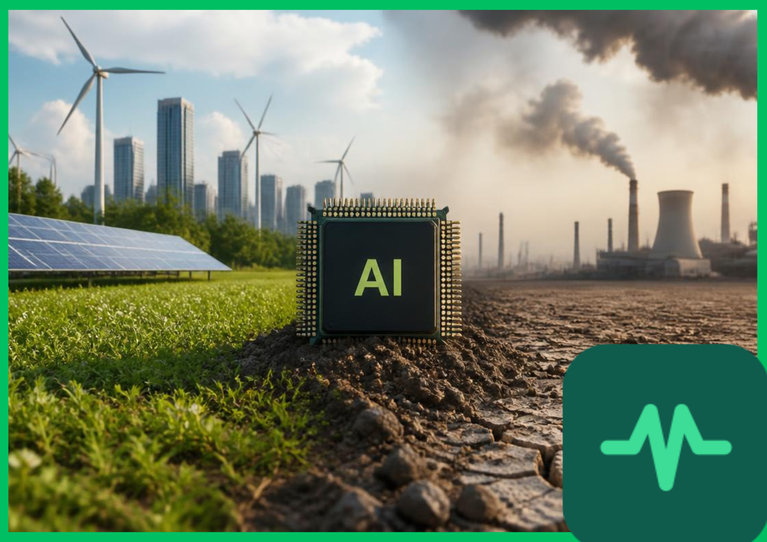
AI and Climate Change: A Complicated Relationship
The conversation around AI and climate change is becoming more important as artificial intelligence spreads across the global economy.
AI is already being used in energy, transport, manufacturing and buildings. It can process large amounts of information quickly. It can also identify patterns that humans may miss.
As a result, AI could help companies use energy more efficiently. It could reduce waste. It could also improve the performance of existing infrastructure.
However, AI and climate change cannot be viewed from only one side.
AI also needs electricity. Large data centres run the computing systems behind many AI services. They also need cooling and other infrastructure.
Therefore, AI and climate change are linked by both opportunity and risk.
The International Energy Agency (IEA) says widespread adoption of existing AI applications could lead to around 1,400 million tonnes of CO₂ emissions reductions in 2035. That would be equivalent to about 5% of energy-related emissions in that year. However, the IEA also says these reductions would still be far smaller than what is needed to address climate change.
This shows why AI and climate change should be discussed with realistic expectations.
How AI Could Reduce Emissions
One of the biggest opportunities in AI and climate change is improving the efficiency of existing systems.
Energy systems are complex. Electricity demand changes throughout the day. Renewable energy production can also change with weather conditions.
AI can help analyse these changes.
For example, AI can help energy companies predict electricity demand. Better forecasts can make it easier to balance supply and demand.
AI can also support renewable energy. Better forecasting can help operators manage solar and wind power more effectively.
Another area is industrial production.
Factories use large amounts of energy. AI can analyse production data and identify ways to reduce unnecessary energy use. It can also help improve equipment performance.
This makes AI and climate change particularly relevant to industries looking for ways to lower their environmental impact.
Buildings are another important area.
AI-powered building management systems can adjust heating, ventilation and cooling based on conditions inside a building. The IEA says optimised heating, ventilation and air-conditioning controls can produce energy savings of around 10% in some applications.
Transport could also benefit.
AI can improve route planning and vehicle operations. According to the IEA, better vehicle operations and route choices can produce efficiency gains of around 5% to 10% in some applications.
These examples show the positive side of AI and climate change.
AI Could Help Detect Environmental Problems
Another benefit of AI and climate change is the ability to detect problems earlier.
AI can process information from satellites, sensors and other monitoring systems.
For example, AI can help identify methane leaks from oil and gas operations. Faster detection can allow companies to find problems sooner.
AI can also support predictive maintenance.
Instead of waiting for equipment to fail, organisations can use data to identify possible problems earlier. This can reduce downtime and improve efficiency.
In the energy sector, AI can also help optimise power plants and electricity networks.
The IEA estimates that AI applications could unlock up to 175 gigawatts of additional transmission capacity from existing power lines.
That could become increasingly important as countries add more renewable energy.
The Energy Problem Behind AI
However, AI and climate change also have a less positive side.
AI systems require electricity.
The largest AI models need powerful computing equipment. That equipment operates in data centres. Data centres also need cooling systems and other supporting infrastructure.
As AI adoption grows, electricity demand from data centres is expected to rise.
The IEA projects that global data-centre electricity consumption could reach around 1,200 terawatt-hours by 2035 in its base case.
This creates an important question.
If AI helps one industry save energy but causes electricity demand to rise elsewhere, what is the overall environmental benefit?
That is one of the central questions surrounding AI and climate change.
Where the Electricity Comes From Matters
The climate impact of AI also depends on how its electricity is generated.
If a data centre is powered mainly by low-carbon electricity, its emissions can be lower.
However, fossil fuels still play an important role in meeting growing electricity demand from data centres.
The IEA expects renewables to meet nearly half of the additional electricity demand from data centres through 2030. At the same time, natural gas and coal are expected to remain important sources of supply.
Therefore, AI and climate change cannot be separated from the wider energy transition.
Building more efficient AI systems is important. So is building cleaner electricity systems.
AI Is Not a Climate Miracle
The biggest lesson from AI and climate change is that technology alone cannot solve the climate problem.
An AI application may have the ability to reduce emissions. But that does not mean it will automatically be adopted.
There may be financial barriers.
There may also be limited access to data. Some regions lack the digital infrastructure needed to deploy advanced AI systems.
Skills can also be a problem.
The IEA identifies barriers including data limitations, digital infrastructure gaps, skills shortages, regulatory restrictions and social factors.
This means the potential benefits of AI and climate change depend heavily on real-world adoption.
Rebound Effects Could Reduce the Benefits
There is another issue that should not be ignored.
AI could make certain activities more efficient. However, greater efficiency can sometimes encourage more consumption.
This is known as a rebound effect.
For example, AI could make autonomous transport more efficient. But if more people move away from public transport and use autonomous vehicles instead, some of the expected emissions benefits could disappear.
The IEA specifically warns that rebound effects could reduce some of the potential emissions benefits of AI.
This makes AI and climate change more complicated than simply asking whether AI saves energy.
The full system must be considered.
What Should Companies Do?
Companies exploring AI and climate change should focus on measurable results.
Instead of using AI simply because it is popular, organisations should identify clear environmental goals.
For example, a company could use AI to reduce electricity consumption in its buildings.
It could monitor whether energy use actually falls.
A factory could use AI to improve production efficiency. It could then measure the energy saved.
Transport companies could use AI to optimise routes and compare fuel consumption before and after implementation.
This approach makes AI and climate change more practical.
The goal should not be to label every AI product as “green.”
The goal should be to measure its actual environmental impact.
The Future of AI and Climate Change
The relationship between AI and climate change will become even more important as AI adoption expands.
There are clear opportunities.
AI could help improve energy systems. It could support renewable energy. It could reduce waste in buildings and factories. It could also help companies detect environmental problems faster.
At the same time, AI will increase demand for computing infrastructure and electricity.
The IEA therefore does not describe AI as a climate solution on its own. Instead, it sees AI as a potential tool that can contribute to emissions reductions when the right conditions exist.
The future of AI and climate change will depend on how the technology is developed and deployed:
- Cleaner electricity will matter.
- Efficient hardware will matter.
- Better AI models will matter.
- Government policy will matter.
- Most importantly, actual results will matter.
EcoGreenPulse Verdict
The debate around AI and climate change should move beyond simple claims.
AI is neither automatically green nor automatically harmful.
It is a tool.
Its environmental value depends on how that tool is used.
The strongest applications will likely be those that create measurable energy and emissions savings while keeping their own resource requirements under control.
For businesses, governments and technology developers, the better question is not whether AI is “green.”
The better question is:
Can AI deliver measurable environmental benefits that are greater than the resources required to operate it?
That is the question that should guide the next stage of AI and climate change.
Source:
International Energy Agency (IEA), Energy and AI, including its analysis of AI and climate change. International Energy Agency — Energy and AI
Editorial note: The figures and claims in this article are based on IEA analysis. The IEA’s report was published in April 2025, with related data and analysis updated subsequently.
Comments (0)
Login to leave a comment.
No comments yet. Be the first to share your thoughts!