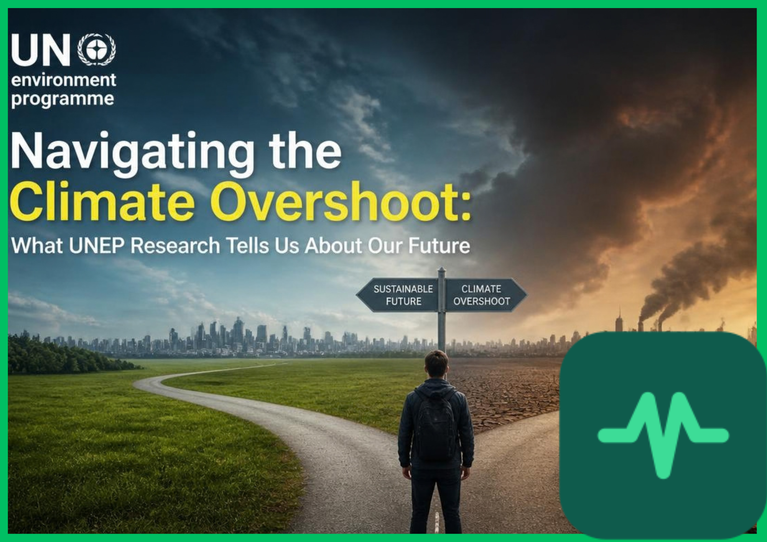
Climate change is no longer a distant future warning. It is our daily reality.
Recent scientific assessments released by the United Nations Environment Programme (UNEP) deliver a stark message: the world is poised to temporarily overshoot the 1.5 degrees Celsius warming limit set by the Paris Agreement.
That realization can easily trigger despair.
Yet, UNEP research emphasizes that an overshoot does not mean game over. It means we must navigate a critical new climate frontier focused on peaking temperatures and actively pulling carbon back out of the atmosphere.
Here is what global environmental research tells us about managing the climate overshoot and finding our way back to safety.
Understanding the 1.5°C Overshoot Reality
To understand the overshoot pathway, you have to look at current global emissions trajectories.
Despite years of international climate pledges, current emission levels mean Earth has entered the critical multi-decade window where average global temperatures will exceed 1.5 degrees Celsius (2.7 degrees Fahrenheit) above pre-industrial conditions.
Every fraction of a degree of warming above that threshold intensifies climate impacts and increases the risk of triggering irreversible ecological tipping points.
The UNEP assessment outlines two primary trajectories: a poorly managed high-overshoot scenario where temperatures climb past 2 degrees Celsius and remain dangerously high, and a managed "overshoot, peak, and decline" pathway.
The latter is our best remaining option to protect vulnerable nations and return global temperatures below the 1.5 degrees Celsius threshold over time.
The Necessity of Large-Scale Carbon Dioxide Removal
Achieving a successful temperature decline requires more than aggressive emissions reductions. It requires large-scale carbon dioxide removal.
Nature alone cannot absorb the sheer volume of greenhouse gases accumulated in the atmosphere.
We must deploy technological carbon removal solutions—ranging from direct air capture facilities to enhanced mineral weathering—alongside natural restoration projects like reforestation and soil carbon sequestration.
However, scientific research warns that carbon removal has physical limits.
Maintaining net-zero carbon dioxide emissions through geological storage could exhaust estimated storage capacity in global sedimentary basins by the year 2200.
Carbon removal is an essential emergency brake, not a license to keep polluting.
Advancing Mitigation and Adaptation Together
Navigating the climate overshoot requires advancing emissions mitigation and community adaptation simultaneously.
Vulnerable frontline communities need robust infrastructure, resilient agriculture, and early-warning systems to cope with intensifying weather extremes today, while heavy industries cut emissions to drive future temperatures down.
As UNEP leadership highlights, decisions taken now and over the next few years will determine whether viable options remain to reverse warming.
The choices we make today dictate how high temperatures peak, how long they stay there, and how safely we can return to a stable planetary climate.

Comments (0)
Login to leave a comment.
No comments yet. Be the first to share your thoughts!