You look at the neat stitching and the soft fabric.
It feels completely harmless, simple, and clean.
Yet behind that single shirt lies an invisible trail of smoke, fuel, and energy consumption that spans half the globe.
To make that shirt, farmers operated heavy diesel tractors in distant fields.
Factories spun raw fibers into yarn using electricity from coal-fired power plants.
Cargo ships burned bunker fuel to haul the finished garments across vast oceans.
Every single product we buy, wear, and use leaves a heavy trail of greenhouse gas emissions behind it.
For generations, corporate sustainability reports played a clever hiding game.
Companies proudly measured the electricity used inside their own shiny corporate headquarters.
They claimed they were green, sustainable, and eco-friendly.
Meanwhile, they ignored the polluting factories that manufactured their parts, the cargo ships hauling their goods, and the customers driving to their stores.
They hid their true climate impact behind narrow accounting tricks.
We cannot build a genuinely sustainable global economy while corporations hide their worst emissions in blind spots.
What if every business had to measure every single gram of carbon linked to its operations, from factory smokestack to customer landfill?
What if corporate climate transparency meant tracing every footprint across the entire global supply chain?
A quiet, profound accounting revolution is transforming boardrooms across the globe.
According to global environmental reports from the International Energy Agency (IEA), resource governance frameworks from the United Nations Environment Programme (UNEP), efficiency benchmarks from ENERGY STAR, and academic supply chain research, tracking scope 1, 2, and 3 emissions for corporate reporting is changing how industry operates.
By measuring direct plant emissions, purchased electricity, and full supply chain carbon footprints, we bring corporate climate accountability out of the shadows.
Here is how emission scopes work, why supply chain transparency changes global manufacturing, and how tracing every footprint secures our sustainable future.
The Comforting Illusion of Direct Emissions
To understand why comprehensive emission tracking matters so much, you have to look at the old, broken way companies reported their climate impact.
For decades, when a large retail brand, tech giant, or automotive manufacturer published a sustainability report, they counted only what happened right in front of them.
They measured the natural gas burned in their office heating boilers and the gasoline used by company delivery vans.
That was it.
They completely ignored the massive steel mills that forged their raw materials, the cargo planes that flew their products overnight, and the energy consumers used when plugging in their devices at home.
It was like a homeowner claiming they lived a zero-waste lifestyle while burning their trash in the neighbor's yard.
Skeptics once argued that tracking emissions across thousands of independent global suppliers was too complex, expensive, and legally impossible.
Environmental scientists and corporate accountability advocates proved those skeptics wrong.
Ignorance is no longer an excuse for pollution.
If you sell a product, you own its carbon trail.
What Are Scope 1, 2, and 3 Emissions?
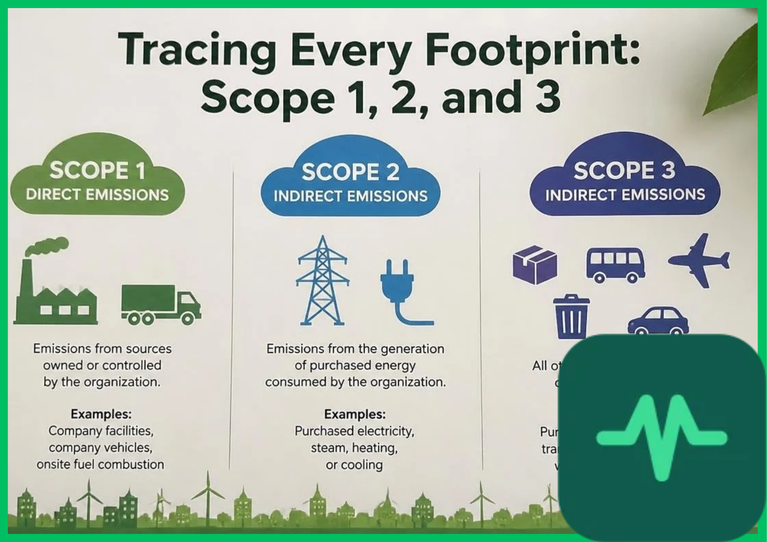
Scope 1, 2, and 3 emissions form the universal greenhouse gas protocol standard used by global businesses to categorize and measure every source of carbon pollution linked directly or indirectly to their operations.
Instead of hiding behind cherry-picked numbers, companies divide their carbon footprint into three clear categories:
- Scope 1 (Direct Emissions): The physical greenhouse gases released straight from sources a company owns or controls, such as factory smokestacks, company delivery trucks, and on-site heating boilers burning natural gas or oil.
- Scope 2 (Indirect Energy Emissions): The carbon pollution generated by power plants when producing the electricity, heating, and cooling that a company purchases to run its offices, stores, and manufacturing plants.
- Scope 3 (Value Chain Emissions): Every other indirect carbon source across the entire corporate supply chain, including raw material extraction, third-party shipping, business travel, employee commuting, and the ultimate disposal of products by customers.
Scope 3 is almost always the giant in the room, often accounting for 70% to 90% of a company's total climate footprint.
When you trace all three scopes, corporate greenwashing instantly collapses.
The Science of Supply Chain Auditing and Carbon Accounting
How can a multinational corporation track carbon emissions across thousands of independent factories, farms, and shipping routes scattered across different continents?
It comes down to standardized greenhouse gas protocols and advanced life-cycle data modeling.
Academic supply chain research shows that modern carbon accounting uses rigorous input-output economic models and primary supplier data to calculate exact emissions per unit of manufactured material.
If a clothing brand buys cotton from a farm using diesel pumps, or a tech company sources microchips from a foundry powered by coal, those suppliers must report their energy use upward through the supply chain.
Furthermore, ENERGY STAR and international industrial efficiency evaluations prove that when companies audit their Scope 1, 2, and 3 emissions honestly, they immediately spot glaring energy wastes in their supply chains.
Fixing those inefficiencies saves millions of dollars while slashing carbon output.
Transparency drives instant operational improvement.
Environmental Integrity and Corporate Accountability
The environmental benefits of rigorous scope 1, 2, and 3 emissions corporate reporting extend far beyond clean spreadsheets or glowing sustainability awards.
They provide the absolute bedrock required to achieve global net-zero emissions targets.
According to UNEP environmental governance frameworks, when major global brands demand carbon transparency from their suppliers, the entire manufacturing sector shifts toward renewable energy to stay competitive in the global marketplace.
A small parts supplier in a developing nation suddenly installs solar panels because the brand buying their components demands low Scope 3 emissions.
According to IEA clean energy roadmaps, scaling up universal climate transparency is an essential pillar to shift trillions of dollars of global capital away from high-carbon supply chains and into clean, renewable infrastructure.
When every business traces its full footprint, the entire global economy cleans up its act.
Overcoming Data Complexity and Supplier Realties
Scaling comprehensive scope 1, 2, and 3 emissions reporting from pioneering eco-conscious brands into mandatory global industrial practice involves navigating real-world data collection hurdles.
Gathering accurate carbon data from small, independent tier-3 and tier-4 suppliers who lack dedicated sustainability departments can be daunting and complex.
Software developers, environmental auditors, and international standard-setting bodies are solving these challenges by creating automated carbon-tracking software platforms, standardized supplier reporting templates, and open-source emission databases that make data collection simple and affordable.
As digital auditing tools mature and regulatory bodies harmonize reporting standards worldwide, full scope carbon accounting is transitioning successfully from corporate voluntary pledges into standard global business law.
Tracing Every Footprint Toward a Sustainable Future
Scope 1, 2, and 3 emissions corporate reporting proves that honesty and radical transparency can reshape global industry from the inside out.
We no longer have to accept that corporations can hide their true climate impact behind narrow accounting tricks and ignored supply chains.
By measuring direct operations, purchased power, and every hidden corner of the global value chain, we bring accountability to light.
We step away from corporate greenwashing, embracing a truthful, transparent, and enduring standard of global commerce.
Through brilliant environmental accounting, rigorous academic research, and a deep respect for our shared biosphere, tracing every footprint secures a clean, accountable, and sustainable future for every community on Earth.

Comments (0)
Login to leave a comment.
No comments yet. Be the first to share your thoughts!