Your clothes, your smartphone, your furniture, and your appliances.
Most of these items share a common design philosophy.
They were built in a straight line.
Factories extract raw materials from the earth. They use those materials to manufacture products. You buy the product, use it for a few years, and then throw it away in the trash.
Take, Make, Waste.
That linear economic model has governed human industry for over two centuries.
It worked fine when our global population was small and natural resources seemed infinite.
Today, that straight line leads straight to a cliff.
Our landfills are overflowing. Oceans fill up with plastic debris. Natural ecosystems are stripped bare to feed an endless appetite for new consumer goods.
We cannot build a sustainable future on a foundation of permanent waste.
We need to bend that straight line into a closed loop.
A quiet, profound global shift is changing how nations write the rules of manufacturing.
According to global resource reports from the International Energy Agency (IEA), circular economy frameworks from the United Nations Environment Programme (UNEP), efficiency benchmarks from ENERGY STAR, and academic industrial ecology research, international circular economy frameworks are transforming our world.
By uniting global nations around zero-waste policies, mandatory repair standards, and regenerative product design, we replace the throwaway culture with a closed-loop system.
Here is how international frameworks work, why circular design changes industrial manufacturing, and how zero-waste treaties secure our sustainable future.
The Broken Logic of the Linear Economy
To understand why international circular frameworks matter so much, you have to look at the sheer inefficiency of our current economic model.
For generations, manufacturers designed products with built-in expiration dates.
If a household appliance broke down, repairing it cost more than buying a brand-new replacement.
Products were glued shut, soldered together, and packed with proprietary parts that made fixing them nearly impossible.
That planned obsolescence kept factories busy and store shelves packed.
It also generated billions of tons of electronic waste, chemical pollution, and packaging trash every year.
Extraction, production, disposal.
That linear cycle ignores a basic physical truth: our planet is a closed ecosystem.
We cannot throw things away because there is no "away." Everything we discard stays right here on Earth.
Economists and environmental scientists realized that local recycling bins and voluntary corporate pledges were not enough to fix a global manufacturing crisis.
We needed binding international agreements to redesign the rules of production at a planetary scale.
What Are International Circular Frameworks?
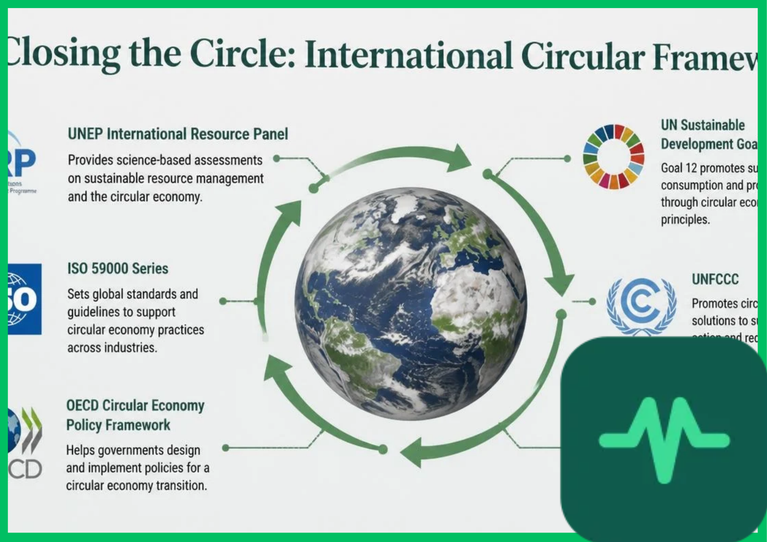
International circular economy frameworks are cooperative global policies, treaties, and standards designed to shift industrial production away from linear extraction and toward regenerative, closed-loop systems.
Instead of letting individual countries set their own chaotic recycling rules, international frameworks establish universal benchmarks for product longevity, repairability, and material recovery.
These frameworks focus on three core principles:
- Eliminate Waste: Designing products from the very beginning so they never produce trash, toxic byproducts, or unrecyclable components.
- Circulate Products: Keeping materials in active use for as long as possible through reuse, repair, remanufacturing, and shared ownership models.
- Regenerate Nature: Rebuilding natural soil health, protecting ecosystems, and ensuring that biological materials return safely to the earth without pollution.
When global trade agreements require products to meet circular design standards, multinational manufacturers change how they build everything from smartphones to washing machines.
The Science of Industrial Ecology and Material Flow
How do international frameworks change what happens inside a factory floor?
It comes down to industrial ecology and material flow analysis.
Academic research in industrial ecology proves that true sustainability requires designing products like living ecosystems where one process's waste becomes another's fuel.
Under strict circular frameworks, manufacturers must practice design for disassembly.
Instead of fusing a battery permanently inside a glued-shut laptop case, engineers use standard screws, snap-fit modules, and clear material labels.
When the laptop eventually wears out after a decade of service, a recycling worker can dismantle it in minutes with basic tools.
Components are sorted, old metals are sent to urban mining facilities, and raw polymers are melted down into virgin-quality resin.
According to ENERGY STAR and international industrial efficiency evaluations, designing products for easy repair and recycling reduces the energy required to manufacture new goods by up to 80%.
IEA resource assessments highlight that closing material loops slashes greenhouse gas emissions across heavy industries like steel, aluminum, and plastics.
Global Treaties and Universal Standards
Coordinating a circular economy across borders requires unprecedented international cooperation.
Different countries used to have wildly conflicting environmental laws, making it easy for polluting industries to shift their manufacturing to regions with weak oversight.
International frameworks eliminate those loopholes.
According to UNEP resource governance guidelines, global treaties establish universal standards for chemical safety, packaging waste reduction, and right-to-repair laws.
When a major nation mandates that all electronic devices use universal charging ports, standardized batteries, and publicly available spare parts, global supply chains adapt instantly.
Manufacturers do not build one phone for a strict region and a throwaway phone for a lax region; they build durable, repairable products for the entire world.
That universal shift raises global environmental standards while making sustainable products cheaper and more accessible for everyone.
Closing the Circle on Our Daily Lives
Transitioning to an international circular economy is not just a job for politicians and industrial engineers. It touches our daily habits.
When you buy products designed to last a lifetime, modular appliances that you can repair with a screwdriver, and clothes crafted from pure, recyclable fibers, your personal footprint shrinks dramatically.
You stop participating in the endless cycle of buying, breaking, and throwing away.
You embrace a lifestyle of stewardship and care.
According to real-world economic data, circular business models—such as product-as-a-service, leasing, and certified refurbished markets—save consumers money while cutting household waste to near zero.
Closing the Circle Toward a Sustainable Future
International circular economy frameworks prove that humanity can redesign its industrial systems to live in harmony with the planet.
We no longer have to accept that modern progress requires a straight line of extraction, pollution, and waste.
By uniting global nations around zero-waste treaties, mandatory repair standards, and regenerative product design, we turn our linear economy into a closed, repeating loop.
We step away from the throwaway culture, embracing a smart, regenerative, and enduring standard of living.
Through brilliant industrial ecology, collaborative international policy, and a deep respect for our natural world, closing the circle secures a clean, thriving, and sustainable future for every generation to come.


Comments (0)
Login to leave a comment.
No comments yet. Be the first to share your thoughts!