
To your lungs, the air feels crisp and ordinary.
Invisible to your eyes, however, the global atmosphere carries an unprecedented burden. Decades of heavy industrial activity, fossil fuel combustion, and deforestation have filled the sky with billions of metric tons of carbon dioxide.
Stopping new emissions is essential. Humanity must transition away from fossil fuels as fast as humanly possible.
Yet, cutting emissions to zero is no longer enough on its own.
According to climate science assessments from the United Nations Environment Programme (UNEP), International Energy Agency (IEA) transition roadmaps, and academic environmental research, we have already pumped more carbon into the atmosphere than natural ecosystems can absorb.
To stabilize our climate, we must actively pull carbon dioxide right back out of the sky.
A futuristic industrial technology is stepping up to make that happen. It is called direct air capture.
Here is how direct air capture works, why it is scaling up worldwide, and how scrubbing the sky offers a vital safety net for our global future.
The Hard Limits of Natural Carbon Sinks
To understand why direct air capture is necessary, you have to look at how nature cleans the atmosphere.
For millennia, forests, oceans, and soil acted as Earth's natural carbon sinks. Trees absorb carbon dioxide during photosynthesis, locking carbon into wood, roots, and soil organic matter.
Nature's system worked brilliantly when human emissions were low.
Today, human activity releases emissions at a scale that overwhelms natural ecosystems. Furthermore, widespread deforestation and severe wildfires frequently turn forests from carbon sinks into massive carbon emitters.
Planting trees is vital, but trees take decades to mature, and they remain vulnerable to droughts, pests, and fires.
We needed a technological solution that works faster, occupies less land, and locks carbon away permanently.
That realization launched the direct air capture industry.
What Is Direct Air Capture?
Direct air capture (DAC) refers to industrial facilities designed to pull carbon dioxide directly out of ambient air.
Unlike smokestack capture—which traps carbon emissions at the point of industrial pollution—direct air capture works anywhere, independent of specific factory sites.
The mechanism operates through two primary engineering pathways: liquid solvent systems and solid sorbent systems.
In a liquid system, massive industrial fans pull atmospheric air through large contactors. The air mixes with a liquid chemical solution that selectively binds to carbon dioxide molecules while letting oxygen and nitrogen pass back out into the atmosphere. The solution is then heated in a high-temperature kiln, releasing pure carbon dioxide gas.
In a solid system, air passes over porous solid filters coated with specialized chemical binding agents. Once the filters are saturated, they are heated under a vacuum to release the captured carbon dioxide.
Whether liquid or solid, the result is the same: purified, concentrated carbon dioxide ready for permanent storage or specialized industrial reuse.
The Physics of Permanent Storage
Once carbon dioxide is captured, what happens to it?
If companies simply released the captured carbon back into the atmosphere by making carbonated drinks or plastic products, the technology would serve no climate purpose.
True climate action requires permanent geologic storage.
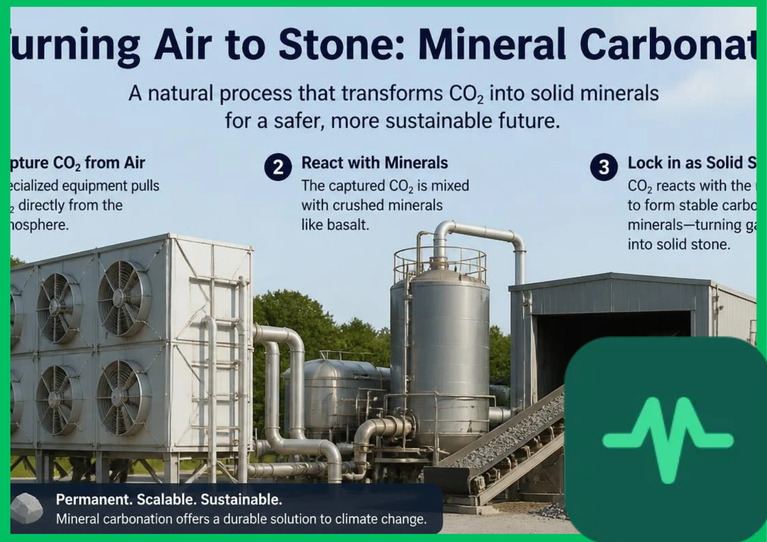
Industrial facilities compress the captured carbon dioxide into a supercritical fluid state—acting partly like a gas and partly like a liquid—and pump it deep underground through high-pressure wells.
The carbon is injected thousands of meters (approx. several thousand feet) down into deep basalt rock formations or saline aquifers.
Over time, through natural mineralization processes studied extensively by academic geologists, the liquid carbon dioxide reacts chemically with surrounding volcanic rock and turns into solid stone.
The carbon is locked away permanently, safely removed from the Earth's active carbon cycle for thousands of years.
Scaling Up an Industrial Pioneer
Direct air capture is an extraordinary engineering achievement, but it faces formidable scaling hurdles.
Capturing carbon requires massive amounts of energy. If a direct air capture plant runs on electricity generated by burning coal or gas, it defeats its own purpose.
For the industry to succeed, DAC facilities must be powered entirely by zero-emission energy sources like geothermal, solar, or wind power.
Furthermore, capital costs remain high. Scaling up global manufacturing lines, building multi-megaton facilities, and streamlining supply chains will take years of sustained investment and rigorous regulatory support.
According to IEA deployment scenarios, global direct air capture capacity must scale up multi-fold over the coming decades to neutralize hard-to-abate industrial emissions.
A Vital Safety Net for Our Climate Future
Direct air capture is not a magic fix that excuses continued fossil fuel use.
Aggressive emissions reductions must remain the absolute priority for global society.
However, carbon removal serves as an indispensable safety net. It cleans up historical pollution, neutralizes unavoidable residual emissions from aviation and agriculture, and helps restore balance to our fragile atmosphere.
By scrubbing the sky and locking carbon safely underground, direct air capture gives humanity a powerful tool to heal our climate and secure a sustainable future.


Comments (0)
Login to leave a comment.
No comments yet. Be the first to share your thoughts!