
You take a deep breath, filling your lungs with fresh outdoor air.
That invisible mixture of gases surrounds our entire planet, sustaining life. It also carries a heavy, invisible burden.
For over a century, human industrial activity pumped billions of metric tons of carbon dioxide into the global atmosphere. We filled the sky with the exhaust of past centuries.
Cutting new emissions is essential, but it is no longer enough. The carbon already trapped up there continues to trap heat, driving climate change across every continent.
What if we could reach out into the open sky and pull that excess carbon right back down?
A bold technological frontier is turning science fiction into physical reality.
According to tracking data from the International Energy Agency (IEA), environmental assessments from the United Nations Environment Programme (UNEP), energy efficiency guidelines from ENERGY STAR, and academic engineering research, direct air capture technology is changing the horizon of climate action.
By using chemical sorbents and massive filtration systems, industrial facilities extract carbon dioxide directly from ambient air for permanent storage.
Here is how direct air capture works, why solid sorbent systems and liquid solvents capture greenhouse gases, and how negative emissions engineering helps heal our global atmosphere.
The Hard Truth About Historical Emissions
To understand why direct air capture matters, you have to look at the math of the global climate challenge.
Every factory we clean, every car we electrify, and every wind turbine we build stops new carbon pollution from entering the air. That stops the crisis from getting worse.
It does nothing, however, to address the legacy carbon that has accumulated in the atmosphere since the dawn of the industrial revolution.
That historical accumulation acts like an overflowing bathtub. Turning off the faucet stops the water level from rising further, but the tub is still flooded.
Nature uses forests, oceans, and soils to absorb carbon naturally.
Trees and plants pull carbon dioxide out of the air through photosynthesis. Natural systems face limits, however. Forests can burn down in wildfires or release stored carbon back into the atmosphere as they decay.
We needed an engineered solution that offers permanent, measurable, and durable carbon removal.
We needed a machine that could scrub the open sky clean.
What Is Direct Air Capture?
Direct air capture (DAC) describes mechanical systems that extract carbon dioxide directly from ambient air.
Unlike traditional smokestack capture—which intercepts emissions directly at the mouth of a factory chimney where gas concentrations are high—direct air capture faces a much harder physical task.
Carbon dioxide makes up a tiny fraction of our open atmosphere—roughly 420 parts per million.
That means out of every million molecules of air, only 420 are carbon dioxide.
Capturing such a dilute gas requires moving massive volumes of air through specialized chemical contactors.
There are two primary technical approaches used across the globe:
- Liquid Solvent Systems: Large industrial contactors mix ambient air with a strong alkaline liquid solution. The liquid chemically binds with the carbon dioxide molecules, stripping them out of the air stream before a high-temperature heating process releases the pure gas.
- Solid Sorbent Systems: Air is pulled through porous solid filter materials treated with chemical amines. The solid filters trap the carbon dioxide molecules on their surface. When heated gently under a vacuum, the filters release a concentrated stream of pure carbon dioxide.
Both systems isolate a pure stream of carbon dioxide gas, ready for permanent underground disposal or circular industrial use.
The Physics of Sorbent Regeneration and Energy
The greatest challenge facing direct air capture is energy consumption.
Tearing chemical bonds apart to release trapped carbon dioxide requires a significant input of thermal and electrical energy.
If a direct air capture facility runs on electricity generated by burning coal or natural gas, the entire process defeats its own purpose.
Academic engineering studies and IEA technology assessments emphasize that DAC plants must be coupled directly with low-carbon energy sources.
Developers co-locate facilities near geothermal power plants, industrial waste heat streams, or dedicated solar and wind farms.
When powered by clean energy, the net carbon removal balance is overwhelmingly positive.
Every metric ton (approx. 2,205 pounds) of carbon dioxide captured and locked away represents a permanent subtraction from the global atmospheric burden.
Permanent Geological Sequestration
Once industrial filters capture and concentrate carbon dioxide, what happens next?
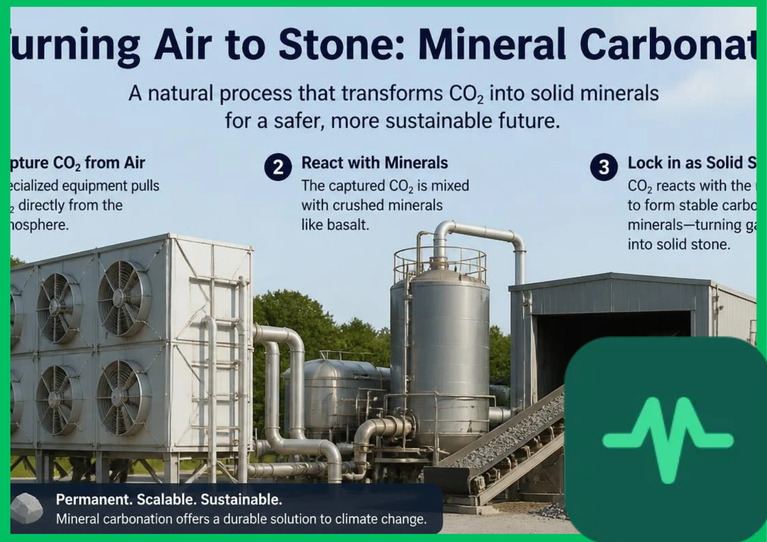
The captured gas is compressed into a supercritical fluid—dense like a liquid but expanding like a gas—and pumped deep underground.
Underground injection sites typically place the carbon dioxide thousands of meters or feet below the surface into deep saline aquifers or basalt rock formations.
Over time, through natural mineralization processes studied extensively by academic geologists, the trapped carbon reacts with surrounding minerals and turns permanently into solid stone.
According to UNEP environmental governance frameworks and ENERGY STAR infrastructure standards, geological sequestration locks carbon away securely for thousands of years.
It prevents the captured gas from ever returning to the atmosphere, fulfilling the true definition of durable, permanent carbon removal.
Healing Our Global Atmosphere
Direct air capture proves that human ingenuity can reach past emission reduction and begin repairing historical damage.
We no longer have to accept that past pollution will linger in the sky forever.
By combining solid sorbents, liquid solvents, clean renewable energy, and permanent geological storage, direct air capture offers a vital safety valve for our planet.
It is not a replacement for stopping emissions at the source. It is a necessary complement—a tool to clean up what we cannot immediately avoid.
Through scientific innovation, rigorous engineering, and global commitment, direct air capture scrubs our sky clean and helps secure a breathable, thriving future for generations to come.


Comments (0)
Login to leave a comment.
No comments yet. Be the first to share your thoughts!